Portrait of Madame Georges Ehrler
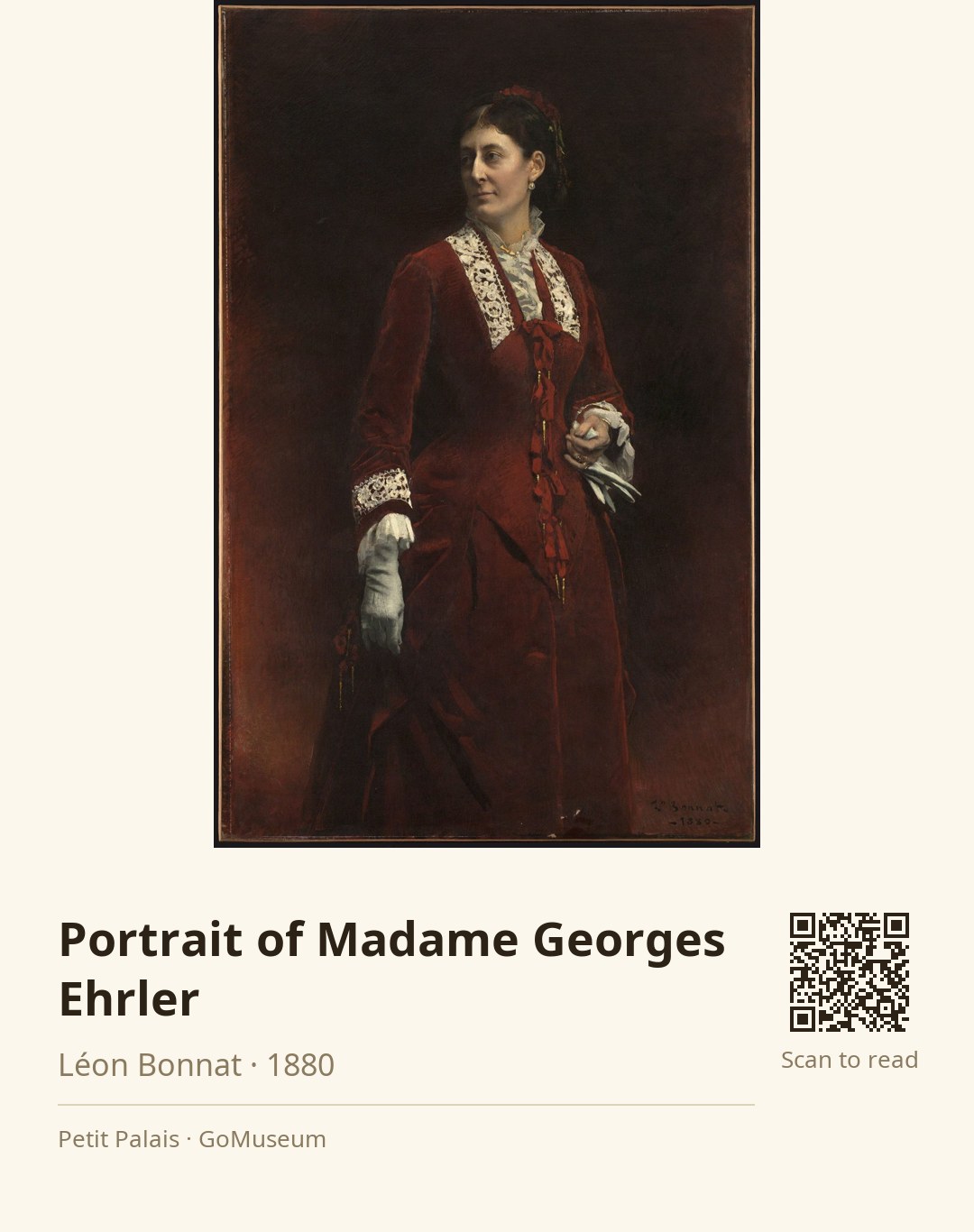
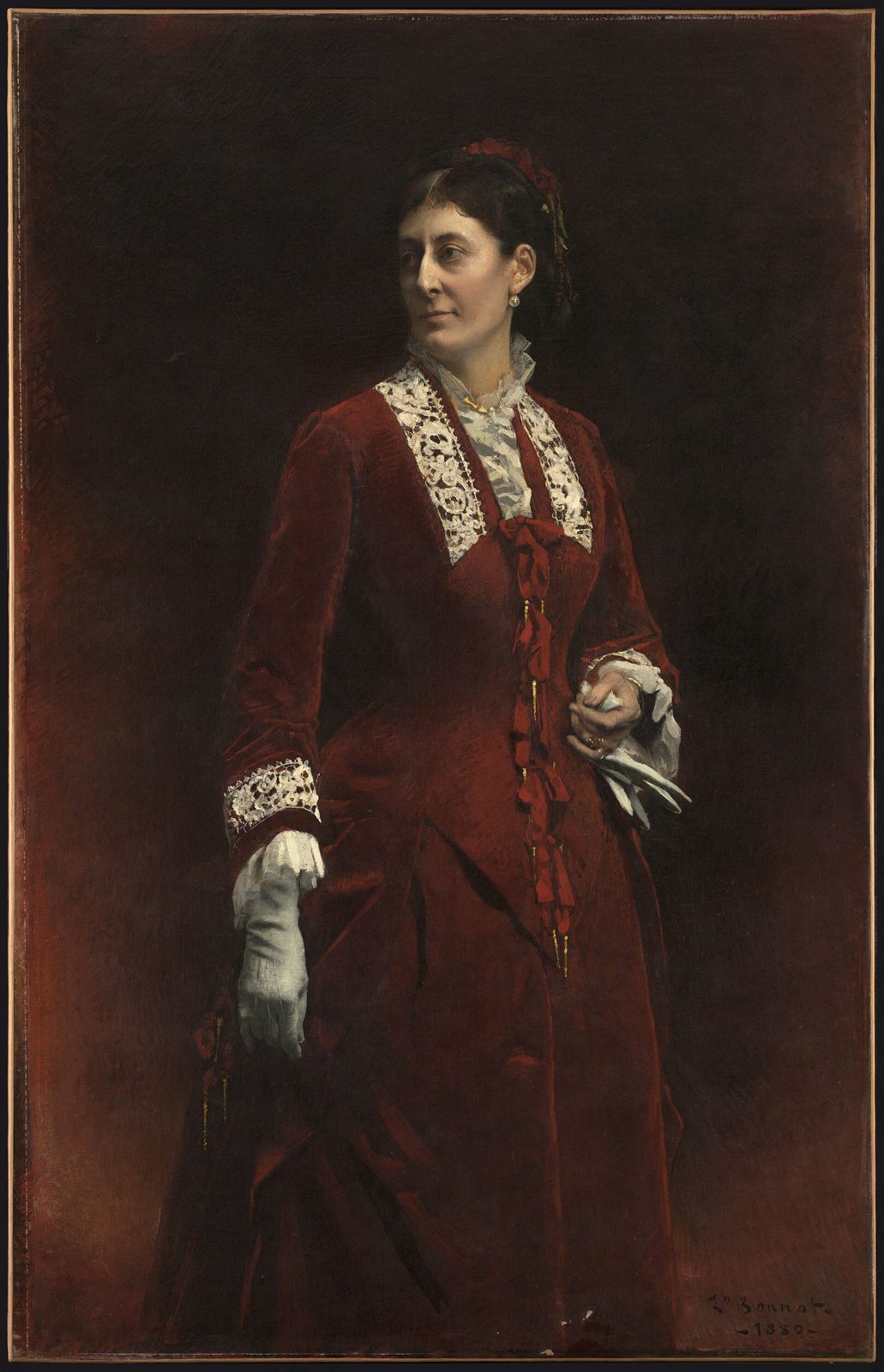
🎧 This work has audio narration — listen in the appMadame Georges Ehrler stands elegantly in her deep red gown, the intricate white lace at her collar and cuffs catching the light. The series of red bows running down the front of her dress adds a playful touch, while her poised left hand holds a pair of white gloves, suggesting both grace and readiness.
The smooth brushwork reveals the texture of her luxurious attire, contrasting sharply with the dark, muted background that enhances her presence. Bonnat’s ability to capture the subtleties of fabric and detail speaks to his mastery as a portraitist, emphasizing the sitter's status and character.
Léon Bonnat, born in 1833, became a prominent figure in the art world, known for his vivid portraits and teaching at the École des Beaux-Arts. He created this portrait in 1880, showcasing his skill in blending realism with the elegance of his subjects.
Léon Joseph Florentin Bonnat, born on June 20, 1833, in Bayonne, was a prominent French painter and art educator known for his vivid portraits and powerful religious works. His early years in Madrid, where he honed his skills under José de Madrazo, ignited his passion for art, leading him to Paris, where he became a leading portraitist by the 1850s. Influenced by Spanish masters and the Old Masters, Bonnat's style combined rigorous drawing with a focus on overall effect, positioning him between academic painters and the emerging Impressionists.
Bonnat's career flourished as he won numerous accolades, including the Grand Officer of the Légion d'honneur and a professorship at the École des Beaux-Arts, where he inspired many notable artists, including Henri de Toulouse-Lautrec and John Singer Sargent. His portraits of contemporary figures, alongside significant religious paintings like "Christ on the Cross," showcased his ability to blend realism with emotional depth.
Despite facing criticism, Bonnat was recognized for his contributions to art, becoming an honorary member of the National Academy of Design in 1917. He passed away on September 8, 1922, leaving behind a rich legacy and a substantial collection of art that continues to influence the field.
The smooth brushwork creates a velvety texture that brings the luxurious fabric of Madame Ehrler's gown to life. Each stroke is deliberate, emphasizing the intricate lace details at her collar and cuffs, which contrast beautifully against the dark background. The deep red of her dress is not just a color choice; it’s a statement of her social standing and femininity, rendered with a richness that draws the eye. Bonnat's use of color is strategic, allowing the subject to pop against the muted tones, while the play of light subtly highlights her features, giving her an almost ethereal quality. The three-quarter pose adds depth, inviting viewers to engage with her gaze, which is directed just off to the left, suggesting a moment captured in time. This careful composition and paint handling elevate the portrait beyond mere representation to a vivid portrayal of character and emotion.
Interestingly, Bonnat was not just a painter but also a significant figure in art education. He taught at the École des Beaux-Arts, where he influenced many notable artists, including the famous American painter John Singer Sargent. Bonnat's teaching style encouraged students to embrace freedom in their artistic expression, which was quite revolutionary for the time. His emphasis on the Spanish painting technique, learned during his years in Madrid, introduced a new dimension to French art, blending traditional methods with innovative approaches.
Bonnat's approach, which balanced overall effect with detailed drawing, positioned him between the Impressionists and traditional academic painters, influencing the evolution of both styles.
While in Rome, Bonnat formed friendships with several prominent artists, including Edgar Degas and Gustave Moreau, which likely influenced his artistic development.