Children's Heads
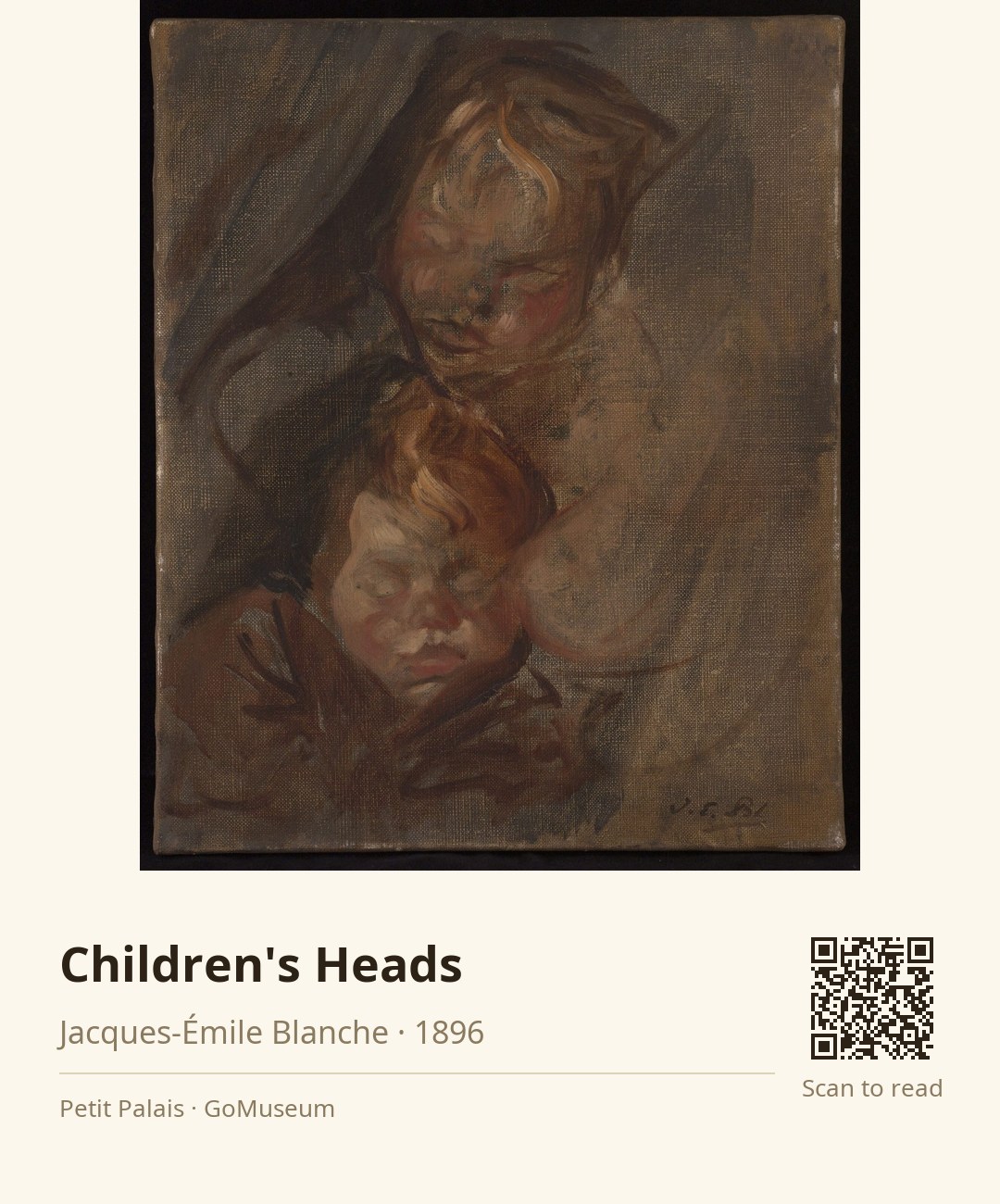
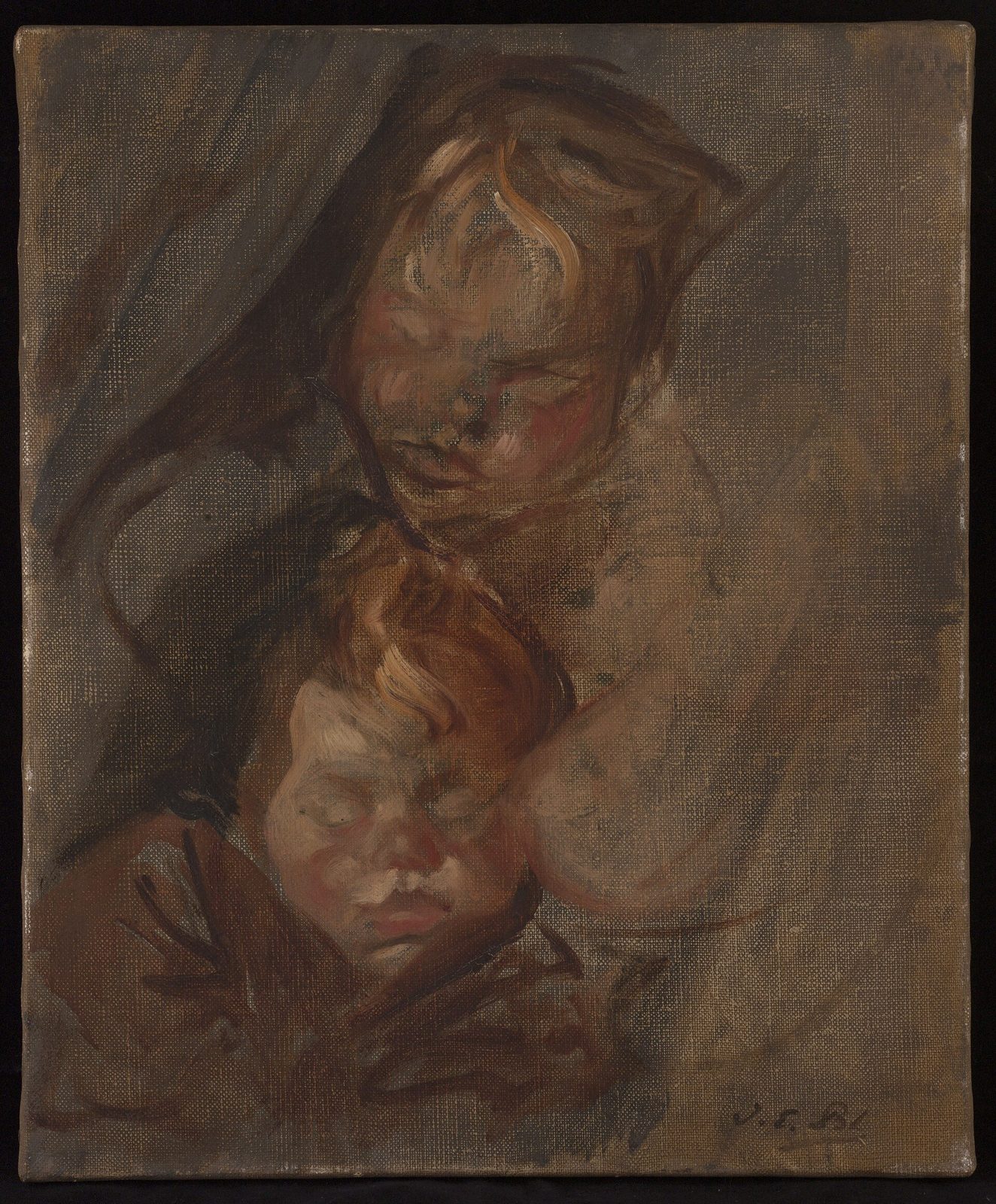
🎧 This work has audio narration — listen in the appThe tender embrace of a mother and child fills this canvas, capturing a moment of serene intimacy. The soft brushstrokes envelop the figures in warm browns and gentle reds, while the mother's closed eyes and peaceful expression convey a deep sense of love and tranquility. The child, nestled close, mirrors this calm with a serene face, creating a harmonious bond between them.
This portrayal reflects Jacques-Émile Blanche's ability to evoke emotion through his loose, expressive brushwork, which enhances the warmth of the scene. The muted earthy background allows the figures to stand out, emphasizing their connection and the tenderness of their shared moment. Blanche, largely self-taught, drew inspiration from 18th-century English portraiture, blending it with influences from his Parisian contemporaries, which is evident in the refined yet intimate style of this work.
Created in 1896, "Têtes d'enfants" exemplifies Blanche's mastery in capturing the essence of familial love, a theme that resonates throughout his body of work.
Jacques-Émile Blanche was a French portrait painter born on January 1, 1861, in Paris. Raised in an artistic environment, he was influenced by the notable figures who frequented his father's psychiatric clinic. Although he received some guidance from established artists like Henri Gervex and Pierre-Auguste Renoir, he is primarily considered self-taught. His work, characterized by a refined style reminiscent of 18th-century English painters and the Impressionists, gained him recognition in both London and Paris.
Blanche's notable portraits include those of literary giants like Marcel Proust and James Joyce, as well as cultural figures such as Claude Debussy and Auguste Rodin. He was deeply embedded in the artistic community, befriending contemporaries and participating in salons that shaped Parisian culture. His leadership at the Académie de La Palette and later at the Académie Vitti showcased his commitment to nurturing new talent.
Despite being a closeted homosexual, Blanche married Rose Lemoinne in 1895, though his personal life remained complex. He passed away on September 30, 1942, leaving behind a legacy celebrated in museums and streets named in his honor. His contributions to portraiture and his connections to literary and artistic movements solidify his place in art history.
Jacques-Émile Blanche created 'Têtes d'enfants' in 1896, a year that marked a significant period in his career as he was gaining recognition in the Parisian art scene. This painting, which beautifully captures the tender bond between a mother and child, was likely influenced by his experiences and connections within the artistic community of the time. Although it was not commissioned by a specific patron, Blanche's works were often displayed at prominent exhibitions, including the Salon and the Société Nationale des Beaux-Arts. The reception of his art was generally positive, as he was well-regarded among his contemporaries, including literary figures like Marcel Proust, who was a close friend.
Blanche's technique in 'Têtes d'enfants' showcases his mastery of oil paint on canvas, employing soft, flowing brushstrokes that create an intimate atmosphere. The loose application of paint allows for a sense of movement and warmth, enveloping the figures in a gentle embrace. The choice of a muted earthy background serves to highlight the mother and child, drawing the viewer's focus to their serene expressions. The warm browns and soft reds not only enhance the emotional depth of the scene but also reflect Blanche's influences from 18th-century English portraiture. His ability to manipulate color and light, though subtle, adds a layer of depth that invites viewers to feel the tranquility and love shared between the figures. This approach is characteristic of Blanche's style, blending traditional techniques with a modern sensibility.
Interestingly, Jacques-Émile Blanche was not only a painter but also an author. He published works that documented the artistic and literary circles of his time, although his reliability as a historian was often questioned. Walter Sickert famously remarked that Blanche had a tendency to twist facts into 'monstrous fibs', highlighting the sometimes blurred lines between art and narrative in his life.