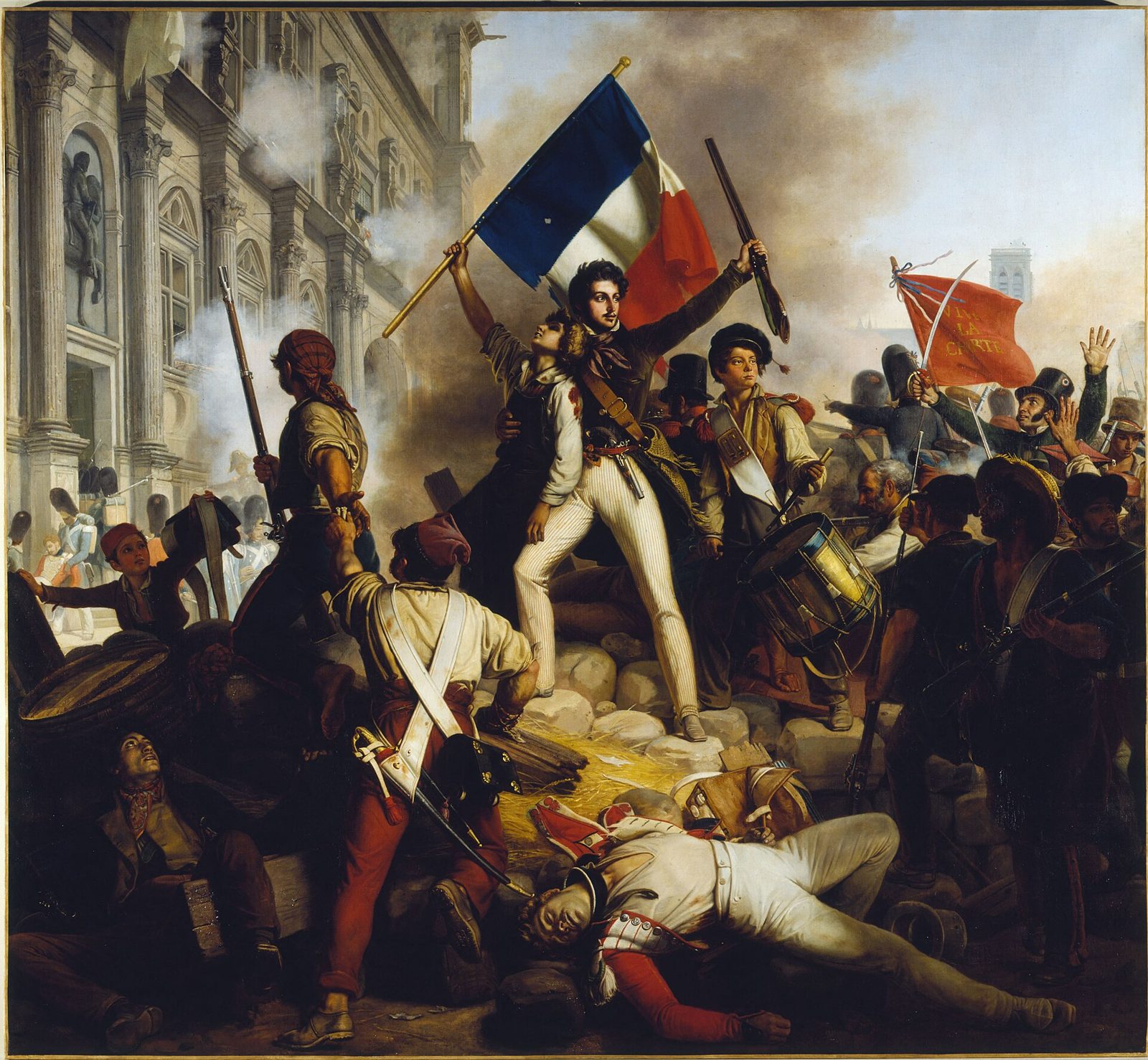
Combat devant l'Hôtel de Ville le 28 juillet 1830
🎧 This work has audio narration — listen in the appA young man stands defiantly atop a pile of rubble, brandishing the French tricolor flag in Jean Victor Schnetz's "Combat devant l'Hôtel de Ville le 28 juillet 1830." Surrounding him, a diverse group of revolutionaries, armed with rifles and swords, captures the fervor of the July Revolution. The urgency of the scene is heightened by a nearby drummer boy, while fallen soldiers in the foreground starkly contrast the vibrant attire of the living, emphasizing the cost of their struggle.
This painting encapsulates the chaos and camaraderie of the uprising against Charles X's oppressive regime. The central figure, reminiscent of a heroic martyr, symbolizes the collective hope of the Parisian populace as they rise against tyranny. The grand building in the background, partially shrouded in smoke, serves as a reminder of the battle for liberty taking place at the Hôtel de Ville. Schnetz’s choice of deep reds and blues not only heightens the emotional intensity but also reflects the revolutionary spirit of the time, uniting various social classes in their quest for freedom.
Commissioned alongside three other monumental works for the Hôtel de Ville, Schnetz's painting was exhibited at the Salon of 1834 but never displayed in its intended location. Instead, it was stored away, escaping the fire that consumed the City Hall in 1871.
Jean-Victor Schnetz, born on April 14, 1787, in Versailles, was a prominent French academic painter known for his historical and genre works. Studying under Jacques-Louis David, Schnetz developed a distinctive style that blended classical techniques with vivid depictions of everyday life. His career flourished as he exhibited at the Salon from 1808 to 1867, earning accolades including first-class medals and becoming a Chevalier of the Legion of Honor.
Schnetz was deeply influenced by his time in Italy, where he served as Director of the French Academy in Rome twice, from 1841 to 1846 and again from 1853 to 1866. His commitment to painting from nature rather than plaster models inspired many students at the Villa Medici. He is noted for his ability to navigate the artistic tensions between neoclassicism and romanticism, capturing picturesque scenes of rural life and historical events, such as the revolutions in Paris.
His works are housed in prestigious institutions, including the Louvre and the Hermitage, cementing his legacy in art history. Schnetz passed away on March 15, 1870, in Paris, leaving behind a rich body of work that reflects both his technical skill and his passion for the human experience.
Jean Victor Schnetz's 'Combat devant l'Hôtel de Ville le 28 juillet 1830' was created in 1833, commissioned as part of a grand project to celebrate the revolutions of July 1789 and July 1830. Alongside Schnetz, artists like Delaroche and Cogniet were tasked with painting monumental works for the Hôtel de Ville's Throne Room. Although it was exhibited at the Salon of 1834, the painting never graced its intended location. Instead, it was relegated to storage, fortuitously escaping the devastating fire that engulfed the City Hall in 1871. The subject matter resonated deeply with the public, reflecting the fervor of the July Revolution, yet critics were harsh. Some described it as a 'deplorable aberration,' questioning Schnetz's artistic choices and suggesting he lacked the spirit to capture such a tumultuous event.
The brushwork is vigorous, capturing the chaos of revolution with a sense of immediacy. Deep reds and blues dominate the palette, evoking passion and urgency, while earth tones ground the scene in reality. The central figure, standing atop rubble, is rendered with a heroic posture, emphasizing his defiance. The composition is structured yet fluid, with figures swirling around the central action, enhancing the feeling of movement. This technique not only conveys the emotional weight of the moment but also reflects the diverse social classes united in their fight for liberty.
The painting was restored in 2015, and the restoration was sponsored by the Carré Rive Gauche endowment fund.
Jean Victor Schnetz studied under Jacques-Louis David in Paris.
In 1837, Schnetz was elected to the Académie des Beaux-Arts.