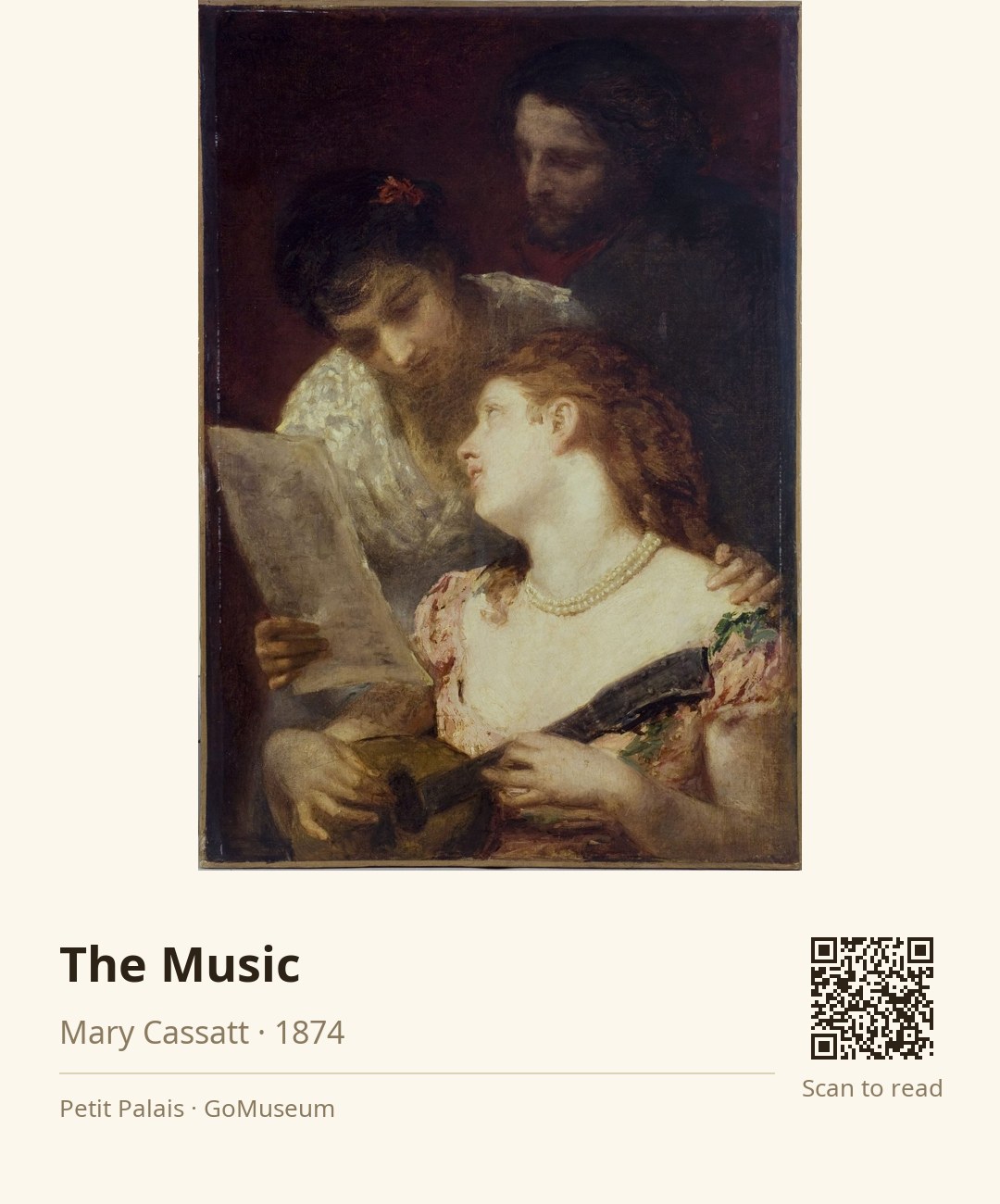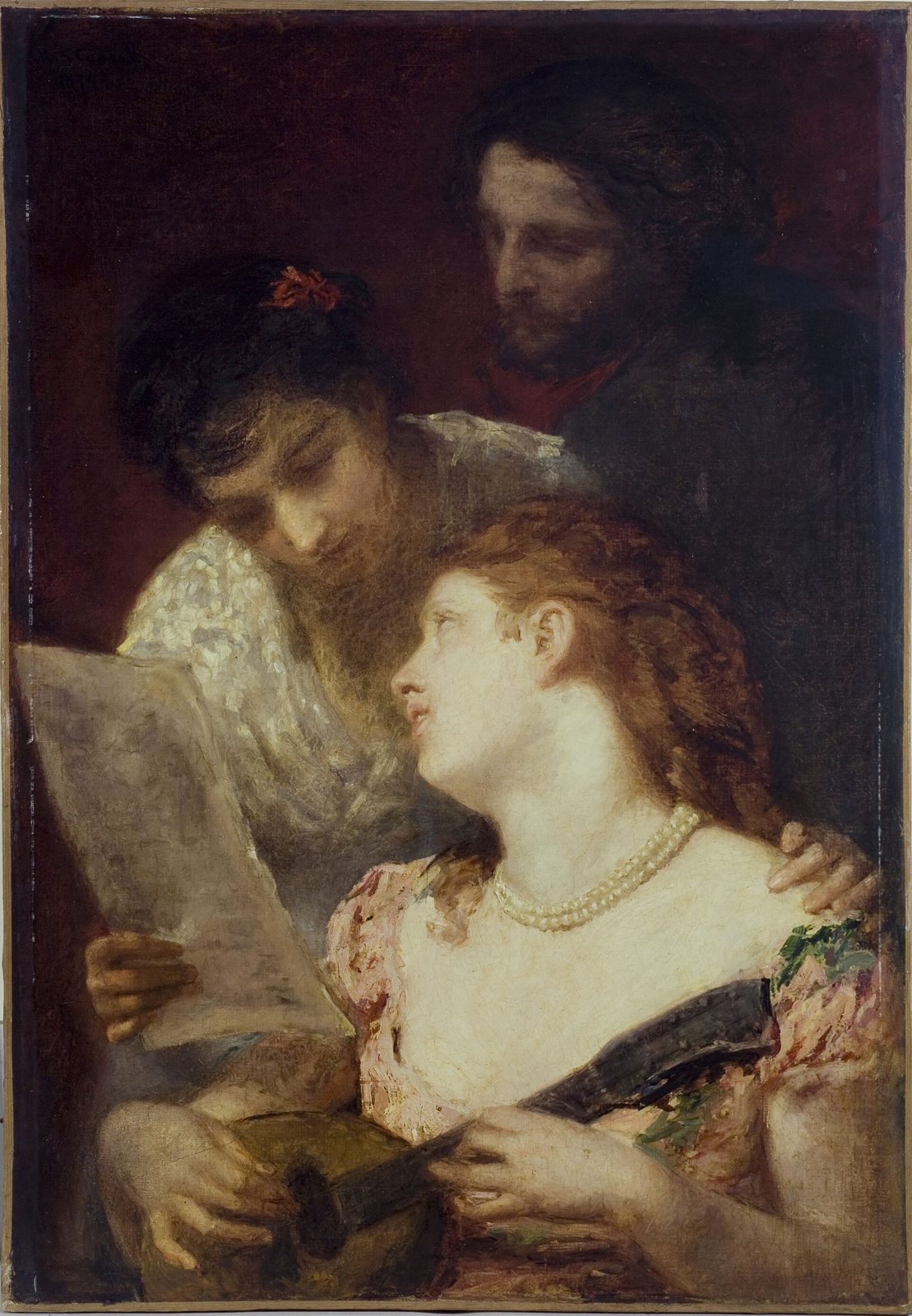
The woman with the red hair, cradling a lute, draws your attention as she gazes upward, her expression one of rapt concentration. Beside her, another woman leans in closely, a red flower in her dark hair, holding a sheet of music that hints at the intimacy of this musical gathering. The bearded man behind them, partially obscured by shadow, adds a sense of mystery to the scene, inviting you to wonder about the relationship between these figures.
This close-knit composition captures a moment of shared creativity and connection, emphasizing the bonds formed through music. The warm, muted palette and soft brushwork create a gentle atmosphere, allowing the viewer to feel the warmth of their interaction. Cassatt's choice to focus on women engaged in music reflects her commitment to portraying the private lives of women, a theme she explored throughout her career. The dark background enhances the figures, drawing you into their world and highlighting the significance of their shared experience.
Created in 1874, "The Music" exemplifies Cassatt's unique perspective as one of the few female artists associated with Impressionism, showcasing her ability to capture the nuances of social interactions.
Mary Stevenson Cassatt was an American painter and printmaker born on May 22, 1844, in Allegheny, Pennsylvania. She spent most of her life in France, where she became a prominent figure in the Impressionist movement, closely associated with Edgar Degas. Cassatt's work primarily focused on the lives of women, particularly the intimate relationships between mothers and children, capturing the nuances of domestic life with sensitivity and depth.
Despite her family's initial objections to her artistic ambitions, Cassatt pursued her passion, studying at the Pennsylvania Academy of the Fine Arts before moving to Paris in 1866. There, she studied under notable artists and developed her unique style, influenced by both the Impressionists and Japanese prints. Her contributions to art were significant, as she played a crucial role in introducing Impressionism to American collectors, notably through her connections with the Havemeyer family.
Cassatt was recognized as one of the three great ladies of Impressionism, alongside Berthe Morisot and Marie Bracquemond. Her work, characterized by its focus on female subjects and domestic scenes, remains celebrated in major museums across Europe and the United States. Cassatt's legacy endures as a pioneering female artist who broke barriers in a male-dominated field, leaving an indelible mark on art history until her death on June 14, 1926.
Commissioned by René Mayer, this painting was later gifted to the Petit Palais in Paris in 1966, where it remains today. The reception of Cassatt's work during her lifetime was mixed; while she was celebrated among her peers, the broader public often struggled to appreciate her focus on women's private lives. Cassatt, one of the few female artists associated with the Impressionist movement, navigated a challenging landscape, often overshadowed by her male counterparts. Yet, her unique perspective on domestic life and women's roles in society resonated with many, paving the way for future generations of female artists.
In 'The Music', Cassatt employs a rich, warm palette that envelops the viewer in a sense of intimacy. The soft brushwork creates a gentle texture, enhancing the emotional depth of the scene. The figures are arranged closely, almost as if they are cocooned in their own world, with the dark background serving to isolate and highlight their expressions and interactions. The choice of a vertical format draws the eye upward, mirroring the upward gaze of the woman with the lute, suggesting aspiration and connection. Cassatt's handling of light is subtle; it softly illuminates the figures, creating a contrast that enhances their presence without overwhelming the viewer. This careful balance of light and shadow, along with the fluidity of the brushstrokes, invites you into a moment of shared creativity, making the viewer feel like a part of this intimate gathering.
In addition to music, Cassatt often depicted the intimate bonds between mothers and children, showcasing the social and private lives of women.