Portrait of Madame Edgard Stern
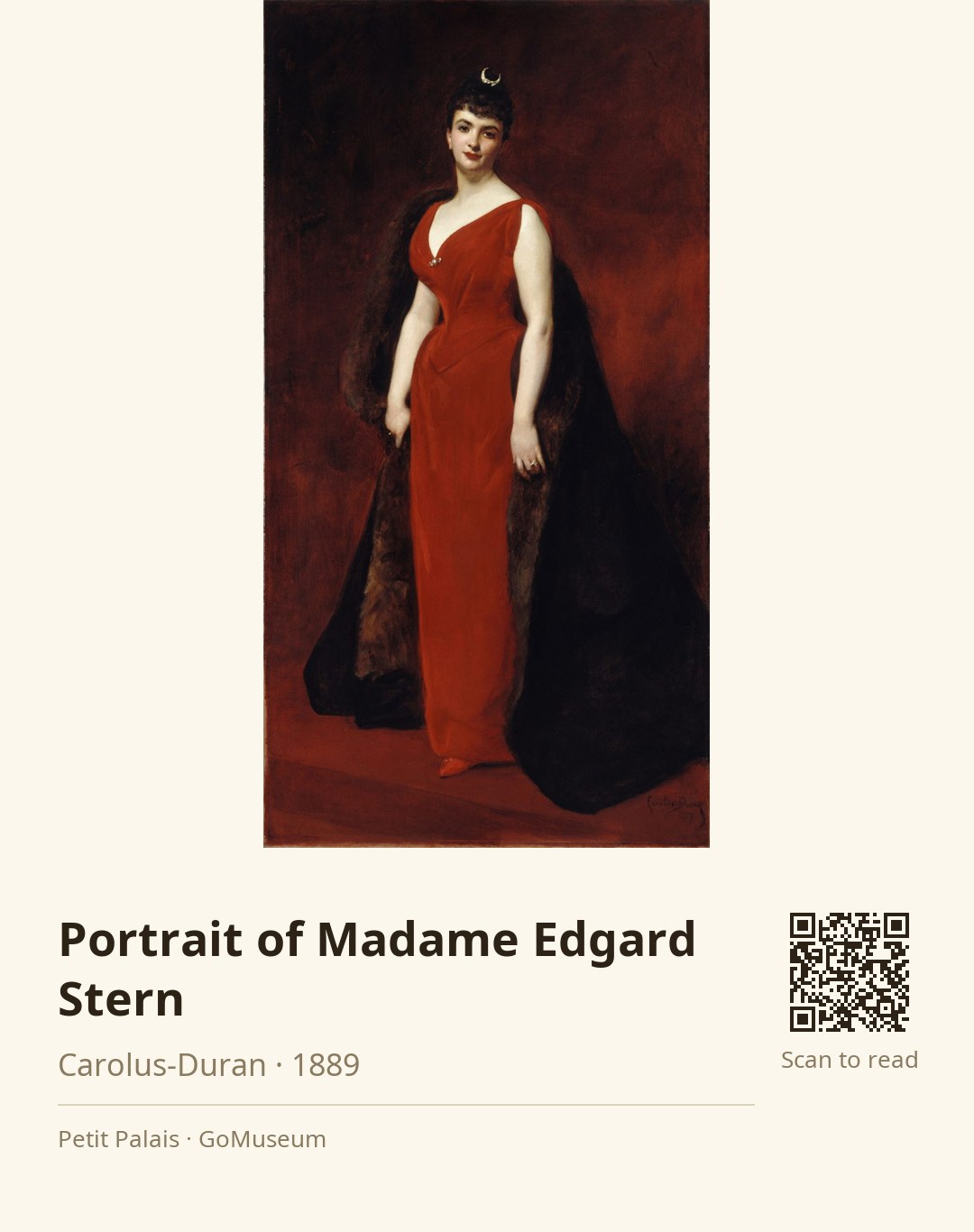
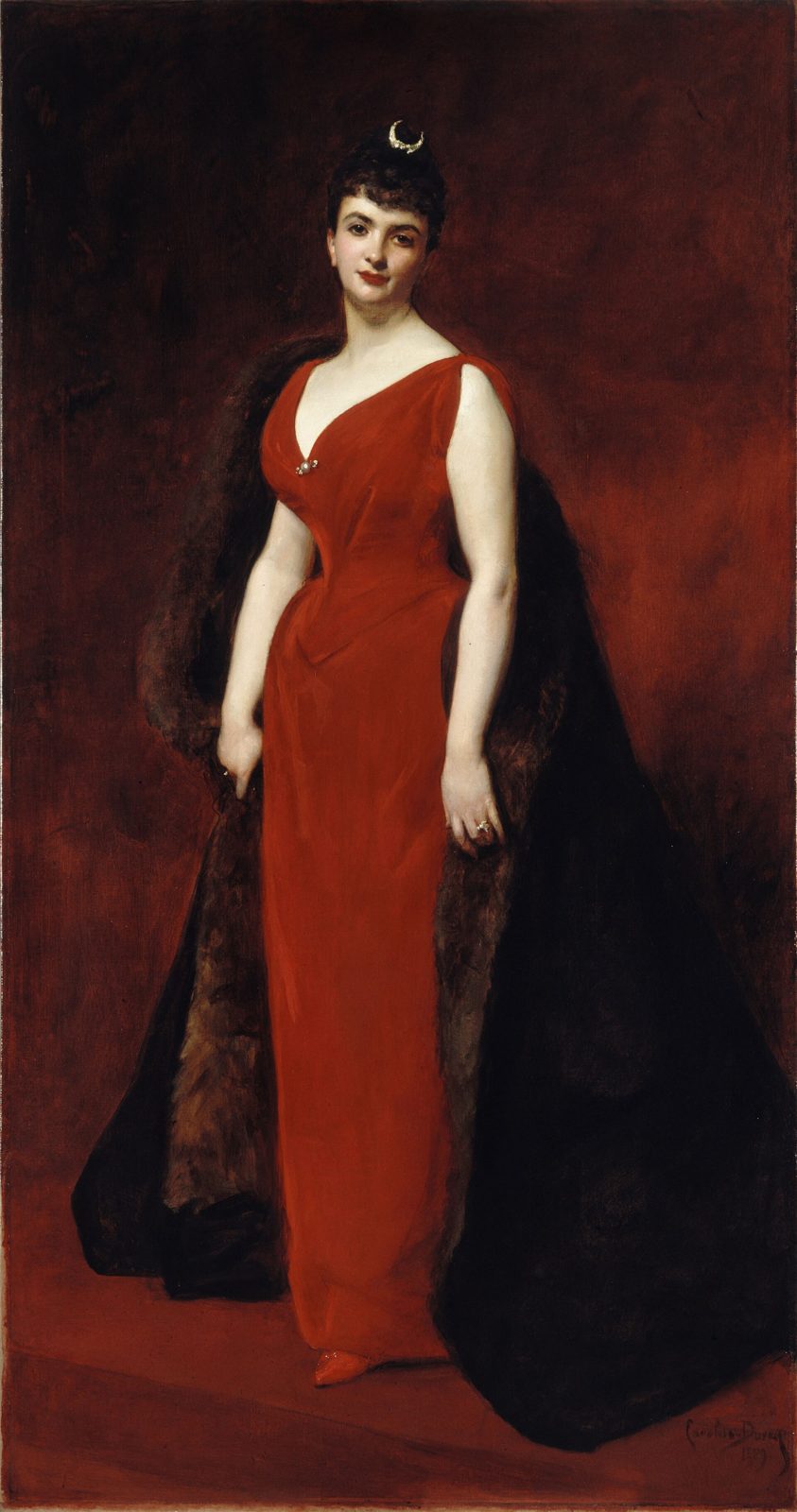
🎧 This work has audio narration — listen in the appMadame Edgard Stern stands tall in her striking red gown, the deep neckline accentuating her poised elegance against a rich crimson backdrop. Draped over her shoulders is a dark fur stole, which adds a layer of luxury to her composed demeanor, while her hair, styled up and adorned with a crescent-shaped ornament, hints at her high social standing. The smooth brushwork captures the sumptuous textures of her attire, creating a vivid contrast that draws the eye.
This painting, created by Carolus-Duran in 1889, encapsulates the essence of Belle Époque portraiture, where the artist skillfully portrays the opulence of his subjects. The choice of a vertical composition emphasizes Madame Stern's stature, while the dominant reds evoke a sense of warmth and intimacy. Duran’s meticulous attention to detail not only highlights the luxurious fabric but also reflects the societal status of his subjects, making them emblematic of the affluent class of Third Republic France.
Carolus-Duran, a prominent portraitist of his time, dedicated much of his career to capturing the likenesses of the elite, establishing a reputation that attracted many wealthy patrons. His influence extended beyond his own work, as he became a mentor to a generation of artists, including John Singer Sargent, who would later achieve fame in their own right.
Charles Auguste Émile Durand, known as Carolus-Duran, was a prominent French painter and art instructor born on July 4, 1837, in Lille. He emerged during the Belle Époque, celebrated for his elegant portraits of high society in Third Republic France. His artistic journey began with drawing lessons from a local sculptor, followed by formal studies in painting under François Souchon in Paris, where he adopted his pseudonym.
Durand's early work was influenced by Realism, particularly Gustave Courbet, but he later gravitated towards the style of Diego Velázquez after traveling to Rome and Spain. His breakthrough came with the painting "Murdered," which garnered significant acclaim. He became renowned for his portraiture, capturing the essence of his affluent subjects with a distinctive flair.
As an educator, Durand established a prominent atelier in Paris, mentoring many notable artists, including John Singer Sargent. His contributions to the art world were recognized with numerous honors, including multiple promotions within the Légion d'honneur. He played a crucial role in the art community, co-founding the Société Nationale des Beaux-Arts and serving on juries for major exhibitions.
Durand's legacy is marked by his ability to blend academic techniques with a modern sensibility, making him a key figure in the transition from traditional to contemporary portraiture. He passed away on February 17, 1917, leaving behind a rich artistic heritage that continues to influence artists today.
The smooth brushwork creates a lifelike texture that makes the luxurious fabrics of Madame Stern's gown and stole almost palpable. The choice of a vertical composition not only emphasizes her stature but also draws the viewer's eye upward, enhancing the sense of elegance. The rich reds dominate the palette, creating a warm, inviting atmosphere while simultaneously suggesting the wealth and status of the subject. Duran's ability to blend realism with a touch of idealism allows for a striking portrayal that feels both intimate and grand. The careful handling of light and shadow, though subtle, adds depth and dimension to the figure, making her presence commanding yet approachable.
Carolus-Duran opened a studio on the Boulevard du Montparnasse, where he taught painting.
Notable students of Carolus-Duran included John Singer Sargent and Hiram Reynolds Bloomer, among others.
After his death, a plaza and a beach were named in his honor at the resort in Fréjus where he frequently visited.