Miss Meuriot on Her Pony
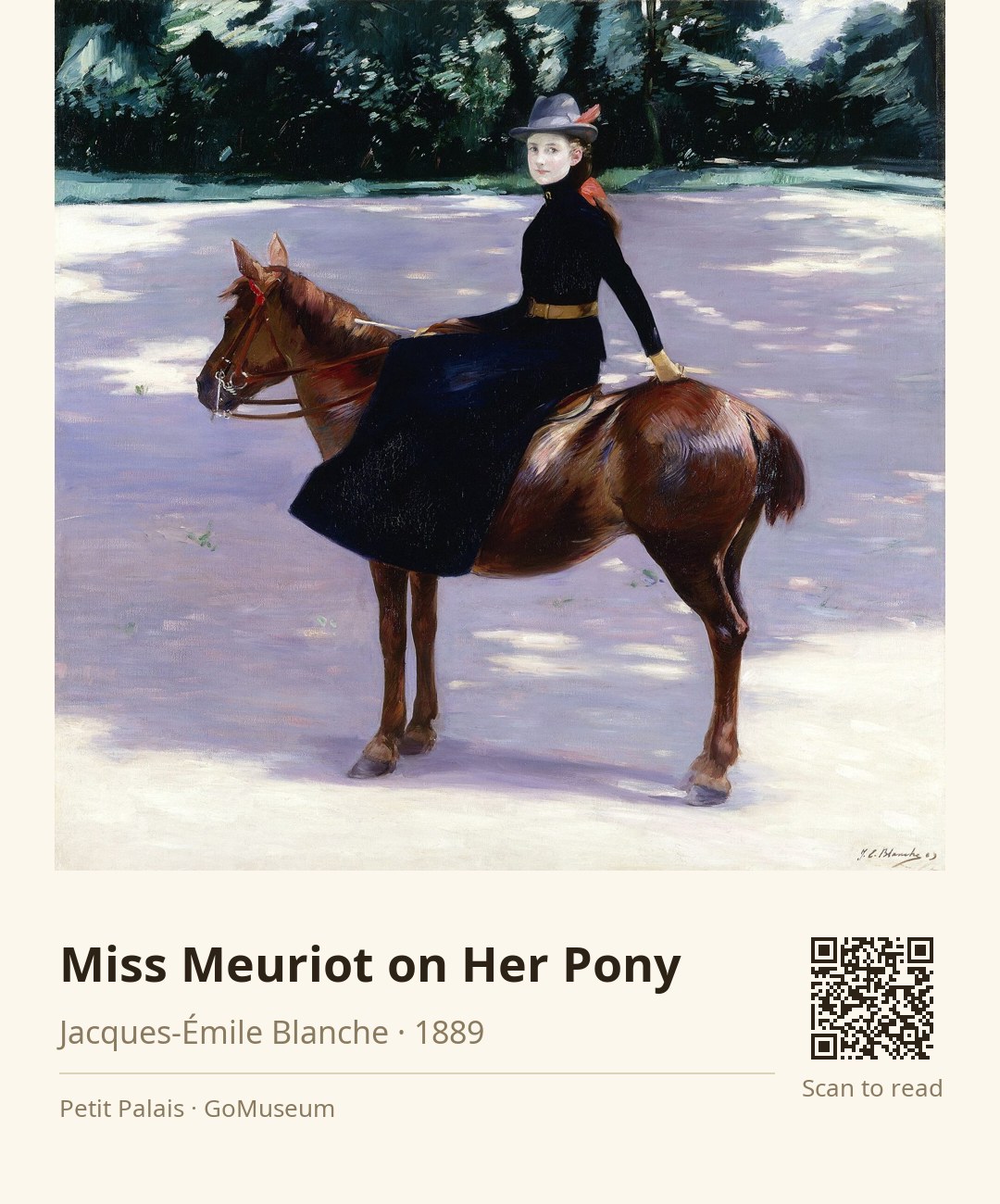
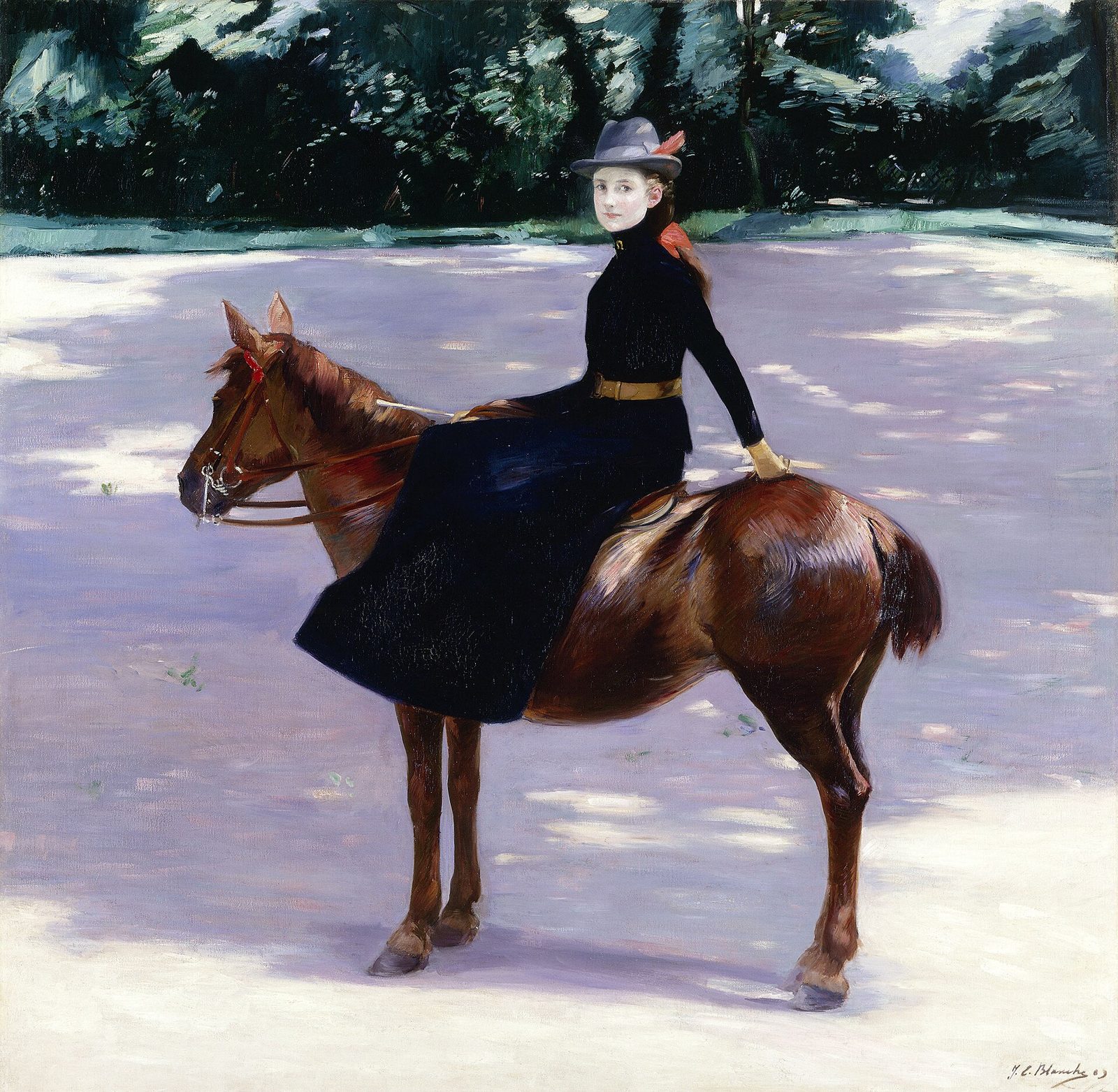
🎧 This work has audio narration — listen in the appThe woman on the chestnut horse commands your attention with her poised demeanor, dressed in a dark riding habit that accentuates her elegance. A wide-brimmed hat, adorned with a striking red feather, frames her face as she gazes directly at you, creating an intimate connection. The horse, calm and composed, stands with its head slightly turned, suggesting a moment of tranquility amidst the vibrant park setting.
This portrayal captures not just a moment in time but also the social context of the late 19th century, where women began to assert their presence in traditionally male-dominated spaces like equestrian sports. The dappled sunlight filtering through the trees, rendered with loose brushstrokes, contrasts beautifully with the meticulous details of the rider and her horse, highlighting the artist's skill in blending realism with impressionistic techniques. The rich palette of browns, blacks, and purples, punctuated by soft greens, evokes a sense of warmth and vitality, inviting viewers into a serene outdoor scene.
Jacques-Émile Blanche, a largely self-taught artist, painted this work in 1889, reflecting his deep engagement with the social circles of Paris and his friendships with notable figures like Marcel Proust.
Jacques-Émile Blanche was a French portrait painter born on January 1, 1861, in Paris. Raised in an artistic environment, he was influenced by the notable figures who frequented his father's psychiatric clinic. Although he received some guidance from established artists like Henri Gervex and Pierre-Auguste Renoir, he is primarily considered self-taught. His work, characterized by a refined style reminiscent of 18th-century English painters and the Impressionists, gained him recognition in both London and Paris.
Blanche's notable portraits include those of literary giants like Marcel Proust and James Joyce, as well as cultural figures such as Claude Debussy and Auguste Rodin. He was deeply embedded in the artistic community, befriending contemporaries and participating in salons that shaped Parisian culture. His leadership at the Académie de La Palette and later at the Académie Vitti showcased his commitment to nurturing new talent.
Despite being a closeted homosexual, Blanche married Rose Lemoinne in 1895, though his personal life remained complex. He passed away on September 30, 1942, leaving behind a legacy celebrated in museums and streets named in his honor. His contributions to portraiture and his connections to literary and artistic movements solidify his place in art history.
Jacques-Émile Blanche painted this striking work in 1889, a time when he was deeply immersed in the vibrant social scene of Paris. Blanche, who was largely self-taught, had already made a name for himself as a portraitist, influenced by the likes of Manet and Gainsborough. His connections with literary figures, including Marcel Proust, helped elevate his status in the art world. The reception of his work was generally positive, as audiences appreciated his ability to blend realism with an impressionistic flair.
This painting showcases Blanche's adeptness with oil paint, employing a technique that balances meticulous detail with expressive brushwork. The rider and her horse are rendered with precision, highlighting the textures of the dark riding habit and the chestnut coat, while the background bursts with loose, lively strokes that evoke the dappled sunlight filtering through the trees. The contrast between the detailed foreground and the more abstract background creates a sense of depth, drawing the viewer into the scene. The rich palette of browns, blacks, and purples, punctuated by vibrant greens, not only captures the essence of the moment but also reflects the artist's emotional engagement with his subjects. This dynamic use of color and brushwork invites viewers to feel the warmth and vitality of the park setting, making the painting a vivid snapshot of its time.
Interestingly, Jacques-Émile Blanche was not just a painter but also a writer. He authored several books, including 'Portraits of a Lifetime,' where he shared his experiences and insights about the art world. However, his accounts were sometimes viewed with skepticism; fellow artist Walter Sickert noted that Blanche had a tendency to embellish stories, leading to a reputation for 'monstrous fibs.' This blend of artistry and storytelling adds another layer to understanding his complex character.
In addition to being a painter, Jacques-Émile Blanche was also a writer who authored several books, including 'Portraits of a Lifetime.'
Jacques-Émile Blanche's family home was visited by many prominent figures, including literary and artistic celebrities such as Hector Berlioz and Camille Corot.