Van Dyck in London
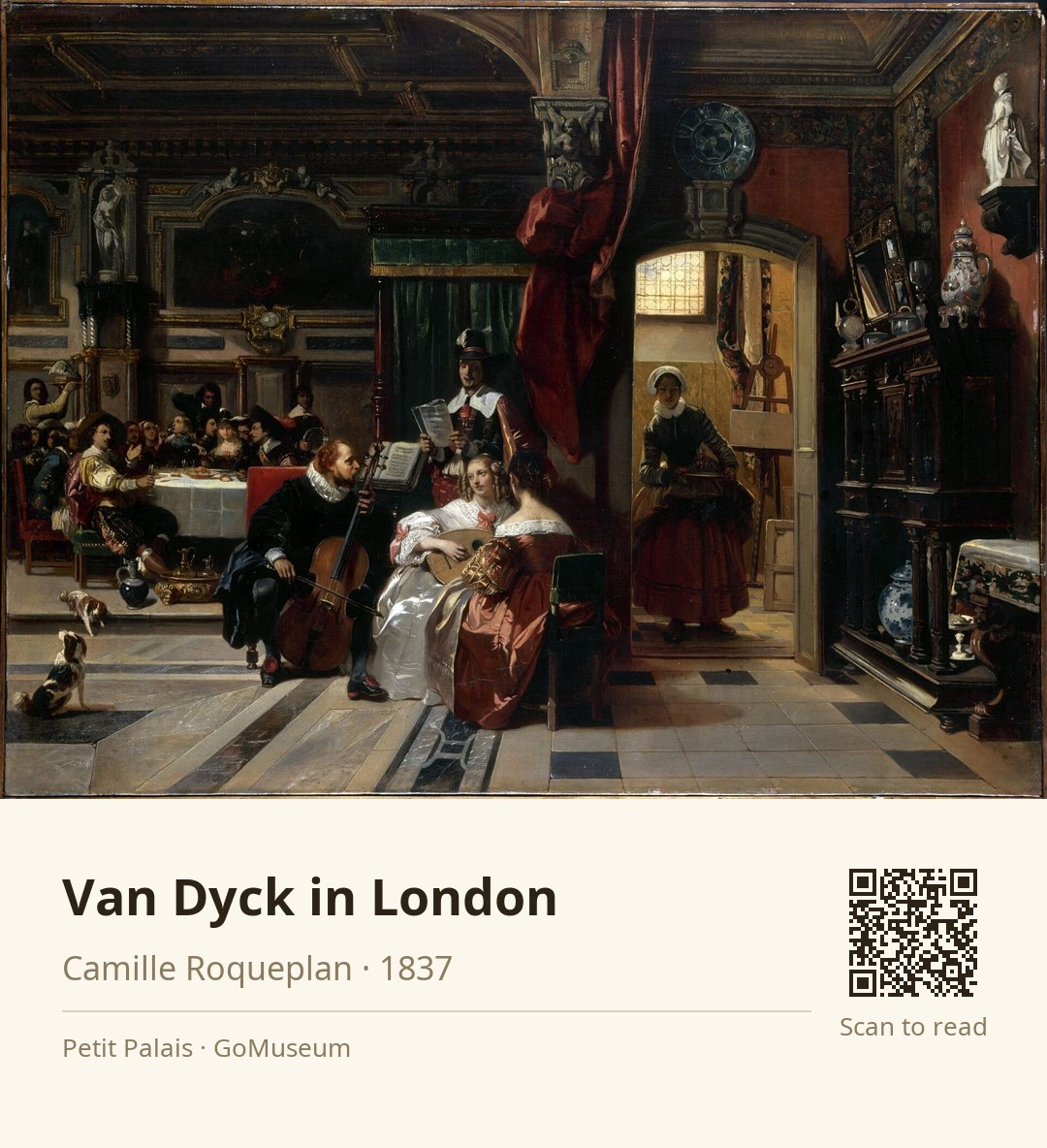
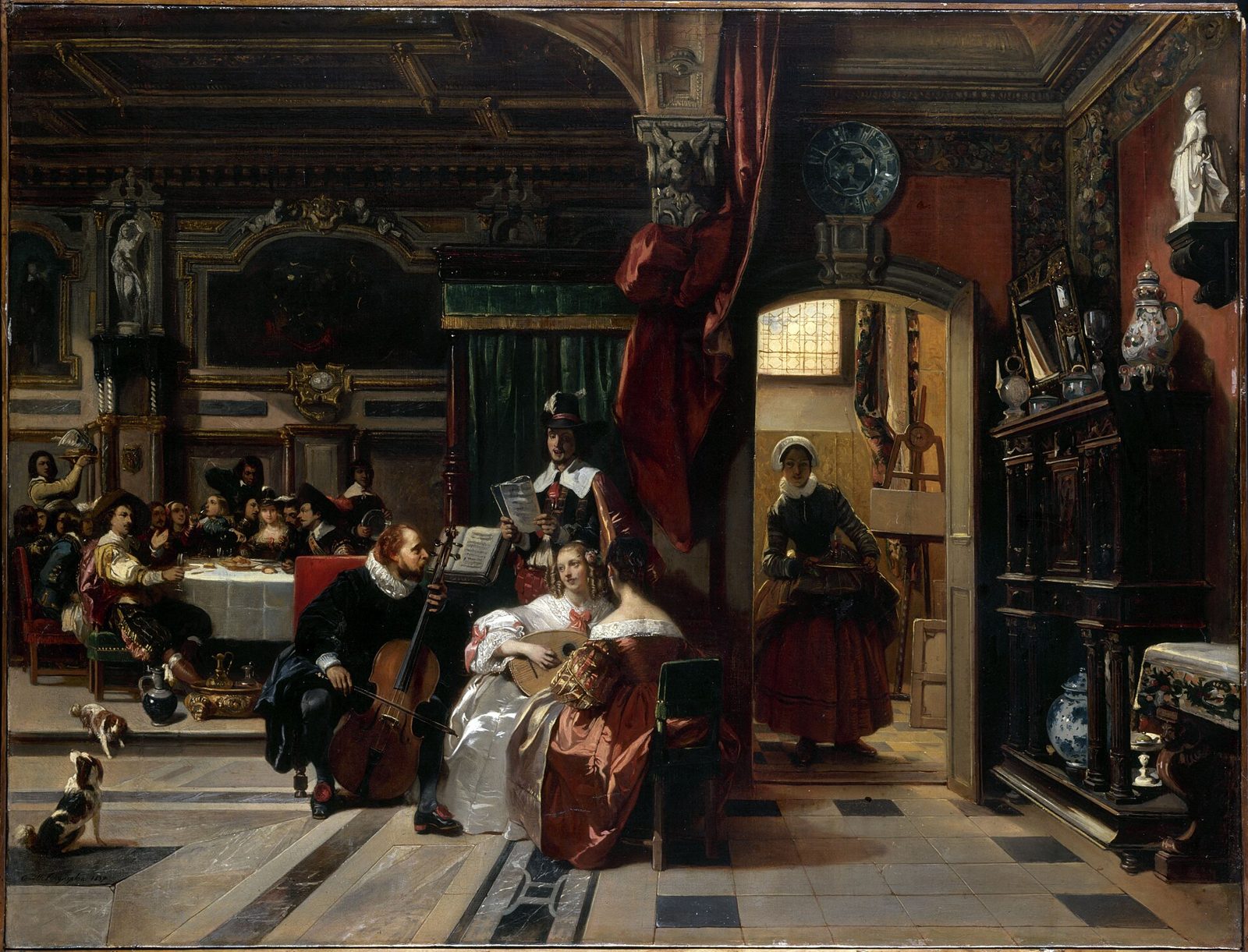
🎧 This work has audio narration — listen in the appThe opulent interior of "Van Dyck in London" draws you into a lively gathering, where a man plays the cello while a woman strums a guitar beside him. Nearby, another figure holds a sheet of music, suggesting a moment of artistic collaboration. Richly draped curtains frame this scene, while a small dog sits attentively on the floor, adding a touch of warmth to the atmosphere.
This composition not only captures a social moment but also reflects the cultural milieu of the time, where music and art intertwined seamlessly. Roqueplan's choice of deep reds, browns, and golds enhances the luxurious feel of the setting, evoking the grandeur associated with Van Dyck's own portraits of the English court.
Camille Roqueplan, a prominent figure of the Romantic movement, painted this work in 1837, showcasing his ability to blend historical narrative with rich visual detail. His depiction of Van Dyck was exhibited at the Salon of 1838 in Paris, where it garnered attention for its vibrant portrayal of artistic life. Today, it resides in the collection of the Musée des Beaux-Arts de la ville de Paris, having been acquired in 1902.
Camille Joseph Etienne Roqueplan was a French Romantic painter born in Mallemort in 1802 or 1803. He showed artistic talent early on, often correcting his classmates' drawings. Initially hesitant to pursue art as a career, he briefly studied medicine and worked as a clerk before fully committing to painting. His artistic journey included studying under Abel de Pujol and Antoine Gros, though he faced discouragement and self-doubt throughout his education.
Roqueplan's breakthrough came with his first exhibit at the Salon of 1822, where he won a gold medal. He became known for his landscapes and historical scenes, often inspired by the works of Walter Scott. His later years were marked by a return to landscape painting, particularly in the Pyrenees, where he captured peasant life. Roqueplan also contributed to art education, teaching notable students at the École des Beaux-arts. He passed away in Paris in 1855, leaving a legacy as a significant figure in the Romantic movement and a bridge between classical techniques and emerging modern sensibilities.
This painting was commissioned to celebrate the legacy of Anthony van Dyck, a Flemish artist who had a significant impact on English portraiture during the 17th century. Roqueplan, a prominent figure in the Romantic movement, sought to blend historical narrative with rich visual detail, reflecting his admiration for Van Dyck's work. The painting eventually found its way into the collection of the Musée des Beaux-Arts de la ville de Paris, where it has been housed since its acquisition in 1902.
In 'Van Dyck in London,' Roqueplan employs a rich palette dominated by deep reds, browns, and golds, creating an atmosphere of opulence that mirrors the grandeur of the setting. The brushwork is meticulous, with each stroke contributing to the intricate details of the interior, from the lavish drapery to the ornate architectural elements. The composition is thoughtfully arranged, with figures engaging in music and conversation, drawing the viewer into this intimate gathering. The use of light is strategic; it highlights the musicians while casting softer shadows around the room, enhancing the sense of depth. The easel in the background serves not just as a prop but as a narrative device, suggesting that this scene unfolds in a creative space, where art and music coexist harmoniously. Roqueplan's technique captures the vibrancy of the moment, inviting you to feel the energy of the gathering.
Interestingly, Roqueplan faced significant challenges in his early artistic career, including a brief stint studying medicine before fully committing to painting. His journey reflects a struggle between personal passion and societal expectations, making his eventual success as a Romantic painter all the more remarkable. This background adds depth to understanding his portrayal of Van Dyck, as it embodies the artist's own quest for identity and expression within the art world.
Roqueplan initially struggled with his artistic career, briefly studying medicine before realizing his true passion for painting.
Roqueplan was a significant figure within the Romantic movement, contributing to its themes and aesthetics through his historical and genre paintings.