The White Queen of Castile Freeing the Prisoners
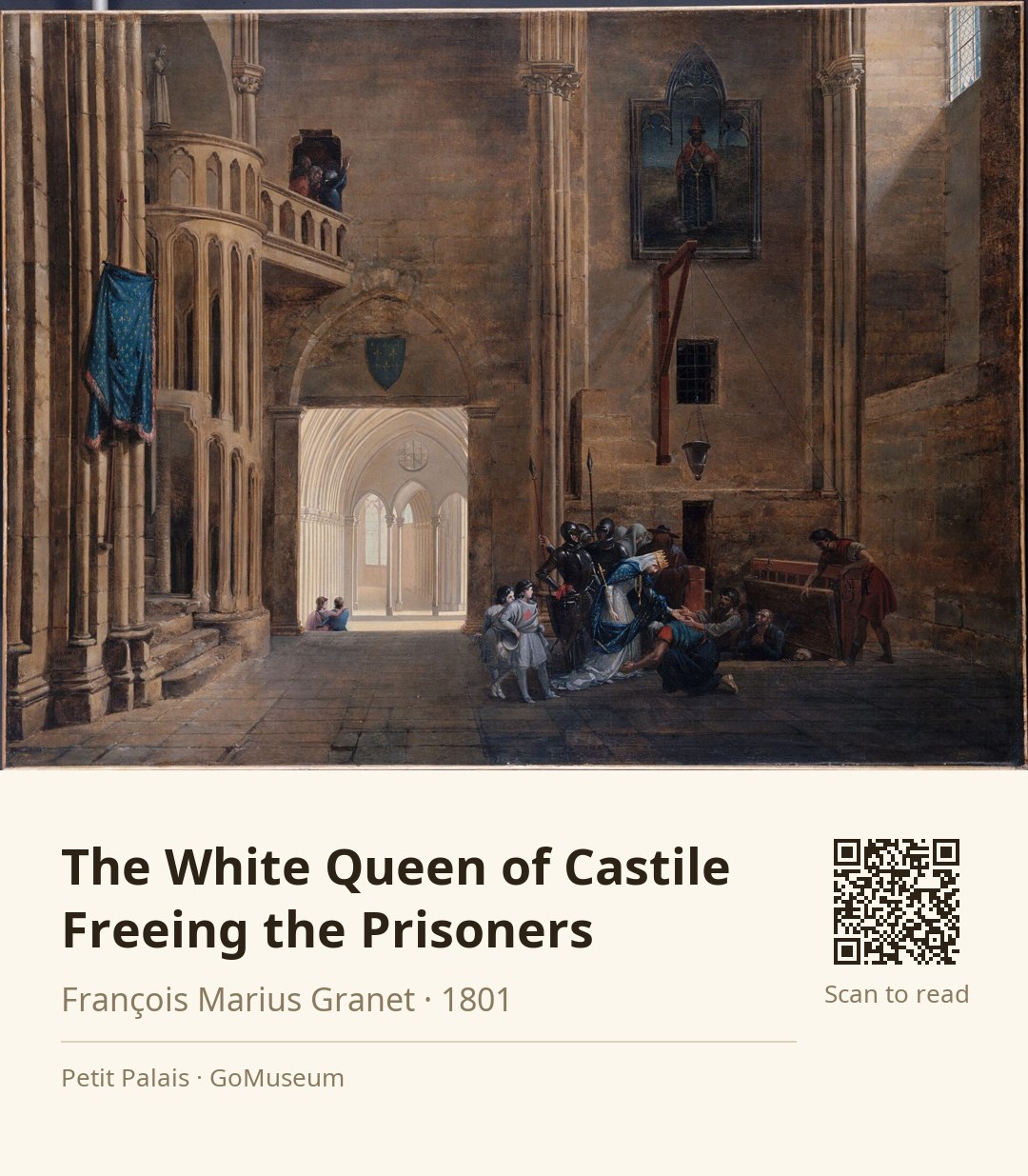
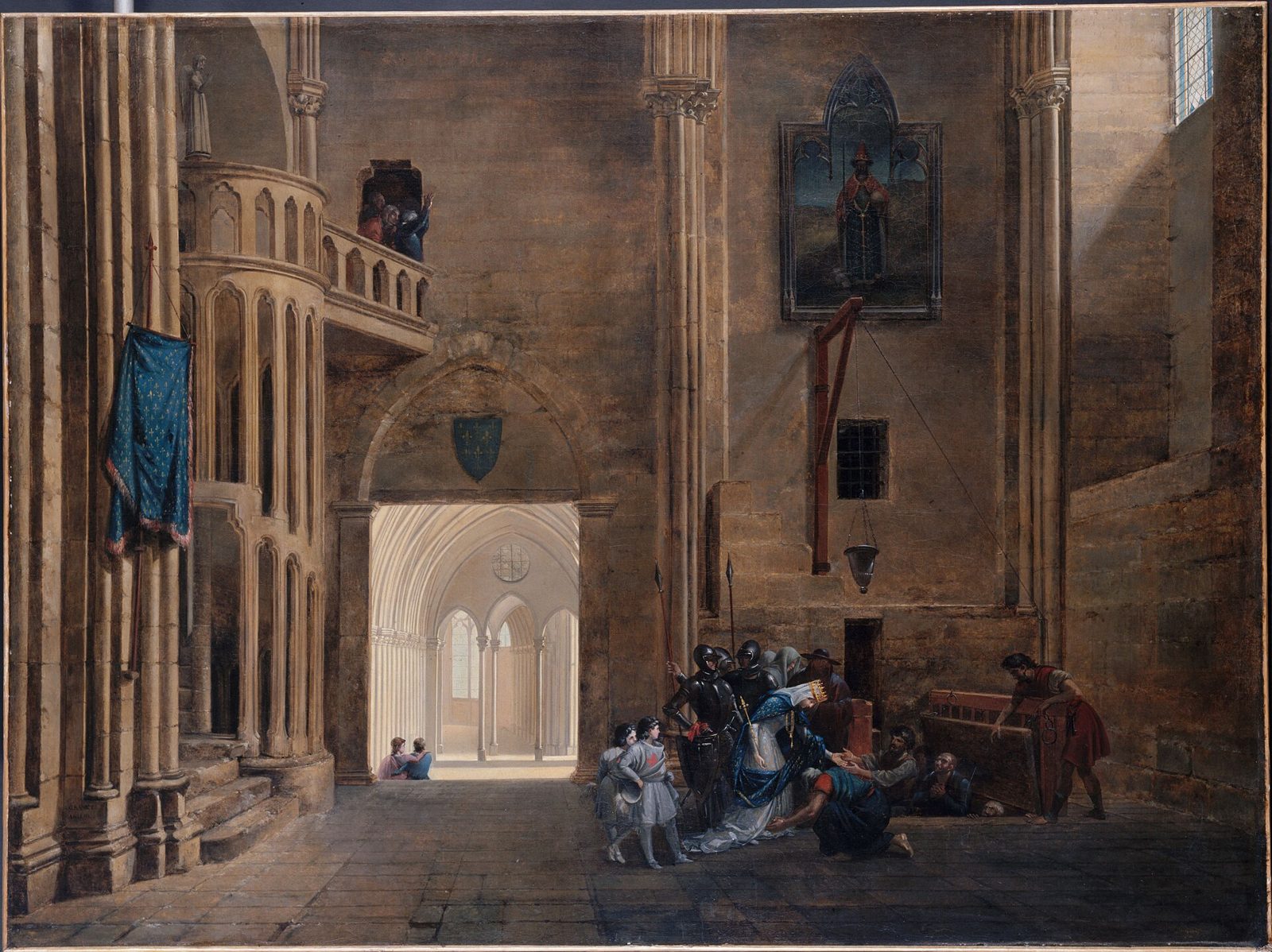
🎧 This work has audio narration — listen in the appA woman in a blue robe kneels in a Gothic cathedral, reaching out to a seated man surrounded by armored guards. The scene, rich with muted earth tones and splashes of blue and red, captures a moment of compassion amidst authority, highlighting the tension between the figures' emotional expressions and their imposing surroundings.
The kneeling figure, representing Blanche of Castile, symbolizes mercy and justice, as she intervenes to liberate prisoners. This act of reaching out not only emphasizes her role as a protector but also invites viewers to consider the broader themes of power and humanity. The guards, with their spears, stand in stark contrast to her gentle gesture, embodying the conflict between oppression and the desire for freedom.
François Marius Granet, known for his architectural subjects, painted this work in 1801, during a time when neoclassicism was prevalent in France. His focus on the interplay between figures and their architectural settings reflects his deep understanding of space, as seen in the cathedral's soaring arches and the play of light through the passageway. Granet's career was marked by a fascination with interiors, particularly those of churches and cloisters, which he often depicted with a somber yet evocative palette.
In 1802, Granet moved to Rome, where he continued to develop his style, ultimately becoming a significant figure in the art world.
François Marius Granet, born on December 17, 1775, in Aix-en-Provence, was a notable French painter known for his architectural subjects. His artistic journey began under the guidance of Jean-Antoine Constantin and later flourished in Paris, where he became a pupil of Jacques-Louis David. Granet's passion for capturing the interplay of light and shadow in cloisters and churches earned him a reputation as a master of tone, blending figures seamlessly into architectural settings.
In 1802, he moved to Rome, where he spent nearly two decades, drawing inspiration from the city's ancient monuments and the lives of artists. His works, characterized by a dark, Dutch-inspired palette, gained recognition, including an award at the Salon in 1808. Granet's return to France in 1824 marked a shift as he took on roles as curator at the Louvre and later at Versailles, contributing to the establishment of a historical museum.
Despite his accolades, including being named Chevalier de l'Ordre St Michel, Granet remained deeply connected to Rome and his hometown. After his wife's death in 1847, he returned to Aix, where he passed away on November 21, 1849. He left a significant legacy, with his collections forming the foundation of the Musée Granet, established in his honor. Granet's work remains a testament to the harmony between architecture and human experience in art history.
François Marius Granet painted this evocative scene in 1801, during a period when neoclassicism was at its height in France. Commissioned by an unknown patron, the work, titled 'La Reine Blanche de Castille délivrant les prisonniers,' was first shown at the Salon in Paris, where it garnered attention for its emotional depth and architectural precision. Granet's fascination with Gothic interiors is evident, reflecting his broader artistic journey that began in Aix-en-Provence and took him to the heart of artistic innovation in Paris. After moving to Rome in 1802, Granet continued to refine his style, drawing inspiration from the grandeur of Italian architecture. His works, including this one, were well-received, contributing to his reputation as a master of architectural subjects. The painting eventually became part of the collection at the Musée Granet in Aix-en-Provence, a museum named in his honor after his death in 1849, where it remains a testament to his legacy.
Granet's technique in this painting showcases his mastery of oil on canvas, allowing him to create a rich, textured surface that draws you into the scene. The muted earth tones dominate the palette, punctuated by the striking blue of the woman's robe and the red accents that add emotional weight. His brushwork is deliberate yet fluid, capturing the intricate details of the Gothic architecture around the figures. The composition is carefully balanced, with the kneeling Blanche of Castile positioned in the foreground, her outstretched hand creating a line of connection to the seated man. The towering arches and columns of the cathedral frame the action, enhancing the sense of scale and depth. Granet's ability to manipulate light within the space, as seen in the bright area beyond the arches, serves to highlight the tension between the figures and their surroundings, emphasizing the themes of mercy and authority.
One intriguing anecdote about Granet is that he lived in a convent in Paris, which had been repurposed as a studio for artists after the Revolution. This unique setting not only influenced his artistic style but also earned him the nickname 'the monk' due to his deep connection to religious themes and interiors. His time in this cloistered environment allowed him to develop a distinctive approach to light and shadow, which became a hallmark of his work.
Granet lived in a convent in Paris that was converted into a studio for artists, which deeply influenced his artistic style and connection to religious themes.
Granet had a particular fascination with painting interiors of churches and cloisters, often using a somber and evocative color palette.
Granet skillfully manipulated light in the painting, creating bright areas that emphasize the tension between the figures and their imposing surroundings.