The Departure of the Prodigal Son
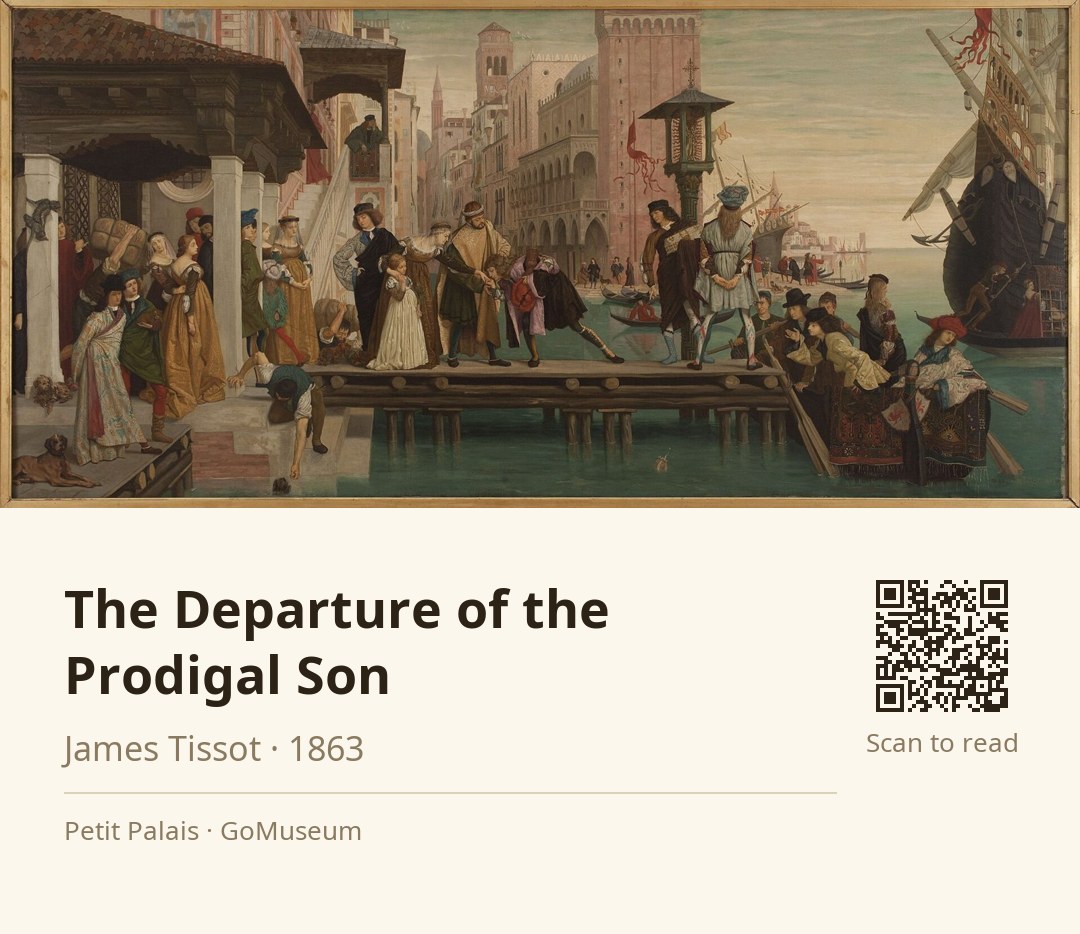
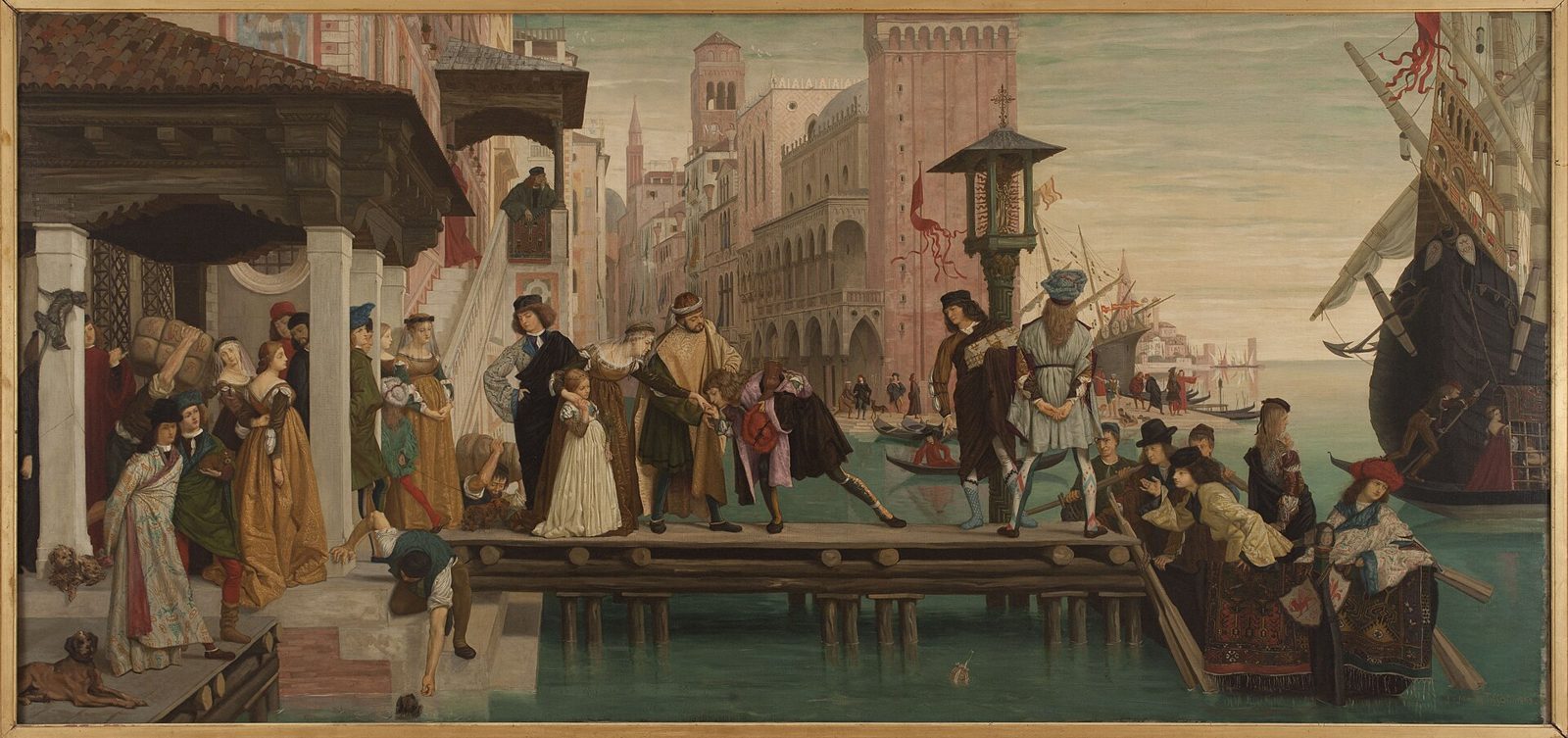
🎧 This work has audio narration — listen in the appA bustling Venetian dock comes alive in Tissot's 1863 painting, "Le départ de l'enfant prodigue." Elegantly dressed figures gather on a wooden pier, some deep in conversation while others observe the lively scene around them. A man leans over the edge, reaching into the shimmering water, while a grand ship looms nearby, its sailors and passengers adding to the vibrant atmosphere. The muted earth tones of the palette are punctuated by splashes of red and blue in the clothing, reflecting the rich textures of both fabric and architecture.
This lively depiction captures the essence of social interaction in 19th-century Europe, showcasing Tissot's keen eye for detail and his ability to convey the subtleties of human behavior. The grand buildings in the background, with their arched windows and balconies, are quintessentially Venetian, grounding the scene in a specific cultural context. Tissot's meticulous attention to the interplay of light and shadow enhances the realism of the moment, inviting viewers to immerse themselves in the bustling life of the dock.
Tissot, originally from Nantes, France, became known for his genre paintings that often highlighted the lives and fashions of high society during the Belle Époque. His work reflects a transition from medieval themes to modern life, marking a significant evolution in his artistic journey. "Le départ de l'enfant prodigue" was exhibited at the Salon in 1863, alongside its companion piece, "Le Retour de l'enfant prodigue."
James Tissot, born Jacques Joseph Tissot in Nantes in 1836, was a French painter and illustrator renowned for his depictions of Victorian high society and women's fashion during the Belle Époque. Initially trained at the École des Beaux-Arts in Paris, he embraced realism and impressionistic techniques, capturing the nuances of contemporary life. Tissot's early works focused on medieval themes, but after moving to London in 1871, he shifted to genre paintings that resonated with British audiences, earning acclaim for his photorealistic style.
His tumultuous life included service in the Franco-Prussian War and a close relationship with Kathleen Newton, who inspired many of his works until her untimely death. Tissot's social circle included notable figures like Edgar Degas and James Whistler, reflecting his integration into the artistic elite. Later in life, he experienced a religious awakening, leading him to create biblical subjects that garnered significant recognition. Tissot's legacy endures as a pivotal figure in 19th-century art, bridging traditional techniques with modern themes, ultimately earning him a place in art history. He passed away in 1902, leaving behind a rich tapestry of works that continue to captivate audiences.
James Tissot's 'Le départ de l'enfant prodigue' was created in 1863, a pivotal moment in his career as he transitioned from medieval themes to modern life. This painting was exhibited at the Salon that same year, alongside its companion piece, 'Le Retour de l'enfant prodigue.' The reception was mixed; while some critics appreciated Tissot's detailed portrayal of contemporary life, others were less favorable, noting his neo-Gothic influences. The painting eventually found its way into the collection of Jean Bonnat, a prominent French painter and collector, which speaks to its significance in Tissot's oeuvre.
The artist employs a meticulous brushwork that captures the textures of both fabric and architecture, allowing the viewer to almost feel the luxuriousness of the clothing worn by the elegantly dressed figures. His choice of a muted earth-tone palette, punctuated by vibrant reds and blues, creates a dynamic visual rhythm that draws the eye across the canvas. The composition is expansive, measuring over two meters wide, which invites you into the bustling scene. Tissot's careful handling of light enhances the realism, making the reflections in the water and the play of sunlight on the figures' garments particularly striking, immersing you in the lively atmosphere of the Venetian dock.
Growing up in Nantes, a port city, likely inspired Tissot's recurring themes of shipping vessels and maritime scenes in his paintings.
Tissot had significant relationships with prominent artists such as James Abbott Whistler and Edgar Degas, which influenced his work and style.
Following Kathleen Newton's death, Tissot returned to Paris and began to focus on portraying women from different social backgrounds in their everyday lives.