Partridge in a Niche
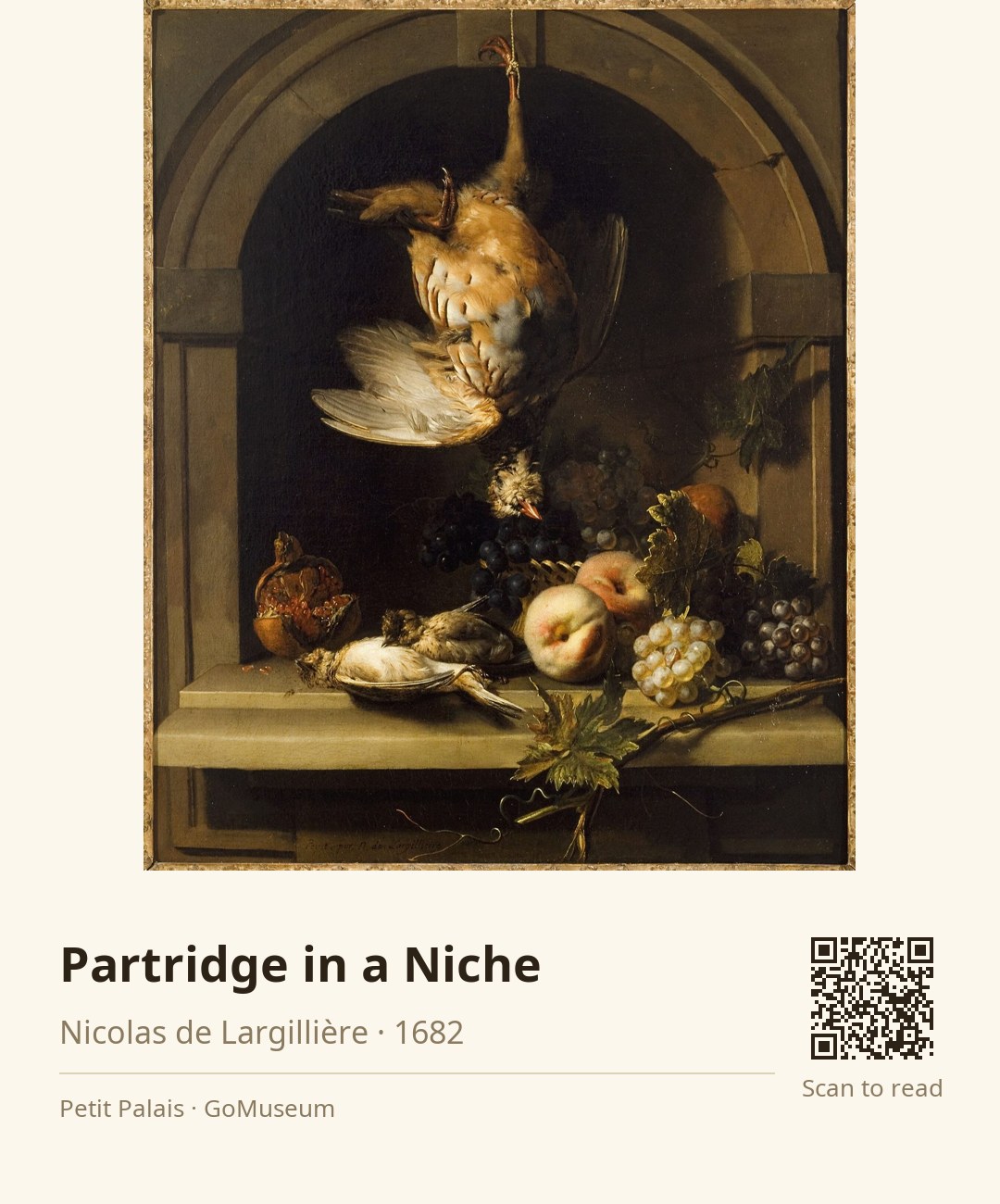
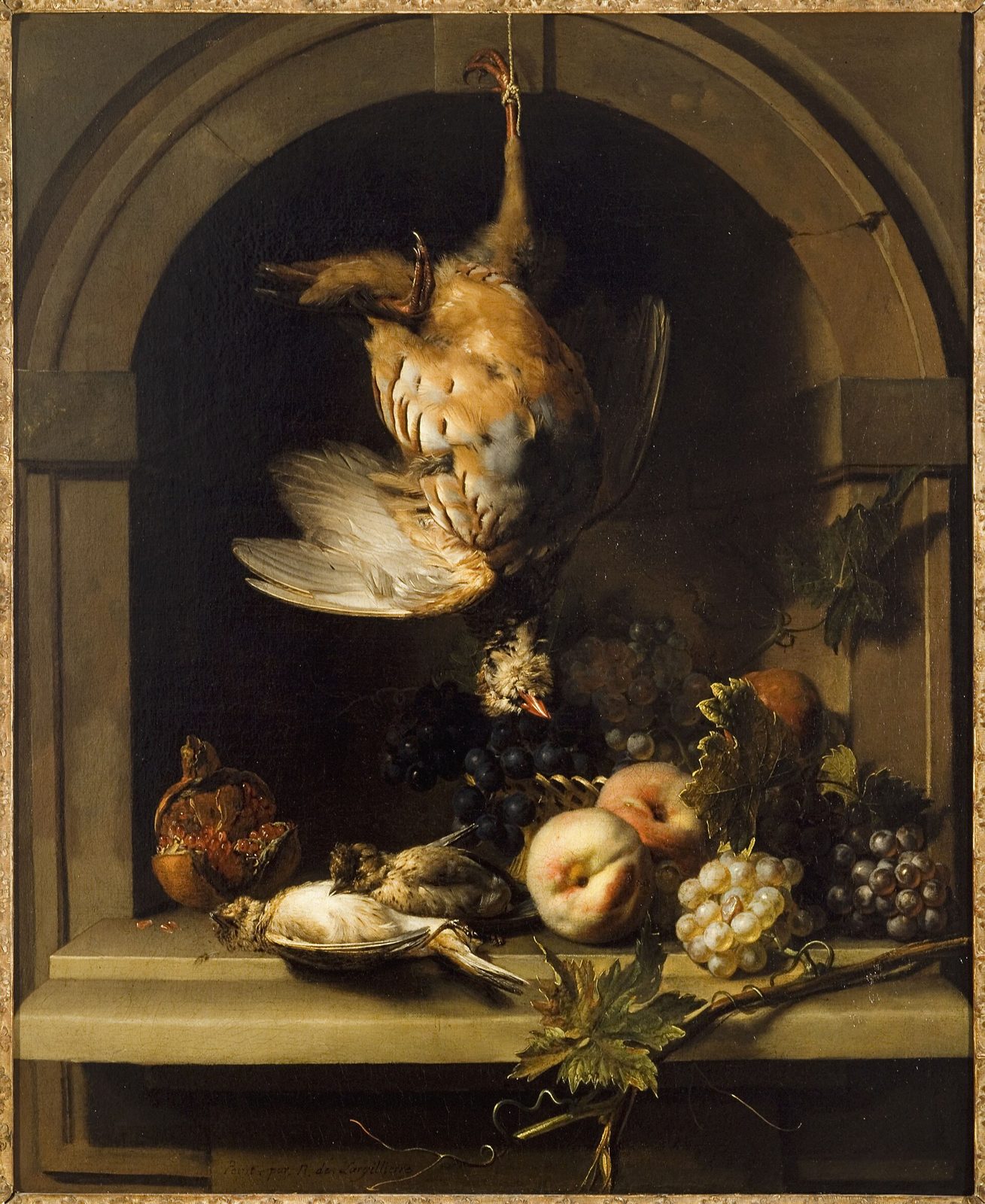
🎧 This work has audio narration — listen in the appThe partridge, suspended by its feet, draws your eye immediately in this still life by Nicolas de Largillière. Below it, a vibrant display of peaches, grapes, and a split pomegranate rests on a ledge, their textures rendered with such precision that you can almost feel their surfaces. This arrangement not only showcases the artist's skill but also highlights the contrast between the life of the fruit and the lifelessness of the birds, creating a tension that invites contemplation on nature's cycles.
Largillière's use of a dark background enhances the rich colors of the fruits and the intricate details of the feathers, emphasizing the artistry involved in capturing both beauty and mortality. The stone niche frames the scene, giving it a sense of depth and context, as if inviting the viewer into a moment frozen in time.
Nicolas de Largillière was a prominent French painter and draughtsman, born in Paris on October 10, 1656. He spent his early years in Antwerp, where his artistic journey began under the mentorship of Flemish painter Anton Goubau. Largillière's talent flourished in England, where he worked alongside Sir Peter Lely, gaining royal attention for his skill in restoring and painting. His return to Paris marked the start of a celebrated career as a portraitist, capturing the likenesses of notable figures, including King James II and Louis XIV's family.
A member of the Académie royale de peinture et de sculpture, Largillière's work was characterized by a blend of Flemish color and French elegance. He became the academy's director in 1733, influencing the next generation of artists. His portraits, known for their psychological depth and vibrant detail, secured his place in art history as one of the leading portraitists of the 17th and 18th centuries. Largillière passed away on March 20, 1746, leaving behind a legacy of artistic excellence and numerous works that continue to be celebrated today.
The oil paint is applied with a precision that brings the textures of the fruits and feathers to life. Each brushstroke reveals the softness of the peach skin and the intricate details of the bird's plumage. The dark background serves a dual purpose: it not only highlights the vibrant colors of the fruits but also creates a dramatic contrast that draws your eye to the central elements of the composition. The use of a stone niche adds depth, making it feel as though you are peering into a three-dimensional space. The careful arrangement of the fruits and the suspended bird creates a balance that invites contemplation, while the rich palette of earthy tones and deep reds enhances the overall impact, making the scene feel both lush and somber.
The arrangement suggests that the artist intended to create a sense of balance and harmony, encouraging viewers to reflect on the relationship between life and death.
It is regarded as one of the masterpieces of the Petit Palais, highlighting its significance in the museum's collection.
Two similar compositions, titled Nature morte à la perdrix rouge and Nature morte à la perdrix grise, are preserved in the Musée de Grenoble.