The Republic
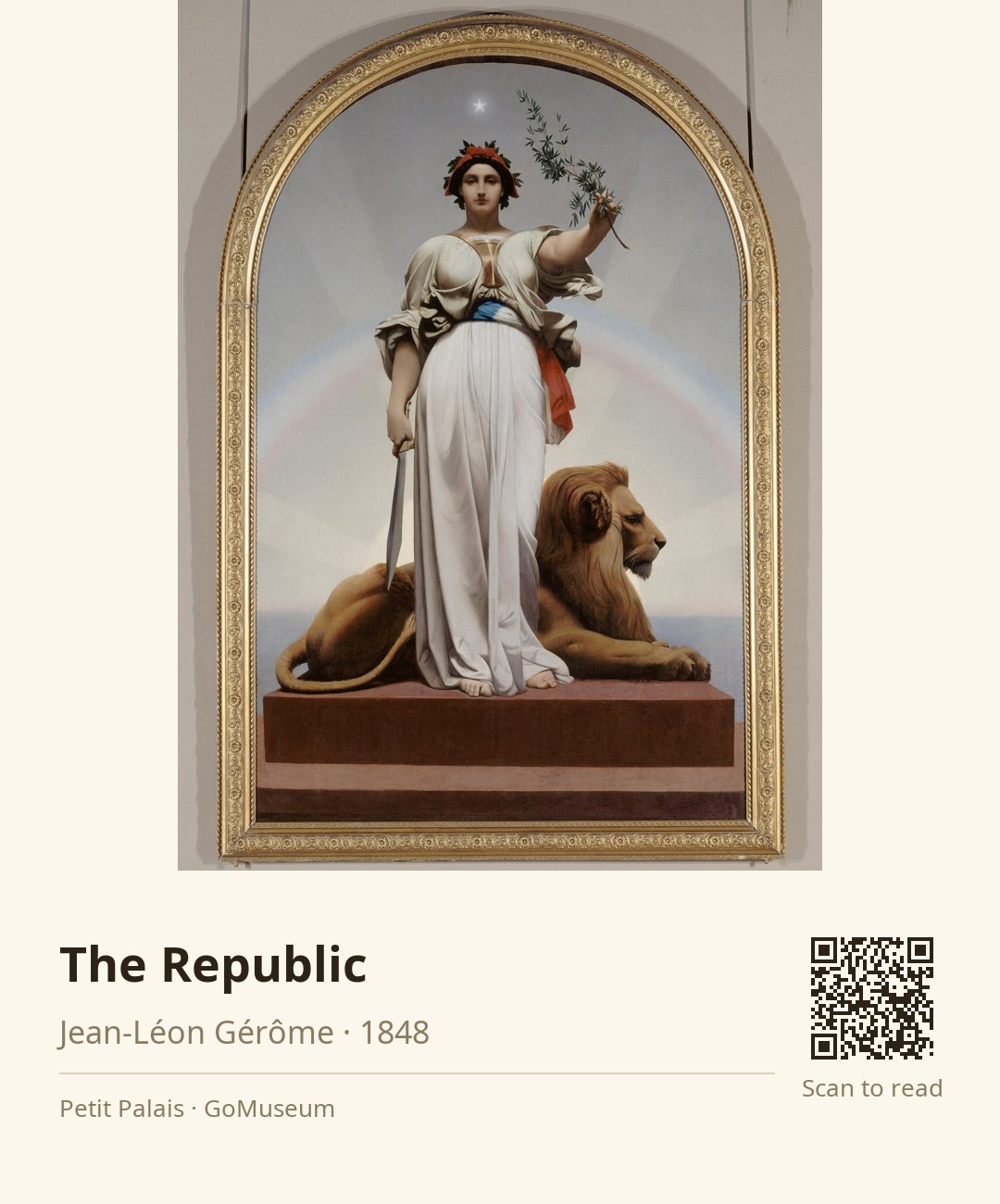
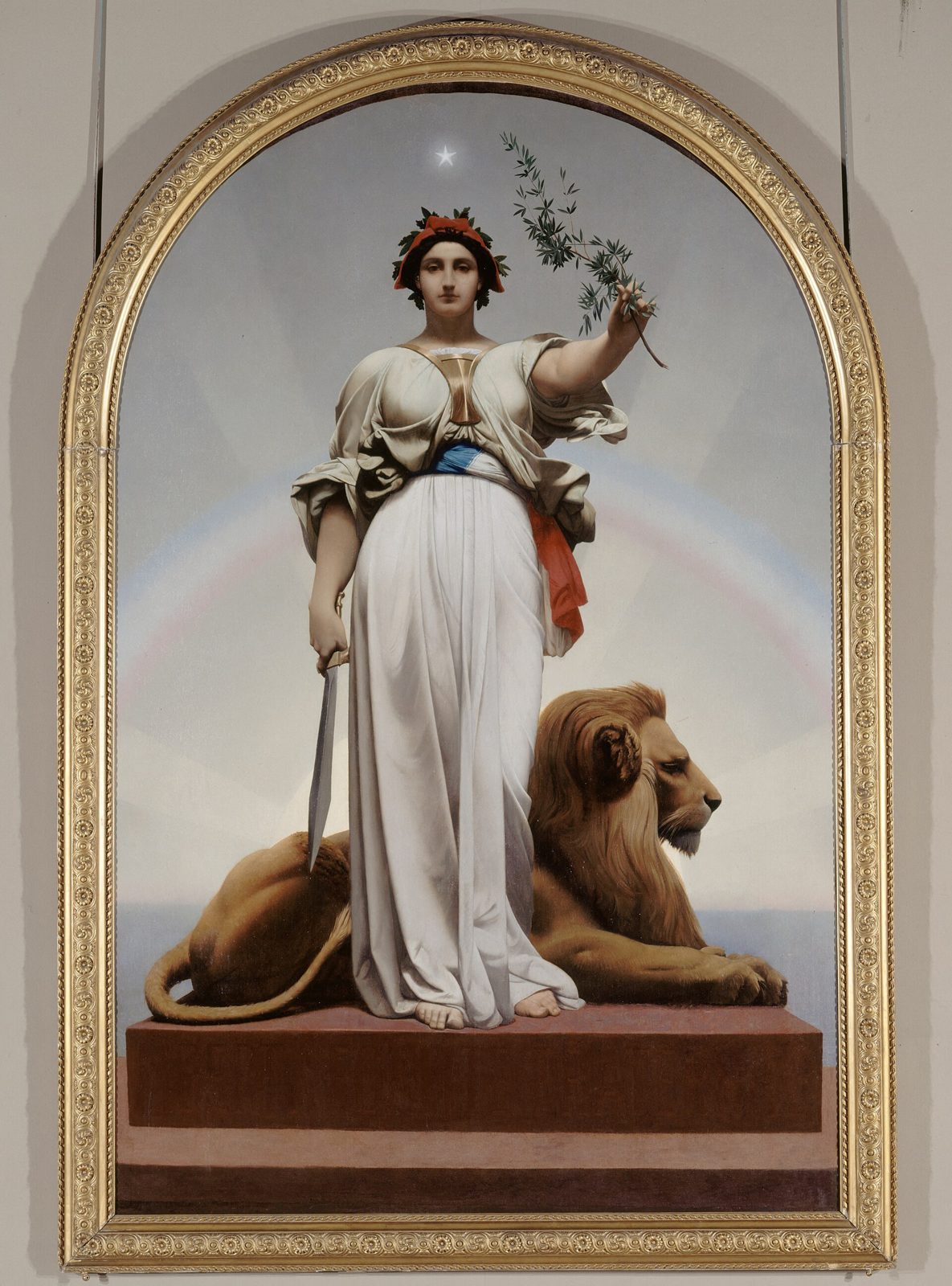
🎧 This work has audio narration — listen in the appThe standing figure of a woman in classical attire commands attention, her sword raised in one hand and an olive branch in the other. The red wreath atop her head and the blue sash around her waist add vibrant color to her serene presence, while a lion rests beside her on a pedestal, symbolizing strength and courage.
This depiction of the Republic embodies the ideals of the 1848 revolution, aiming to present a new allegorical figure that could unify and inspire the nation. The soft palette of earth tones and pastels enhances the peaceful yet powerful aura of the figure, suggesting a balance between strength and tranquility. The faint rainbow in the background, arching across a serene sky, symbolizes hope and the promise of a brighter future following the tumult of revolution.
Commissioned after the fall of the July Monarchy, the painting was part of a competition organized by the provisional government of the Second Republic, seeking a representation that could be disseminated throughout France. Although Gérôme's work did not win the competition, it remains a significant artistic response to the political climate of its time. In 1848, the state acquired "The Republic" for the town hall of Montmartre, where it has since been a testament to the artistic ambitions of a nation in transition.
Jean-Léon Gérôme, born on May 11, 1824, in Vesoul, France, was a prominent painter and sculptor known for his academic style. He gained fame in the mid-19th century, becoming arguably the most celebrated artist of his time. Gérôme's work spanned various genres, including historical, mythological, and Orientalist themes, showcasing his meticulous attention to detail and vibrant compositions. His early education in drawing laid the foundation for his artistic journey, which included studies under notable mentors in Paris.
Gérôme's career flourished after his debut at the Paris Salon in 1847, where his painting "The Cock Fight" garnered critical acclaim. He became a leading figure in the Neo-Grec movement and later embraced Orientalism after travels to Egypt and the Ottoman Empire. His works often depicted exotic scenes, blending accurate architectural details with idealized figures. As a teacher at the École des Beaux-Arts, he influenced a generation of artists, including Mary Cassatt and Thomas Eakins.
Despite his initial success, Gérôme's resistance to modern movements like Impressionism led to a decline in his reputation after his death on January 10, 1904. However, his art experienced a revival in the late 20th century, inspiring filmmakers and continuing to be celebrated for its technical prowess and historical significance. With around 600 paintings and numerous sculptures, Gérôme remains a key figure in the academic art tradition of the Second Empire.
In 1848, Jean-Léon Gérôme created 'The Republic' as part of a competition organized by the provisional government of the Second Republic, following the fall of the July Monarchy. The aim was to find a new allegorical representation of the Republic that could inspire and unify the nation during a time of political upheaval. Gérôme's work was one of many submitted, but it ultimately did not win; he placed sixth out of fifty-eight entries. The jury, which included prominent artists like Ingres and Delacroix, favored Hippolyte Flandrin's submission. Despite not winning, the state acquired 'The Republic' for the town hall of Montmartre, where it has remained a symbol of artistic ambition amidst the turbulent political landscape of the time. Over the years, it has been displayed in various locations, including the town hall of Les Lilas, and was restored in the 1960s, ensuring its continued presence in the art world.
Gérôme's technique in 'The Republic' showcases his mastery of oil paint, with smooth brushwork that brings out the figure's form and the lion's detailed mane. The soft palette of muted earth tones and pastels creates a serene atmosphere, enhancing the figure's peaceful yet powerful presence. The composition is centrally balanced, with the figure standing tall and commanding attention. The use of a tricolor sash and the olive branch juxtaposed with the sword symbolizes the duality of peace and strength. The faint rainbow in the background, along with the serene sky, adds a layer of hope, suggesting a brighter future. Gérôme's careful handling of light and color not only emphasizes the allegorical nature of the figure but also evokes emotional resonance, inviting viewers to reflect on the ideals of the Republic.
An interesting tidbit about 'The Republic' is that the competition it was part of was quite unique for its time, as it required artists to submit anonymous sketches. Each submission had to be accompanied by a sealed envelope containing a motto and a sign to identify the artist, ensuring that the jury's decision was based solely on the merit of the artwork, rather than the reputation of the artist. This method aimed to promote fairness and equality in the selection process, reflecting the revolutionary ideals of the era.
Artists had to submit anonymous sketches along with a sealed envelope containing a motto and a sign to identify themselves, ensuring that the jury's decision was based solely on the artwork's merit.
Although Gérôme was highly celebrated during his lifetime, his strong opposition to avant-garde movements led to his decline in popularity after his death, only to be rediscovered and appreciated again in the late 20th century.
After being acquired for the town hall of Montmartre in 1848, 'The Republic' was later moved to the town hall of Les Lilas in 1922 and underwent restoration in the 1960s, ensuring its preservation and continued display.