Firefighters Running to a Fire
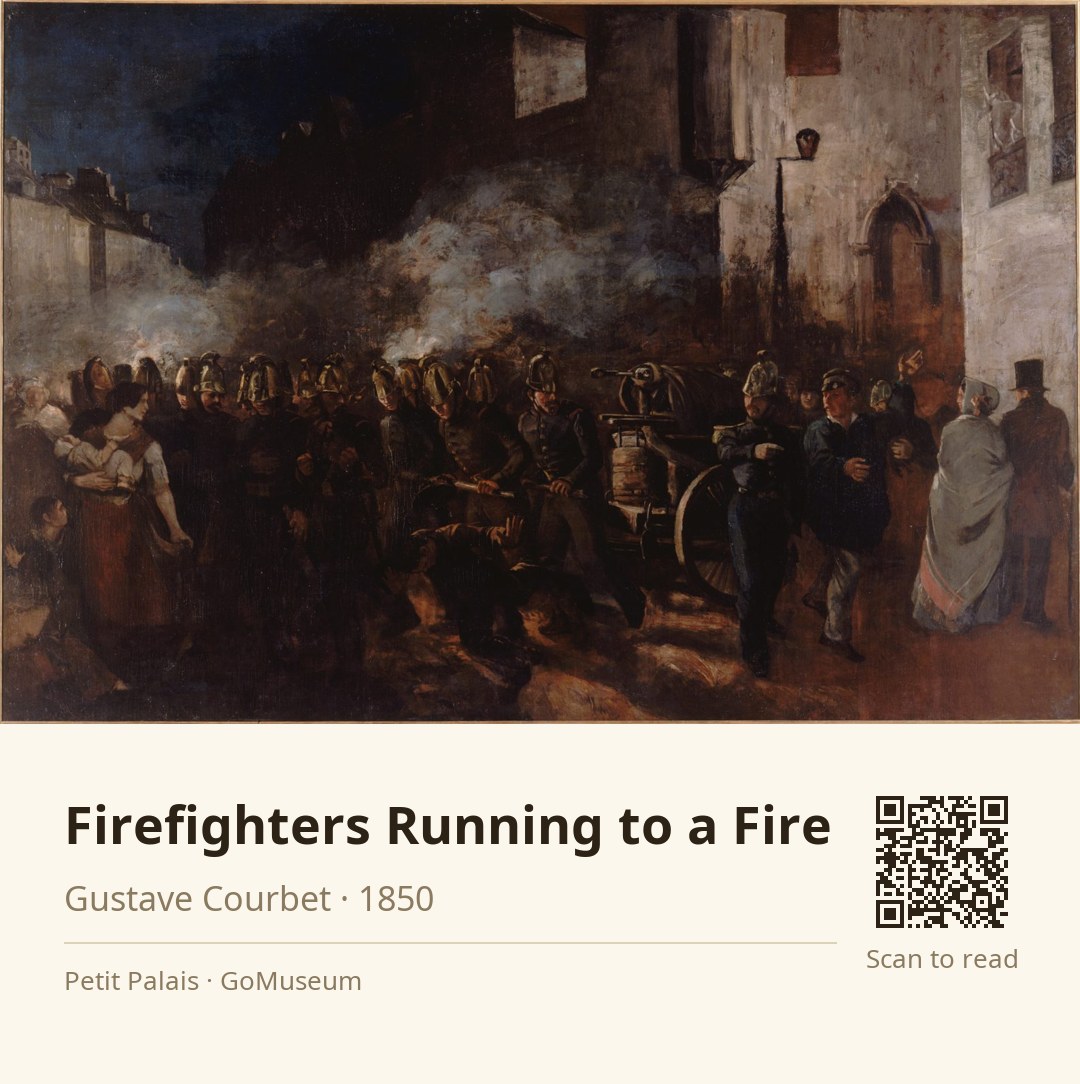
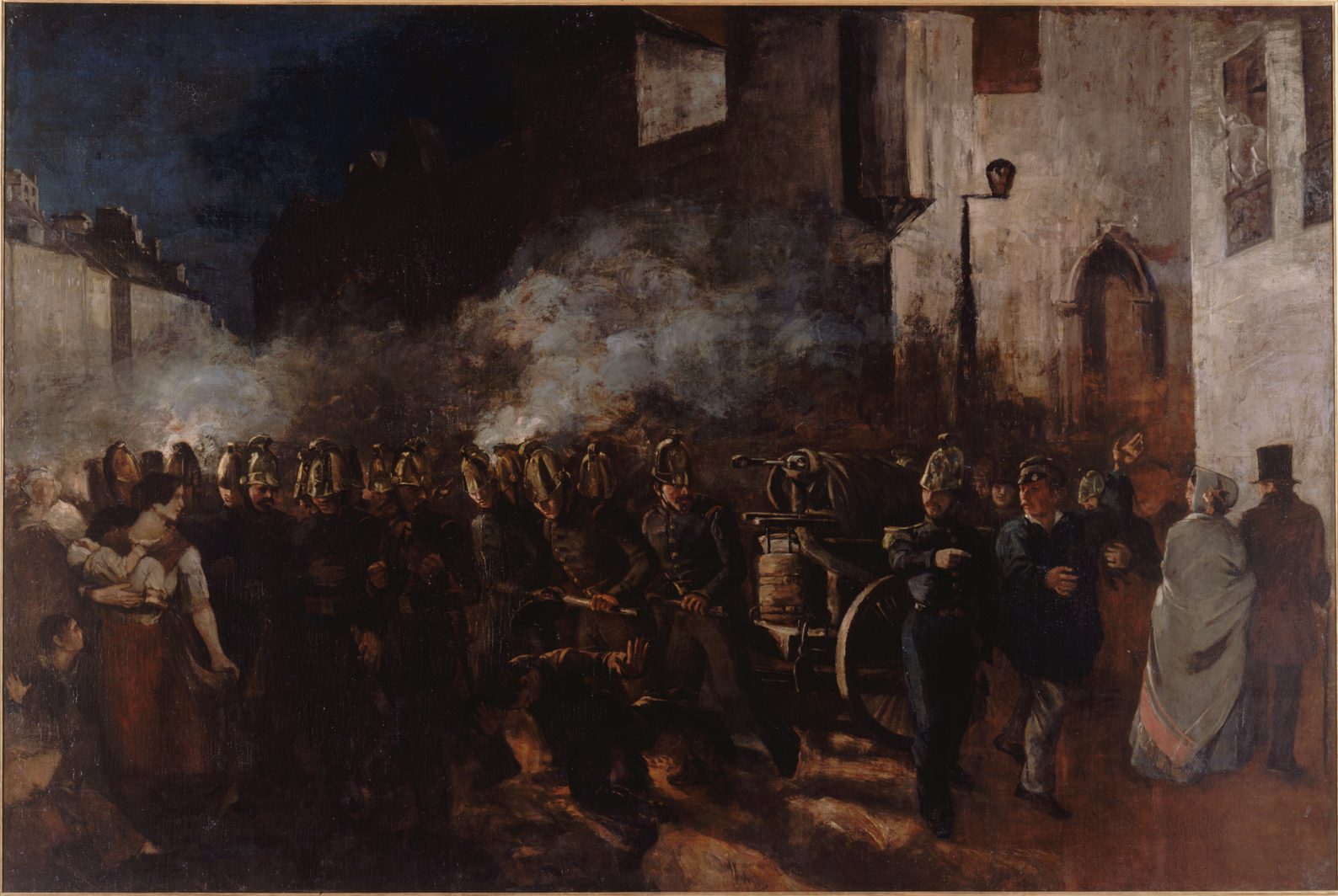
🎧 This work has audio narration — listen in the appThe firefighters in Gustave Courbet's "Firefighters Running to a Fire" are captured mid-stride, their dark uniforms and helmets stark against the smoky backdrop of a chaotic urban scene. The fire engine, partially visible, hints at the urgency of their mission, while a woman clutching two children to her side embodies the distress of the moment.
These figures are not merely characters in a dramatic tableau; they represent the very essence of human response to crisis, illustrating the bravery and community spirit that emerges in times of danger. The loose brushwork enhances the sense of movement and urgency, drawing you into the action as smoke billows ominously in the background. The dark palette, punctuated by highlights on the figures, evokes the tension of a night filled with uncertainty.
Created in 1850, this painting reflects Courbet's commitment to realism, a movement that sought to portray everyday life with honesty and immediacy. The work was left unfinished due to the political turmoil surrounding the artist, specifically the insurrection at the barracks where he was working, following the coup d'état of December 2, 1851.
Gustave Courbet, born on June 10, 1819, in Ornans, France, was a pioneering painter who championed the Realism movement in 19th-century art. Rejecting the conventions of academic painting and the idealism of Romanticism, he focused on depicting the world as he observed it, often portraying unidealized peasants and workers in monumental compositions. His early works gained recognition, notably "After Dinner at Ornans," which won him a gold medal at the Salon of 1849, allowing him to exhibit without jury approval.
Courbet's commitment to realism was revolutionary; he believed that art should stem from personal experience rather than historical or mythological themes. His bold approach often sparked controversy, challenging societal norms and addressing social issues, which resonated with later movements like Impressionism and Cubism. Despite facing criticism and imprisonment for his political involvement during the Paris Commune, Courbet continued to create until his death on December 31, 1877, in Switzerland.
His legacy endures as a transformative figure in art history, whose unflinching depictions of everyday life laid the groundwork for modern artistic expression. Today, Courbet is celebrated for his vigorous and uncompromising work, which continues to engage audiences with its raw honesty and depth.
Gustave Courbet's 'Firefighters Running to a Fire' was painted in 1850, during a tumultuous time in France marked by political upheaval. Commissioned in Poissy, near Paris, the work was left unfinished due to the insurrection at the barracks where Courbet was working, which followed the coup d'état of December 2, 1851. This chaos in the artist's life mirrored the urgency depicted in the painting itself. After Courbet's death in 1877, the artwork was discovered rolled up in his studio, a testament to its incomplete state. In 1882, it was gifted to the Petit Palais in Paris by his sister, Juliette, ensuring its preservation and public display. The painting was met with mixed reactions, typical of Courbet's work, which often challenged societal norms and artistic conventions.
The technique in 'Firefighters Running to a Fire' is a vivid display of Courbet's mastery of realism. The loose brushwork creates a dynamic sense of movement, as if the figures are leaping off the canvas in their rush to respond to the fire. The dark palette, dominated by deep blacks and browns, heightens the tension of the scene, while the strategic highlights on the firefighters' uniforms and the distressed woman draw your eye to the emotional core of the painting. Courbet's choice to depict this chaotic urban scene at night adds an element of drama, with the smoke swirling ominously in the background. The composition, with its horizontal format, captures the urgency of the moment, inviting viewers to feel the weight of the crisis unfolding before them.
Interestingly, Courbet's work was often controversial, and he faced significant backlash for his unidealized depictions of life. 'Firefighters Running to a Fire' was no exception; it was seen as a stark departure from the romanticized portrayals of heroism common in the art of his time. This painting, along with others, contributed to Courbet's reputation as an artist willing to confront societal issues head-on, even if it meant facing public scorn.
The painting remained unfinished because of the political unrest caused by an insurrection at the barracks where Courbet was working after the coup d'état in December 1851.
After Courbet's death, the painting was found rolled up in his studio and was later given to the Petit Palais in Paris by his sister, Juliette, in 1882.
Courbet selected a nighttime setting to enhance the drama of the scene, accentuated by the swirling smoke in the background.