Three Bathers
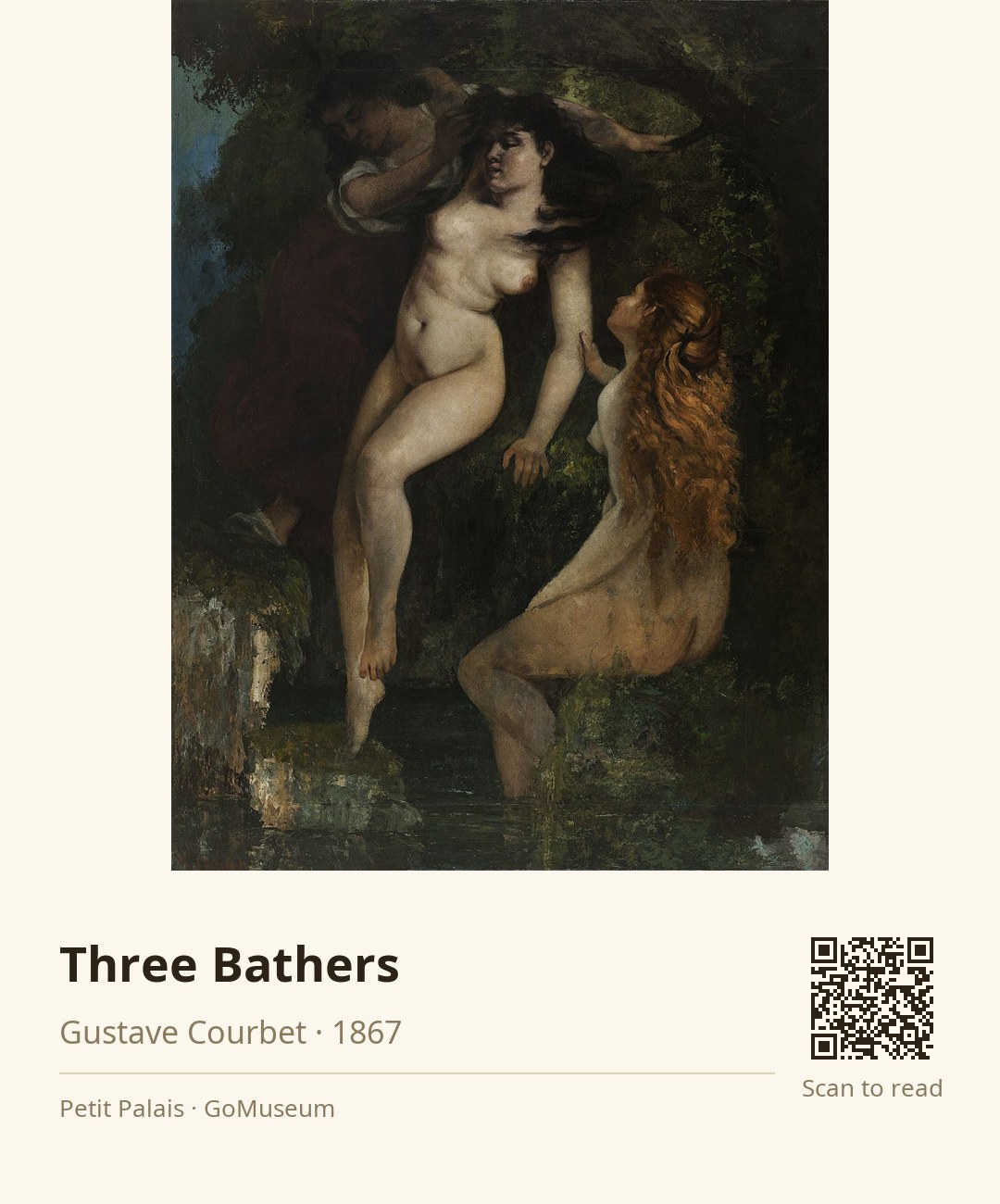
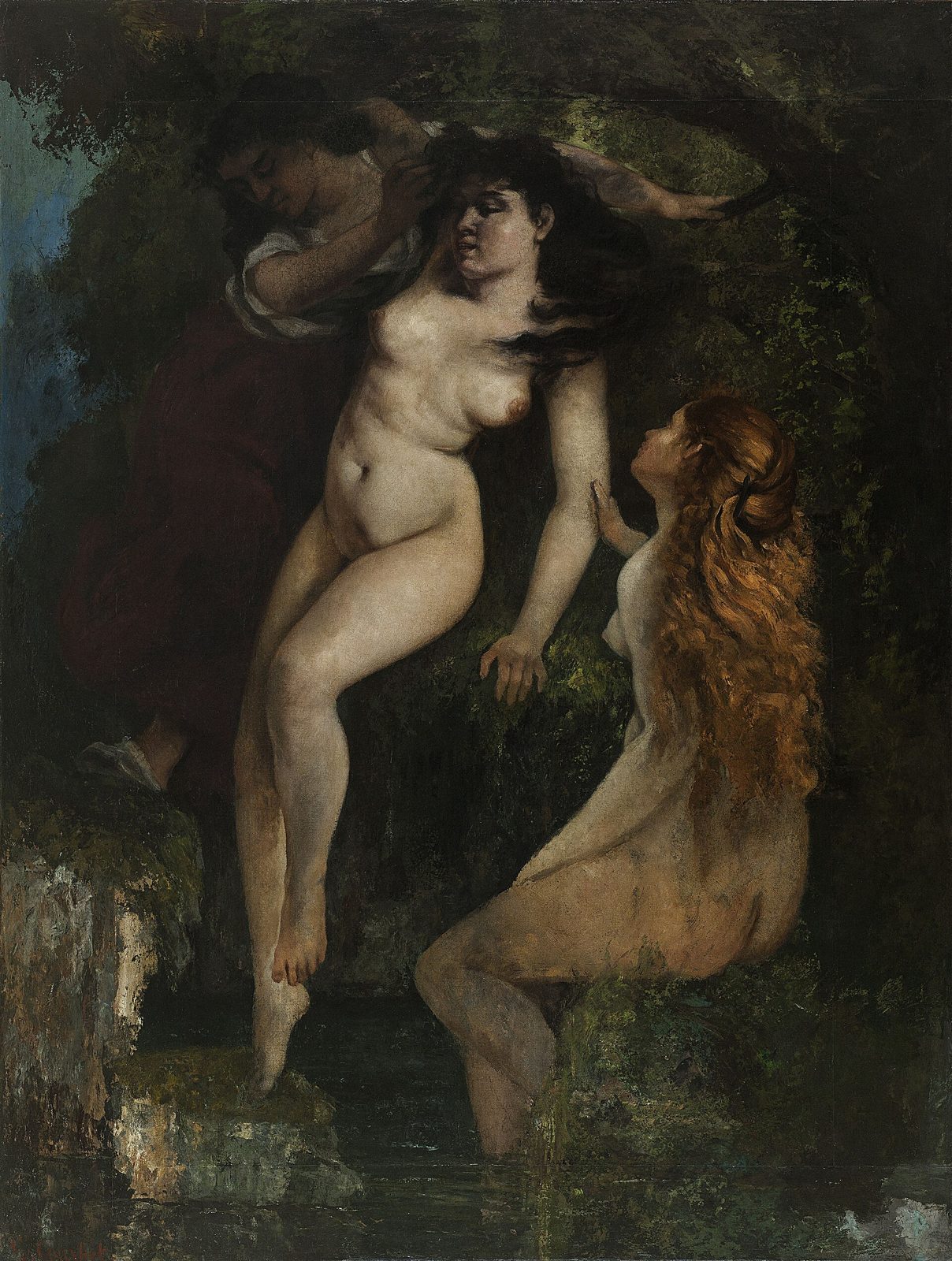
🎧 This work has audio narration — listen in the appThe three women in Gustave Courbet's "Three Bathers" are not just figures in a serene landscape; they embody a moment of intimacy and connection. The central figure, a nude woman with dark hair, reclines against a rock, her body partially submerged in water, eyes closed in a state of relaxation. To her left, another woman in a white blouse and red skirt gently touches her hair, while on the right, a third woman with flowing red hair gazes up at her, creating a sense of harmony among the figures.
This depiction of women in a natural setting reflects Courbet's commitment to realism, capturing not only the physical beauty of the human form but also the emotional bonds between the figures. The lush greenery surrounding them enhances the feeling of seclusion, suggesting a private moment away from the world. The earthy palette of deep greens and browns, combined with soft brushwork, invites viewers into this tranquil scene, emphasizing the gentle, almost dreamlike quality of their interaction.
Gustave Courbet, born on June 10, 1819, in Ornans, France, was a pioneering painter who championed the Realism movement in 19th-century art. Rejecting the conventions of academic painting and the idealism of Romanticism, he focused on depicting the world as he observed it, often portraying unidealized peasants and workers in monumental compositions. His early works gained recognition, notably "After Dinner at Ornans," which won him a gold medal at the Salon of 1849, allowing him to exhibit without jury approval.
Courbet's commitment to realism was revolutionary; he believed that art should stem from personal experience rather than historical or mythological themes. His bold approach often sparked controversy, challenging societal norms and addressing social issues, which resonated with later movements like Impressionism and Cubism. Despite facing criticism and imprisonment for his political involvement during the Paris Commune, Courbet continued to create until his death on December 31, 1877, in Switzerland.
His legacy endures as a transformative figure in art history, whose unflinching depictions of everyday life laid the groundwork for modern artistic expression. Today, Courbet is celebrated for his vigorous and uncompromising work, which continues to engage audiences with its raw honesty and depth.
The brushwork is soft and fluid, creating a sense of intimacy that draws viewers into the serene moment shared by the three women. The earthy palette of deep greens and browns not only captures the lush surroundings but also enhances the naturalism of the figures. Courbet's technique emphasizes the organic forms of the women, with the central figure reclining against a rock, her body partially submerged in water, suggesting a harmonious relationship between humanity and nature. The composition is vertical, drawing the eye upward and creating a sense of elevation in the figures' interaction. This approach reflects Courbet's desire to depict life as it is, unidealized and raw, capturing the essence of the moment with a directness that was revolutionary for its time.
Courbet's early influences included his sisters, Zoé, Zélie, and Juliette, who served as his first models for his drawings and paintings.
The painting was donated to the Petit Palais in Paris by Juliette Courbet, Gustave Courbet's relative, in 1909, which helped secure its place in art history.
A significant event in Courbet's life was his imprisonment for six months due to his involvement with the Paris Commune, after which he lived in exile in Switzerland until his death.