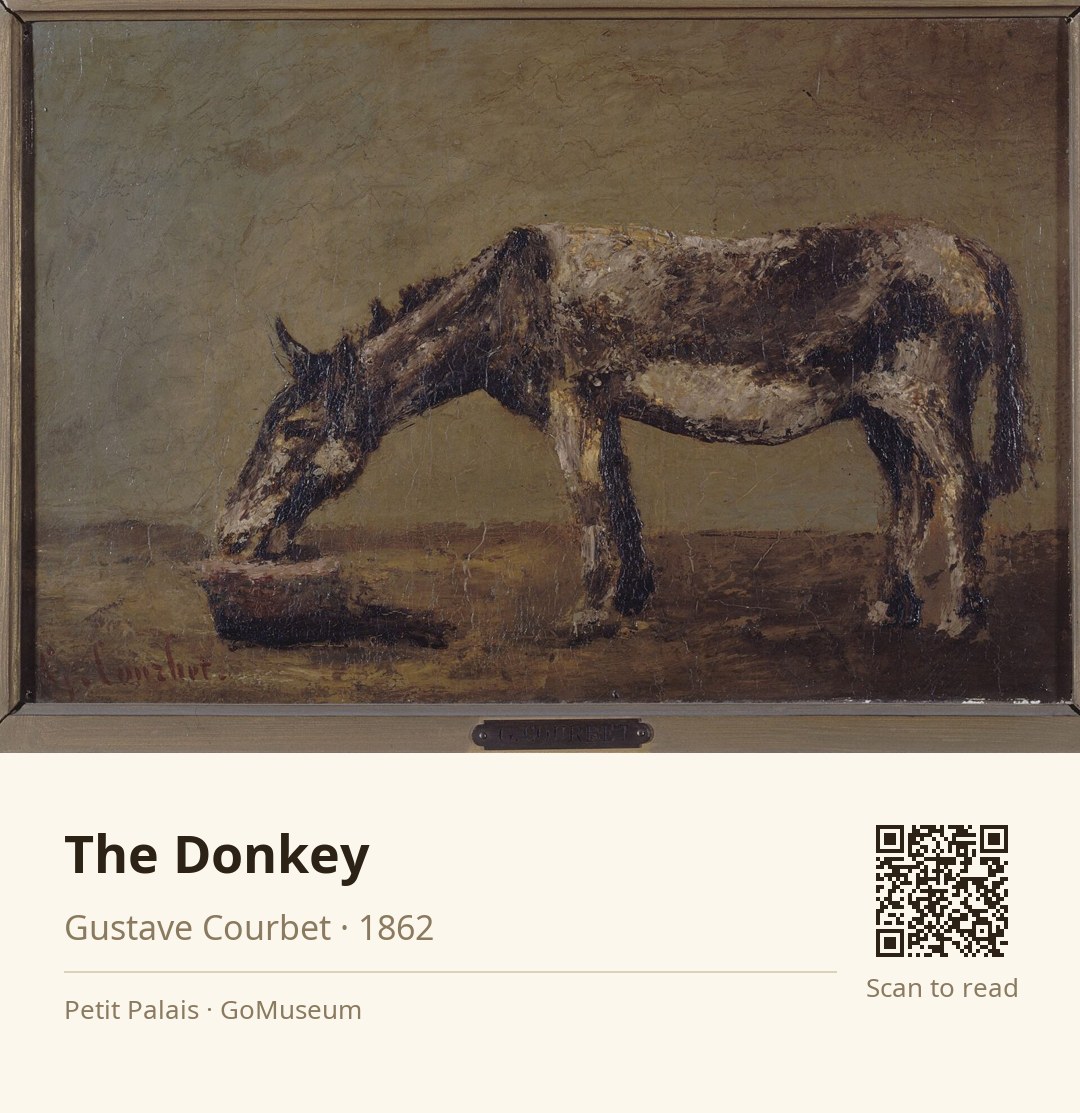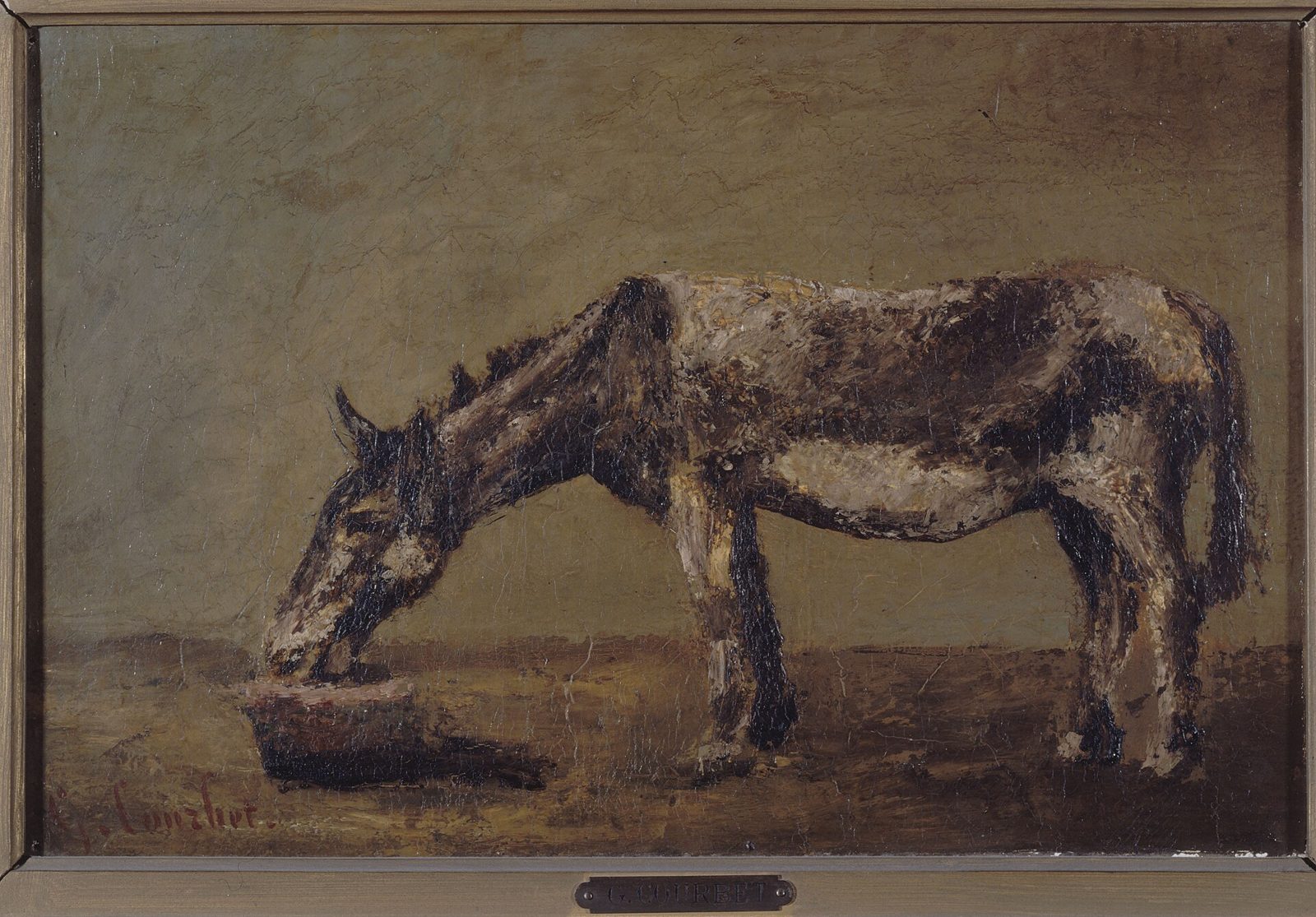
The donkey in Gustave Courbet's 1862 painting stands in profile, its head lowered to a trough, surrounded by a muted brown background that emphasizes its earthy tones of gray and brown. The visible brushstrokes on its coat create a textured appearance, while the rough surface beneath it suggests a simple, unrefined setting, focusing all attention on the animal itself.
This portrayal of the donkey reflects Courbet's commitment to realism, capturing the essence of everyday life without idealization. By choosing such a humble subject, he challenges the conventions of his time, which often favored grand historical or mythological themes. The straightforward composition strips away distractions, inviting viewers to engage with the raw, unembellished nature of the scene, a hallmark of Courbet's artistic philosophy.
Courbet, a leading figure in the Realism movement, sought to depict the world as he saw it, rejecting the romanticized visions of his predecessors. His work often addressed social issues, and through paintings like this, he highlighted the dignity of ordinary life. In 1871, he was imprisoned for his political involvement during the Paris Commune, a testament to his commitment to the values he portrayed in his art.
Gustave Courbet, born on June 10, 1819, in Ornans, France, was a pioneering painter who championed the Realism movement in 19th-century art. Rejecting the conventions of academic painting and the idealism of Romanticism, he focused on depicting the world as he observed it, often portraying unidealized peasants and workers in monumental compositions. His early works gained recognition, notably "After Dinner at Ornans," which won him a gold medal at the Salon of 1849, allowing him to exhibit without jury approval.
Courbet's commitment to realism was revolutionary; he believed that art should stem from personal experience rather than historical or mythological themes. His bold approach often sparked controversy, challenging societal norms and addressing social issues, which resonated with later movements like Impressionism and Cubism. Despite facing criticism and imprisonment for his political involvement during the Paris Commune, Courbet continued to create until his death on December 31, 1877, in Switzerland.
His legacy endures as a transformative figure in art history, whose unflinching depictions of everyday life laid the groundwork for modern artistic expression. Today, Courbet is celebrated for his vigorous and uncompromising work, which continues to engage audiences with its raw honesty and depth.
In 'The Donkey,' Courbet employs oil paint on canvas, a medium that allows for rich texture and depth. The visible brushstrokes create a tactile quality, making the donkey's fur appear almost three-dimensional. The earthy palette of browns and grays not only grounds the animal in its humble setting but also evokes a sense of authenticity and connection to the natural world. The composition is straightforward, with the donkey positioned in profile, drawing the viewer's focus directly to its form and expression. This simplicity is deliberate; by stripping away distractions, Courbet invites you to engage with the essence of the subject. The rough surface beneath the donkey further emphasizes its unrefined environment, reinforcing Courbet's philosophy of realism—capturing life as it is, without idealization.
Initially, Courbet was inspired by literary figures like Victor Hugo and George Sand, but he later shifted his focus to painting from real life rather than literary themes.
Courbet's first major success came in 1849 with 'After Dinner at Ornans', which earned him a gold medal at the Salon.