The Siesta During Haymaking Season
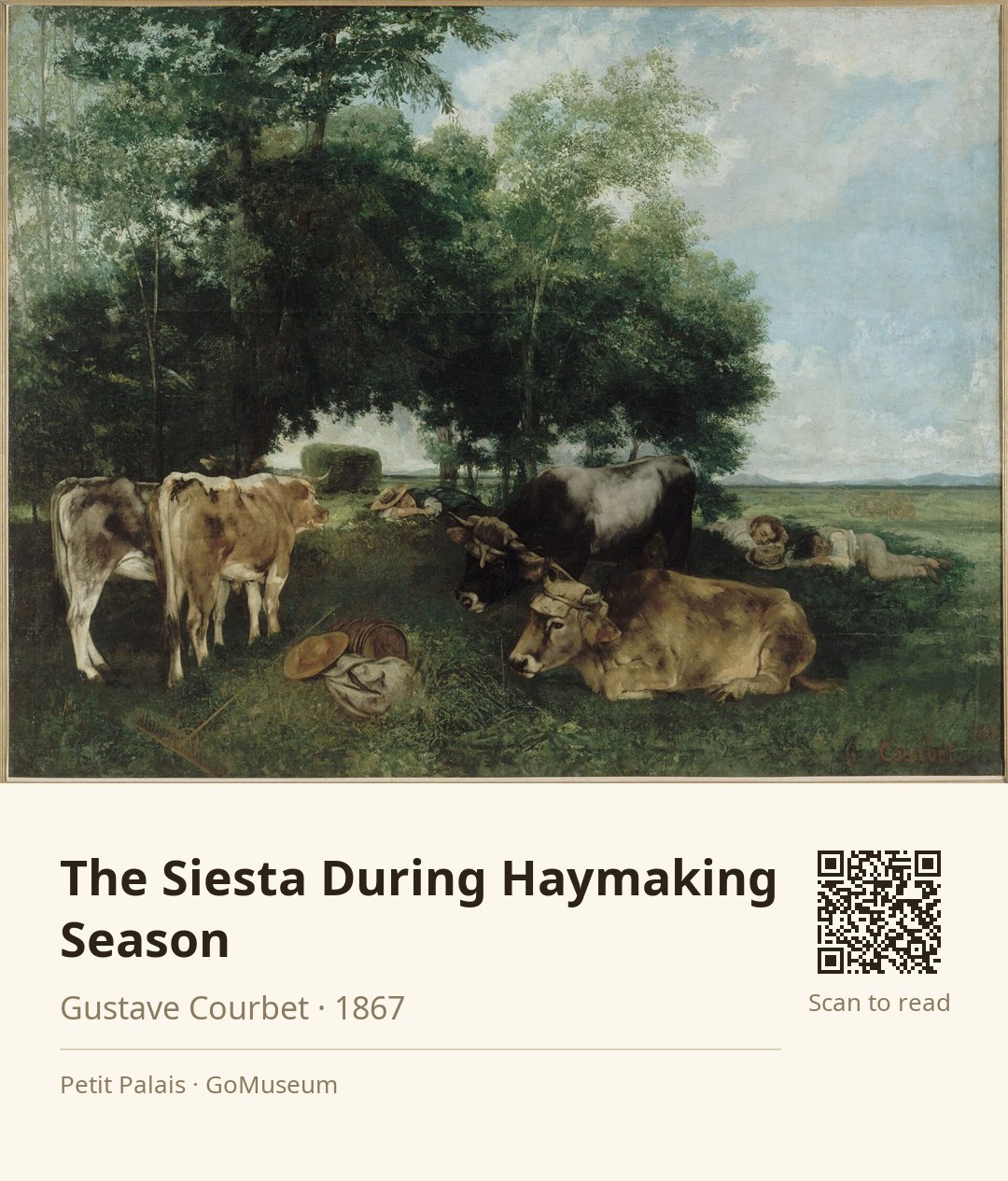
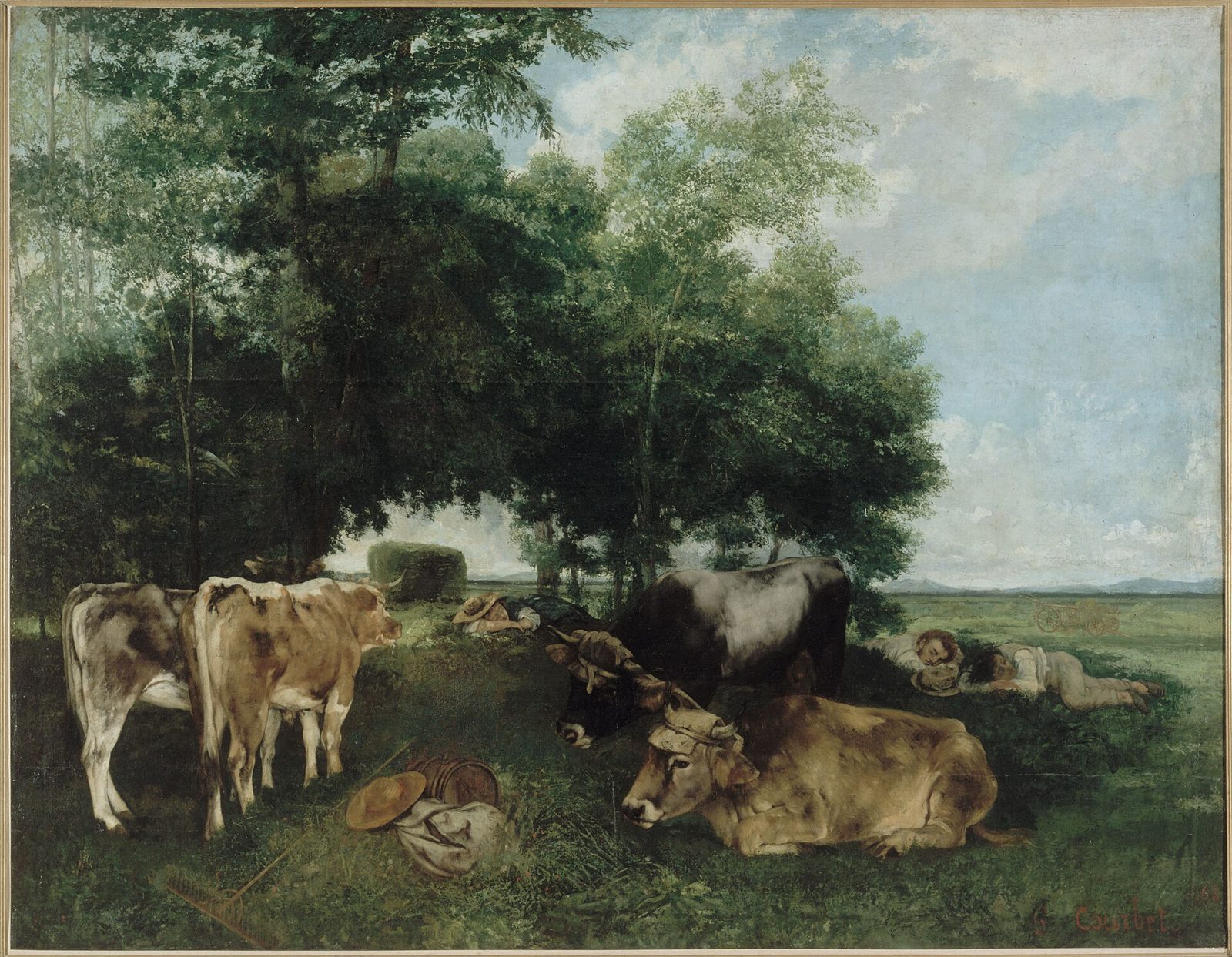
🎧 This work has audio narration — listen in the appA brown cow reclines in the lush green meadow of Gustave Courbet's "The Siesta During Haymaking Season," surrounded by two standing companions and a straw hat resting on the grass. The scene captures a moment of tranquility, with the distant horizon framed by dense trees and a bright blue sky dotted with clouds, evoking the peacefulness of rural life.
This serene depiction of cows and the human tools nearby hints at the labor of haymaking, a seasonal task that connects the figures to the land. Courbet's choice to focus on these humble subjects reflects his commitment to Realism, emphasizing the beauty found in everyday life rather than idealized or romanticized portrayals. The earthy palette and soft brushwork create a naturalistic atmosphere, inviting viewers to appreciate the simplicity and richness of the scene.
Courbet, a leading figure of the Realism movement in the 19th century, sought to portray life as it truly was, often challenging the conventions of his time. His works frequently depicted the lives of peasants and laborers, making bold statements about society and the human condition. In 1867, he created this painting, which stands as a testament to his dedication to capturing the essence of rural existence.
Gustave Courbet, born on June 10, 1819, in Ornans, France, was a pioneering painter who championed the Realism movement in 19th-century art. Rejecting the conventions of academic painting and the idealism of Romanticism, he focused on depicting the world as he observed it, often portraying unidealized peasants and workers in monumental compositions. His early works gained recognition, notably "After Dinner at Ornans," which won him a gold medal at the Salon of 1849, allowing him to exhibit without jury approval.
Courbet's commitment to realism was revolutionary; he believed that art should stem from personal experience rather than historical or mythological themes. His bold approach often sparked controversy, challenging societal norms and addressing social issues, which resonated with later movements like Impressionism and Cubism. Despite facing criticism and imprisonment for his political involvement during the Paris Commune, Courbet continued to create until his death on December 31, 1877, in Switzerland.
His legacy endures as a transformative figure in art history, whose unflinching depictions of everyday life laid the groundwork for modern artistic expression. Today, Courbet is celebrated for his vigorous and uncompromising work, which continues to engage audiences with its raw honesty and depth.
In "The Siesta During Haymaking Season," Courbet employs a technique that emphasizes the tactile quality of the natural world. The earthy palette of greens and browns is not just a choice of color but a deliberate strategy to evoke the richness of the rural landscape. His brushwork is soft yet assertive, creating a sense of depth and texture that draws you into the scene. The scale of the painting—over two meters tall—commands attention, making the viewer feel almost part of the meadow. Courbet's composition is carefully balanced, with the reclining cow in the foreground anchoring the scene while the standing cows and distant trees lead the eye towards the horizon. This arrangement not only captures the tranquility of the moment but also reflects the interconnectedness of the animals and their environment, reinforcing the theme of harmony in rural life.