Breton Woman with a Bouquet
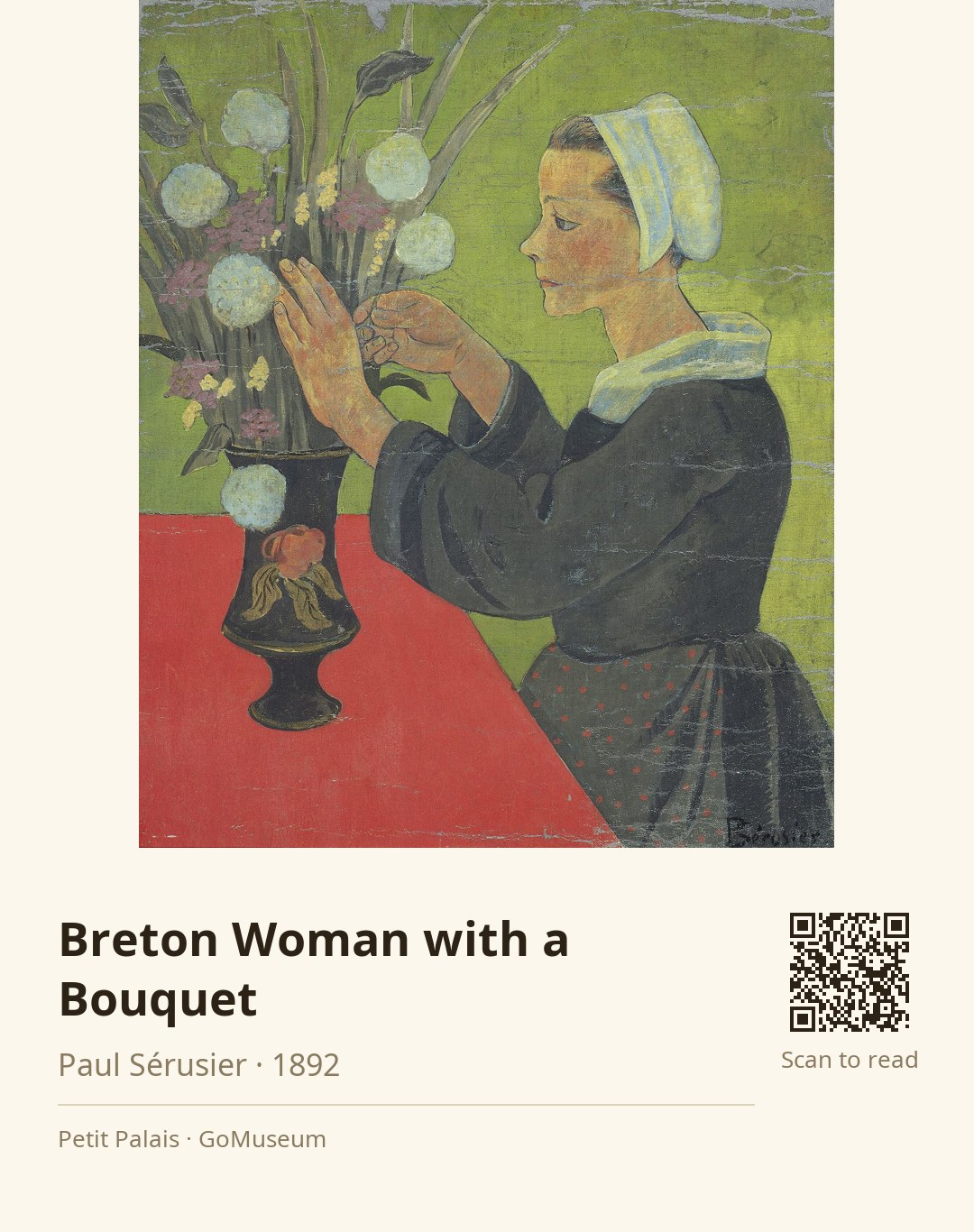
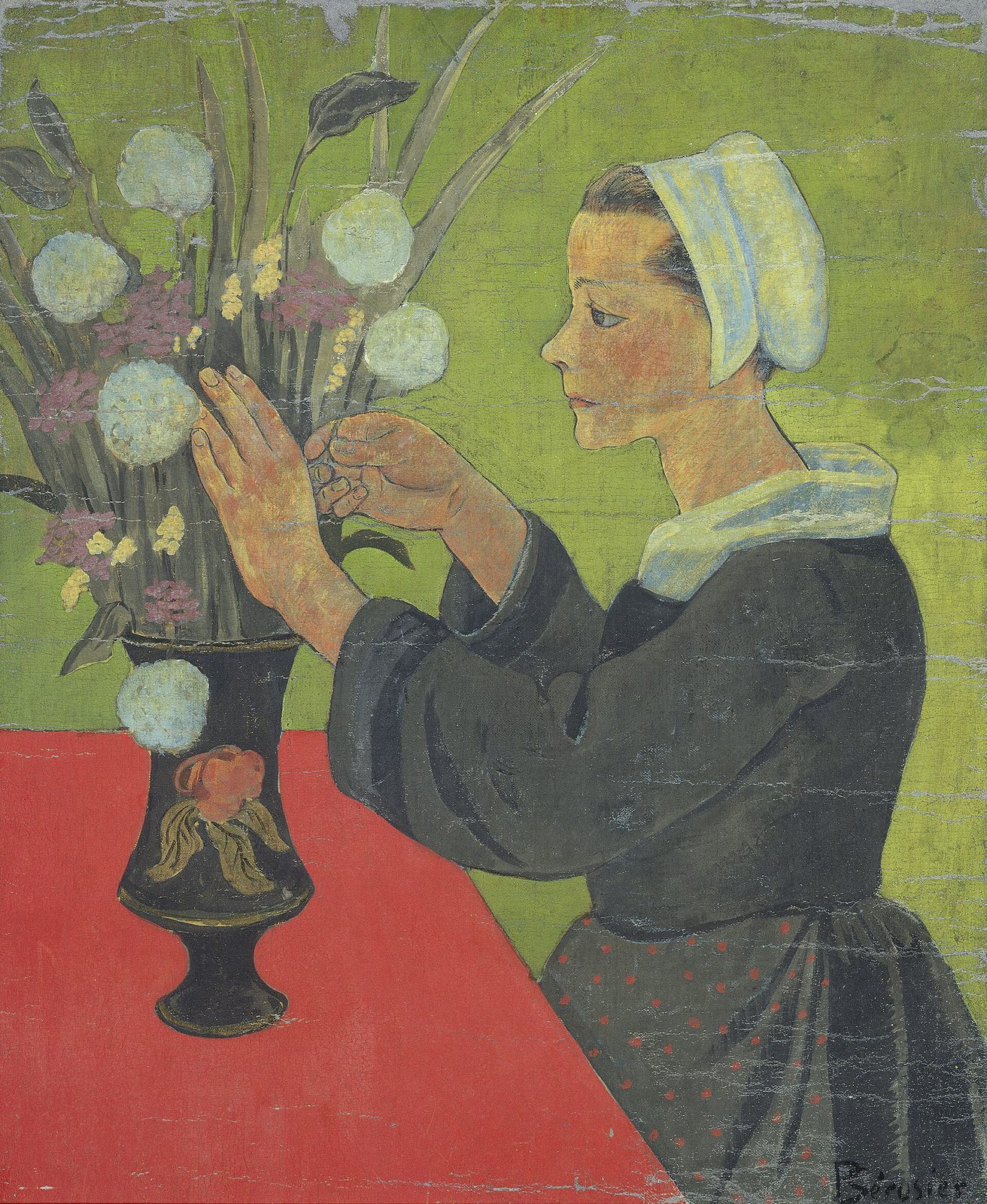
🎧 This work has audio narration — listen in the appThe woman in profile, dressed in a dark gown with a white collar and cap, delicately arranges a bouquet of flowers in a black vase. The vibrant white blooms contrast with the smaller pink and yellow flowers, while the red surface beneath the vase adds a striking pop of color against the muted green background. This simplicity in composition and palette reflects Sérusier's interest in capturing the essence of his subject rather than a detailed representation.
The calm expression on her face suggests a moment of focus and tranquility, inviting viewers to appreciate the quiet beauty of this everyday scene. By employing clear outlines and a limited color range, Sérusier creates a sense of harmony that resonates with the viewer, emphasizing the act of creation itself. This approach aligns with the principles of the Nabis movement, which sought to express emotional and symbolic content through simplified forms and colors.
Painted between 1892 and 1893, "Breton Woman with a Bouquet" showcases Sérusier's development as an artist during his time in Huelgoat, Brittany, where he immersed himself in local culture and landscapes.
Paul Sérusier was a French painter born on November 9, 1864, in Paris, who became a pivotal figure in the evolution of abstract art. A student at the Académie Julian, he was influenced by Paul Gauguin during his time at the Pont-Aven artist colony, where he created "The Talisman," a work that exemplified Cloisonnism and hinted at pure abstraction. Sérusier was a founding member of the Nabis group, which sought to express deeper meanings through color and form, moving beyond mere representation. His character was marked by a friendly disposition and a collaborative spirit, fostering connections with fellow artists like Pierre Bonnard and Édouard Vuillard.
Throughout his career, Sérusier engaged in teaching and writing, publishing "ABC de la peinture" in 1921, which reflected his artistic philosophy. He spent his later years in Brittany, where he continued to explore themes of spirituality and symbolism in his work. Sérusier's contributions to the Nabis movement and his innovative approaches to color and composition solidified his place in art history as a precursor to modern abstraction, influencing generations of artists who followed. He passed away on October 7, 1927, leaving behind a legacy that bridged the gap between Impressionism and the avant-garde.
In 'Breton Woman with a Bouquet,' Sérusier employs a technique that merges simplicity with emotional depth. The brushwork is deliberate and clear, creating defined outlines that lend a sense of structure to the composition. The limited color palette, dominated by muted greens and vibrant whites, enhances the focus on the subject while evoking a serene atmosphere. The red surface beneath the vase acts as a striking contrast, drawing the eye and grounding the composition. Sérusier's choice to depict the woman in profile adds a layer of intimacy, inviting viewers to share in her quiet moment of creation. This approach reflects the Nabis' interest in conveying emotional and symbolic content rather than mere visual accuracy, showcasing Sérusier's mastery of color and form.
During his time in France, Sérusier met and became friends with Scottish artist Charles Hodge Mackie.
The painting was gifted to the Petit Palais in Paris by Marguerite Sérusier in 1948.
The woman's profile creates a sense of intimacy, inviting viewers to engage with her quiet moment of creation.