Naples, Pins Parasols
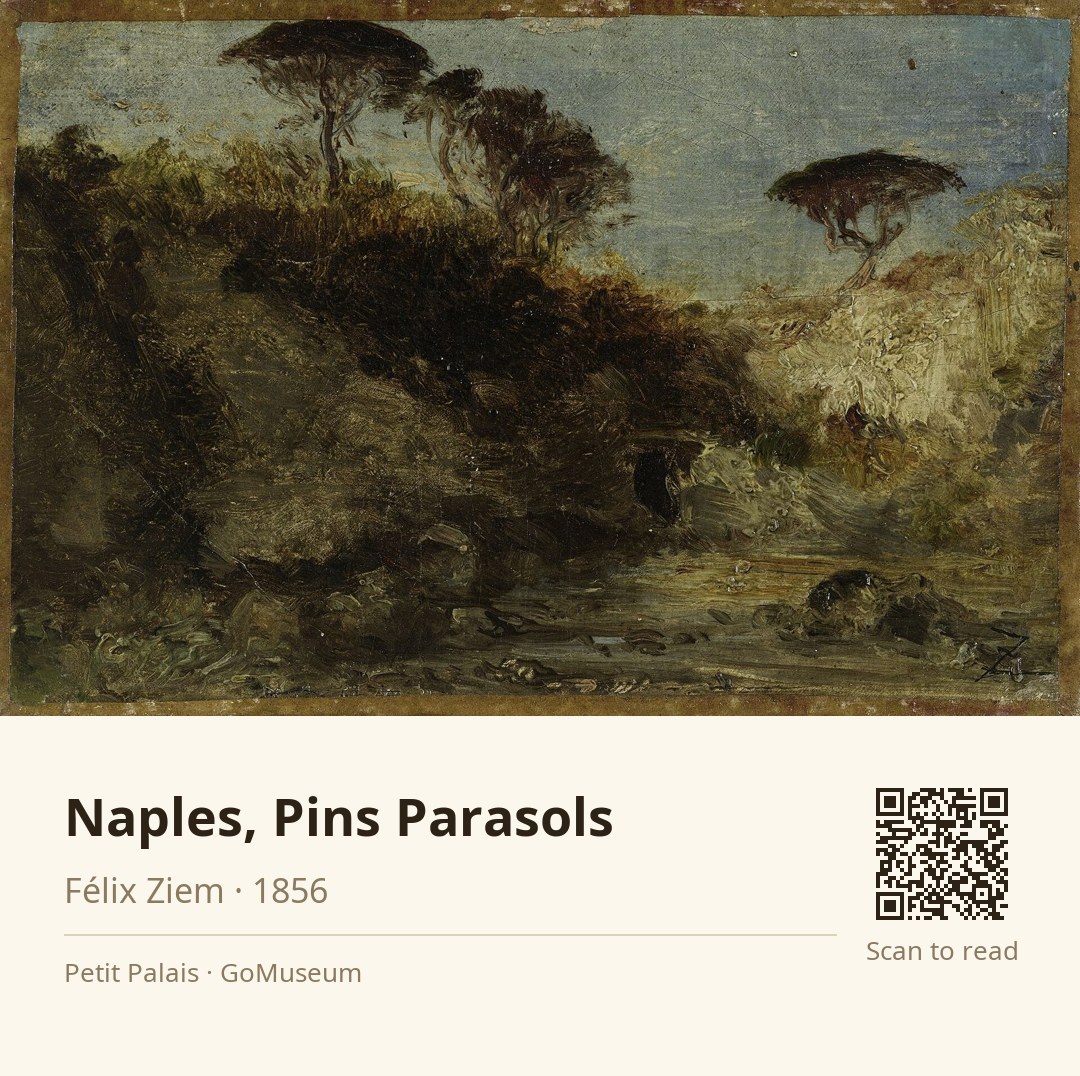
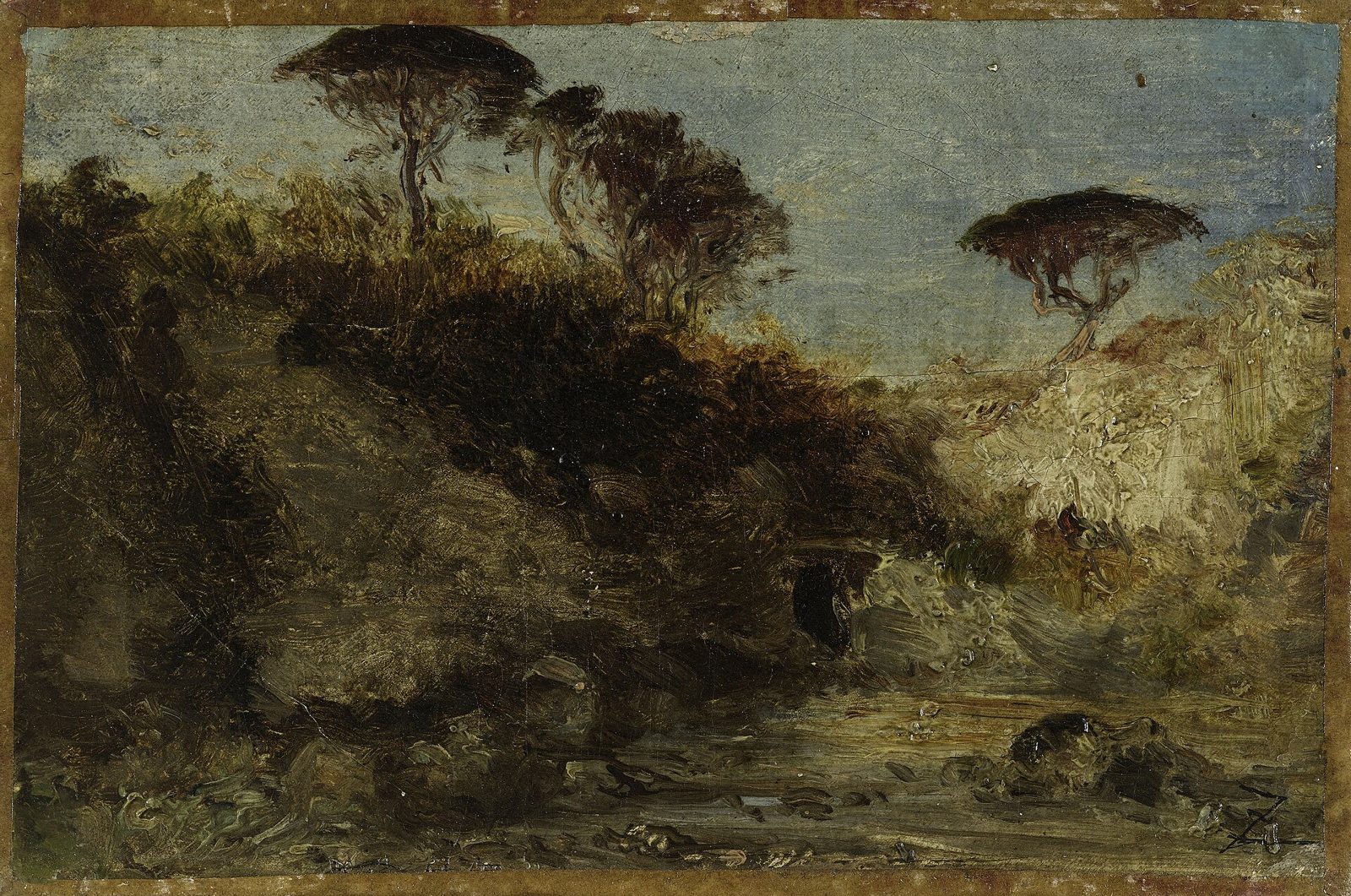
🎧 This work has audio narration — listen in the appThe rugged path winding through dense foliage in Félix Ziem's 1856 painting invites you into a hidden world, where a small figure is almost swallowed by the surrounding greenery. The uneven, rocky ground in the foreground, paired with the tall, windswept trees against a pale blue sky, creates a sense of both isolation and adventure, as if you're about to embark on a journey through this natural landscape.
Ziem's loose, textured brushwork captures the movement of the scene, making the earthy browns and muted greens feel alive, while the distant trees draw your eye further into the composition. This painting reflects Ziem's deep connection to nature, a theme prevalent in his work, which often showcases the beauty of diverse landscapes he encountered during his travels. His experiences in Italy and beyond shaped his artistic vision, allowing him to blend realism with a touch of romanticism.
Born in 1821, Ziem was influenced by the Barbizon School, yet he also ventured into Orientalism later in his career. His landscapes, including this one, reveal his fascination with the interplay of light and nature, a hallmark of his artistic style. In 1856, Ziem was at the height of his creative journey, capturing the essence of the places he loved most.
Félix Ziem, born on February 26, 1821, in Beaune, France, was a prominent painter associated with the Barbizon School and known for his captivating landscapes and Orientalist themes. Initially aspiring to be an architect, Ziem shifted his focus to painting after a transformative trip to Italy in 1841, where he fell in love with Venice, a city that would inspire much of his work. His artistic journey was marked by extensive travel, including a significant expedition to the Ottoman Empire and Egypt, which broadened his subject matter to include exotic scenes.
Ziem's career flourished after his first exhibition at the Paris Salon in 1849, where he showcased his views of the Bosphorus and Venetian canals. He became a fixture in the Paris art scene, moving to Montmartre in 1860, where he enjoyed financial success and was known for supporting young artists. His contributions to art were recognized with the Chevalier of the Legion of Honor in 1857 and later as an officer in 1878.
Ziem's legacy lies in his ability to blend the influences of the Barbizon School with his unique interpretations of light and color, paving the way for future movements like Impressionism. He passed away on November 10, 1911, leaving behind a rich body of work that continues to resonate in the art world today.
In 'Naples, pins parasols; La grotte de Pausilippe,' Ziem employs a loose, textured brushwork that breathes life into the rugged landscape. The uneven, rocky foreground is painted with earthy browns and dark greens, creating a tactile quality that invites you to feel the terrain beneath your feet. The small figure, partially obscured by the dense foliage, adds a sense of scale and mystery, drawing your eye deeper into the scene. The distant trees, swaying against a pale blue sky, are rendered with a fluidity that suggests movement, as if the landscape itself is alive.
Yes, he was commercially successful and recognized for his contributions to the art world while he was still alive.