Sketch for the Staircase of Festivities of the City Hall of Paris: August
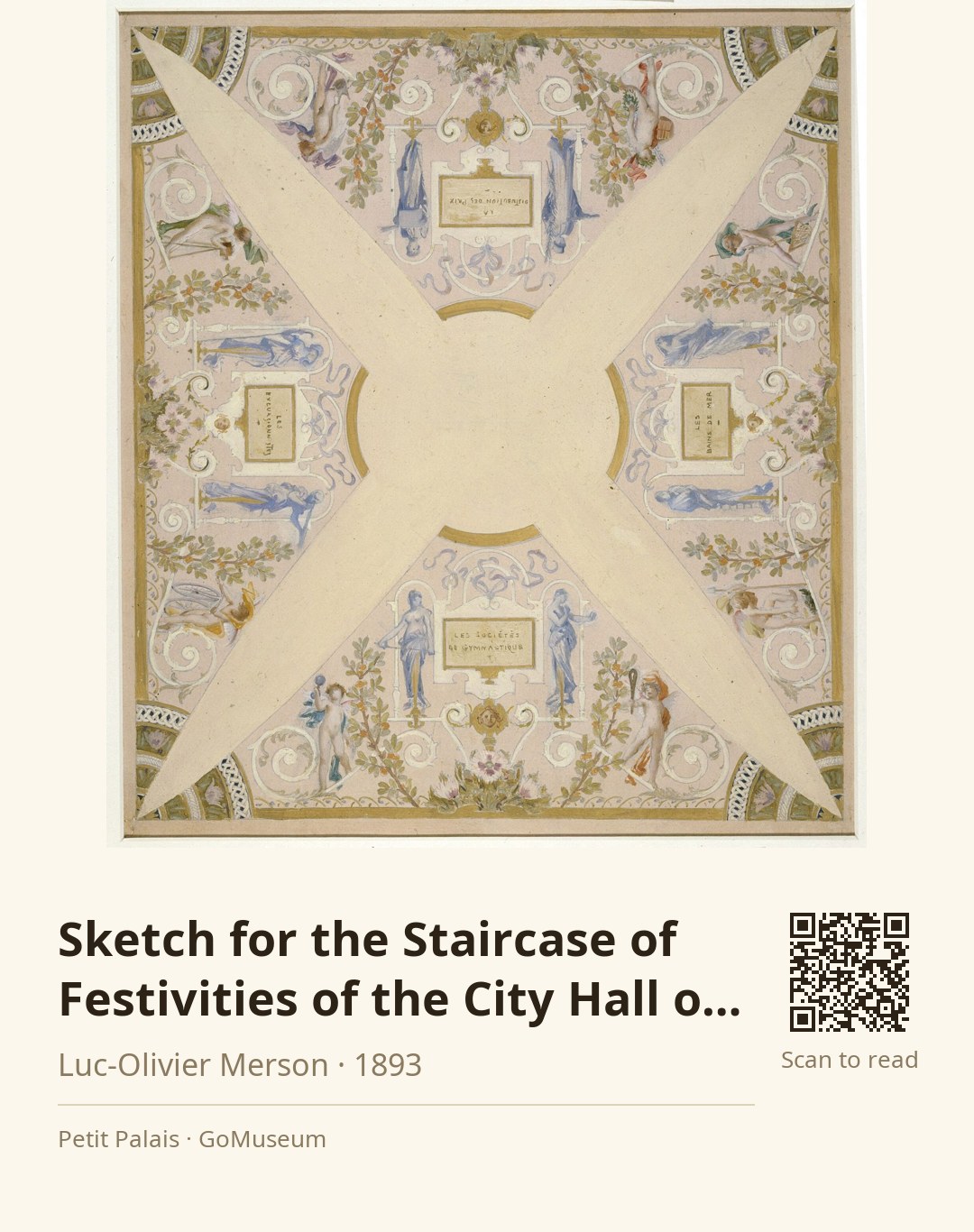
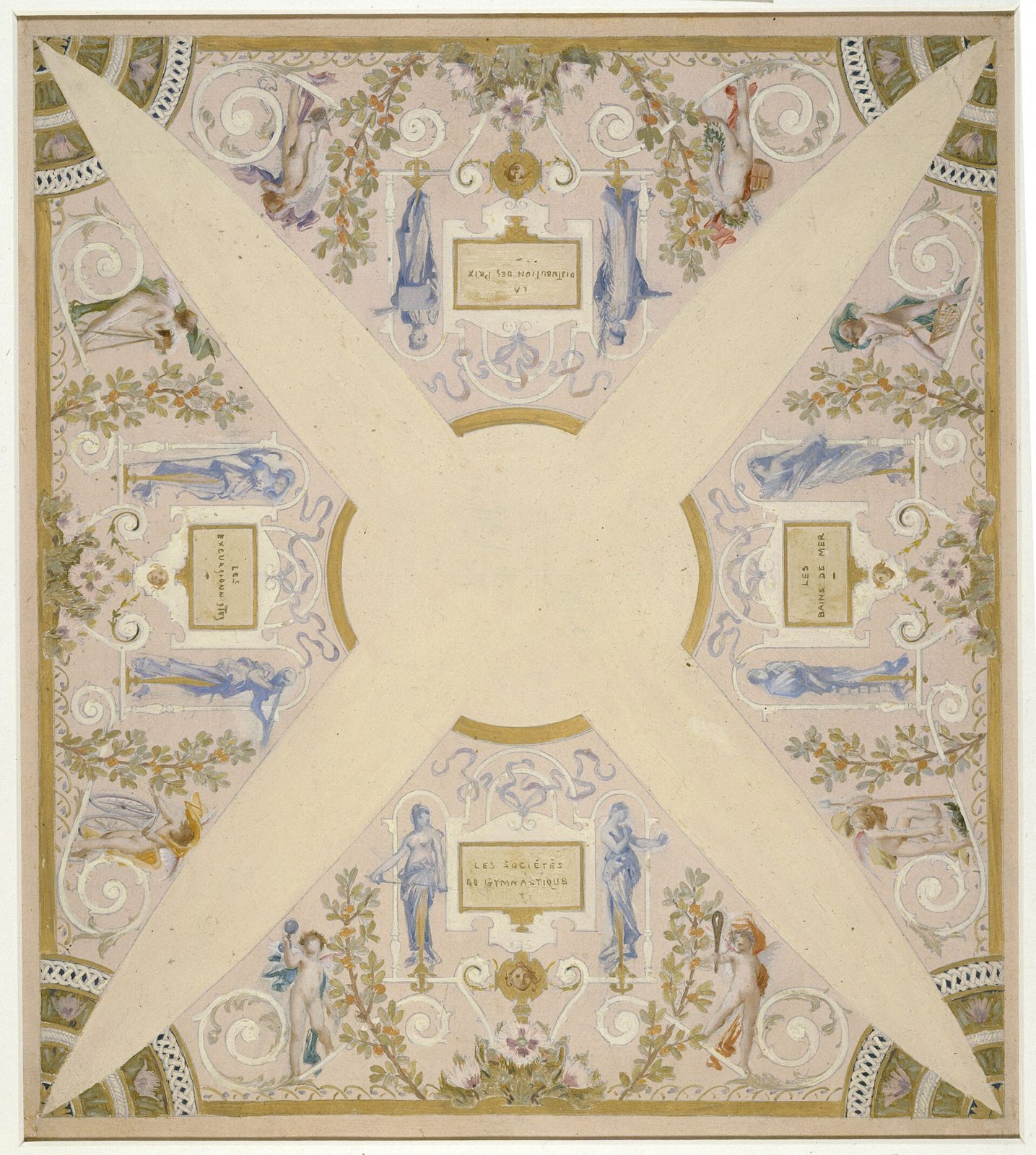
🎧 This work has audio narration — listen in the appThe central circular area of this decorative ceiling design draws the eye, surrounded by four triangular sections that extend outward like rays of light. Each triangle features classical figures, possibly deities or muses, rendered in soft blue tones, while intricate floral motifs and scrollwork in pastel pinks and greens create a harmonious backdrop. The inscriptions in rectangular panels, including "LES SOCIÉTÉS DE GYMNASTIQUE" and "DANSE ET PAR," hint at a celebration of culture and community, emphasizing the artwork's role in the festive atmosphere of the Hôtel de Ville de Paris.
Merson's choice of soft colors and delicate brushwork enhances the elegance of the classical theme, inviting viewers to appreciate the beauty of the figures and the intricate details surrounding them. This piece, created in 1893, serves as an esquisse, or sketch, for a larger decorative project at the Paris City Hall, showcasing Merson's skill in blending classical imagery with contemporary themes of his time. His background as an academic painter and illustrator is evident in the meticulous execution and thoughtful composition, reflecting his training at the École des Beaux-Arts and his experience with major decorative commissions.
In addition to this work, Merson was known for his contributions to religious and historical subjects, as well as for designing postage stamps and banknotes. His artistic journey included significant recognition, such as the gold medal at the 1889 Exposition Universelle and his election to the Académie des beaux-arts in 1892.
Nicolas Luc-Olivier Merson, born in Paris on May 21, 1846, was a prominent French academic painter and illustrator, known for his religious and historical works. Growing up in an artistic family, he was influenced by his father, a painter and critic. Merson studied at the École des Beaux-Arts, where he honed his skills under notable mentors. His career took off after winning the Prix de Rome in 1869, leading to five years in Italy that deepened his focus on spiritual themes.
Merson's notable works include "Notre-Dame de Paris," inspired by Victor Hugo's novel, showcasing his connection to the Symbolist movement. He received numerous accolades, including a gold medal at the 1889 Exposition Universelle and election to the Académie des beaux-arts in 1892. His contributions extended beyond painting; he designed postage stamps and banknotes, influencing French currency design.
Despite his achievements, Merson's legacy faded as avant-garde movements gained prominence. He passed away on November 13, 1920, in Paris, largely forgotten. Posthumously elevated to Commander of the Legion of Honor, Merson's impact on art and design remains significant, with a legacy that includes mentoring future artists.
Luc-Olivier Merson's painting, created in 1893, was commissioned as an esquisse, or sketch, for a grand decorative project at the Hôtel de Ville de Paris. This work was part of a larger artistic endeavor to adorn the city hall, celebrating Parisian culture and community. Merson, who had already gained recognition for his historical and religious subjects, was well-versed in the academic style, having trained at the École des Beaux-Arts. His earlier accolades, including the gold medal at the 1889 Exposition Universelle and his election to the Académie des beaux-arts in 1892, positioned him as a significant figure in the art world.
This painting showcases Merson's mastery of oil paint, evident in the delicate brushwork that brings the figures and floral motifs to life. The soft blue tones of the classical figures contrast beautifully with the pastel pinks and greens of the surrounding scrollwork, creating a sense of harmony. Merson's choice of a symmetrical composition, with a central circular area flanked by triangular sections, draws the eye inward, inviting viewers to explore the intricate details. The inscriptions, carefully integrated into the design, add an element of narrative, enhancing the overall impact. The scale of the work, while modest at 34.5 cm by 31.5 cm, allows for an intimate engagement with the viewer, making the elegance of the classical theme feel accessible and inviting.
Merson was among the first artists to purchase photographs from Eugène Atget, indicating an early appreciation for photography as an art form.
Before creating this artwork, Merson achieved notable milestones including winning a gold medal at the 1889 Exposition Universelle and being elected to the Académie des beaux-arts in 1892.