 Image: Paris Musées / Petit Palais, musée des Beaux-Arts de la Ville de Paris
Modern Times: Sciences, Letters, Arts
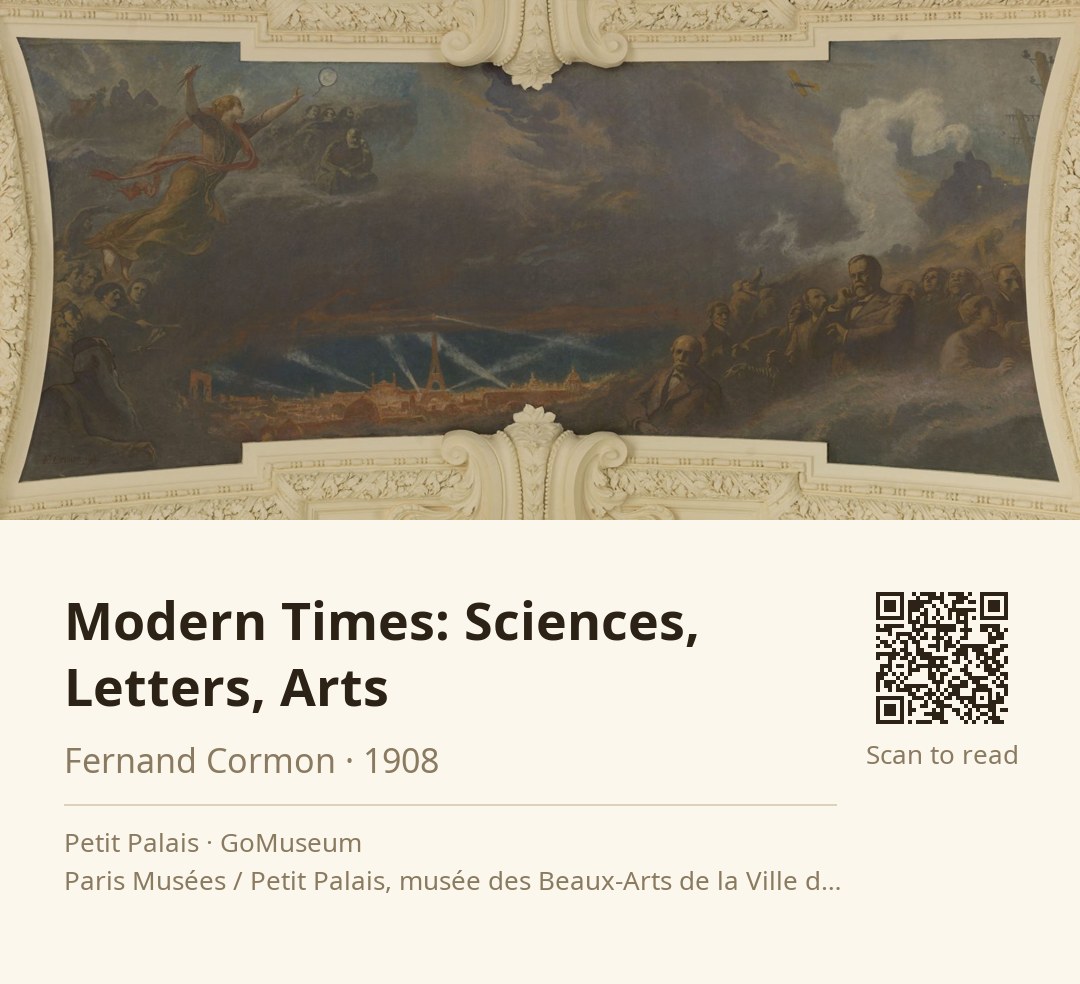
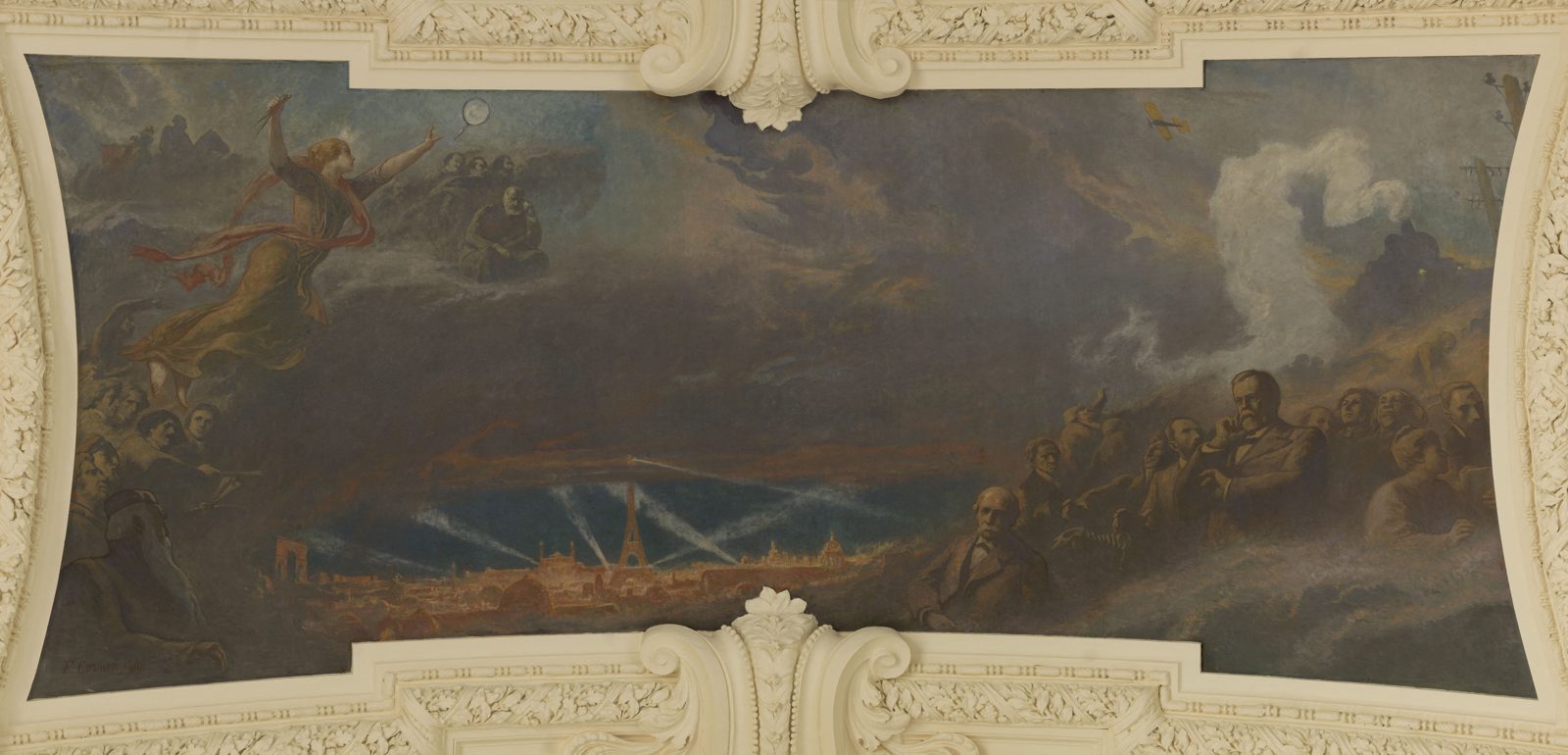
🎧 This work has audio narration — listen in the appThe central figure in Fernand Cormon's 1908 painting soars above a cityscape, her flowing garments suggesting a sense of freedom and transcendence. Below her, a group of men gazes upward, some gesturing as if in awe, while a small airplane cuts through the swirling clouds above, hinting at the modernity of the early 20th century.
This juxtaposition of the ethereal and the earthly captures a moment of aspiration, reflecting the societal shifts of the time as technology and urban life began to redefine human experience. The prominent tower, reminiscent of the Eiffel Tower, anchors the scene in Paris, a city undergoing rapid transformation and symbolizing progress. Cormon's use of dark blues and muted reds enhances the dramatic atmosphere, evoking both the weight of tradition and the thrill of innovation.
Cormon, a prominent historical painter and teacher, was known for his ability to blend classical techniques with contemporary themes, and this work exemplifies his engagement with the changing world around him. In 1908, he created a piece that not only reflects his artistic vision but also resonates with the spirit of an era marked by both hope and uncertainty.
Fernand Cormon was a prominent French painter born in Paris on December 24, 1845. He was the son of playwright Eugène Cormon and actress Charlotte Furais. Cormon studied under notable artists such as Alexandre Cabanel and Eugène Fromentin, quickly gaining recognition for his historical scenes marked by dramatic intensity, exemplified in works like "Murder in the Seraglio" and "Death of Ravana." His artistic journey included a significant focus on themes of violence and mortality, as seen in his grisaille panels for the Mairie of Paris.
In 1880, he was honored with the Legion of Honor, reflecting his status in the art community. Cormon also established the Atelier Cormon, an influential art school in the 1880s, where he mentored many future luminaries, including Vincent van Gogh and Henri de Toulouse-Lautrec. Despite his contributions to the art world, he is often overshadowed by his more famous students.
Cormon's later works included portraits and large-scale historical paintings, yet he remained committed to academic styles throughout his career. He passed away on March 20, 1924, after being struck by a taxi, leaving behind a legacy that is largely remembered through the achievements of his students rather than his own.
Cormon's technique in this painting is striking, showcasing his mastery of brushwork and color. The dynamic movement of the central figure, seemingly floating above the city, is achieved through fluid strokes that convey both grace and power. The dark blues and muted reds create a dramatic tension, enhancing the emotional weight of the scene. Cormon's choice to depict the figures below in a more subdued palette contrasts sharply with the vibrancy of the central figure, drawing the viewer's eye upward. The composition is carefully balanced, with the prominent tower anchoring the cityscape while the swirling clouds add a sense of motion, suggesting the rapid changes of the early 20th century. This interplay of color and form not only captivates but also evokes the aspirations of a society on the brink of modernity.
One surprising anecdote about Fernand Cormon is that despite his own successful career, he is often remembered more for the illustrious artists he taught rather than for his own works. His art school, Atelier Cormon, was a melting pot of talent, where future art legends like Vincent van Gogh and Toulouse-Lautrec honed their skills. This paradox highlights how sometimes, the influence of a teacher can overshadow their own artistic achievements.
Cormon is often more recognized for the famous artists he taught, such as Vincent van Gogh and Toulouse-Lautrec, than for his own artistic achievements.
Fernand Cormon was the son of Eugène Cormon, a playwright, and Charlotte Furais, an actress.
Fernand Cormon died in 1924 after being run over by a taxi outside his studio.