Portrait of Zélie Courbet
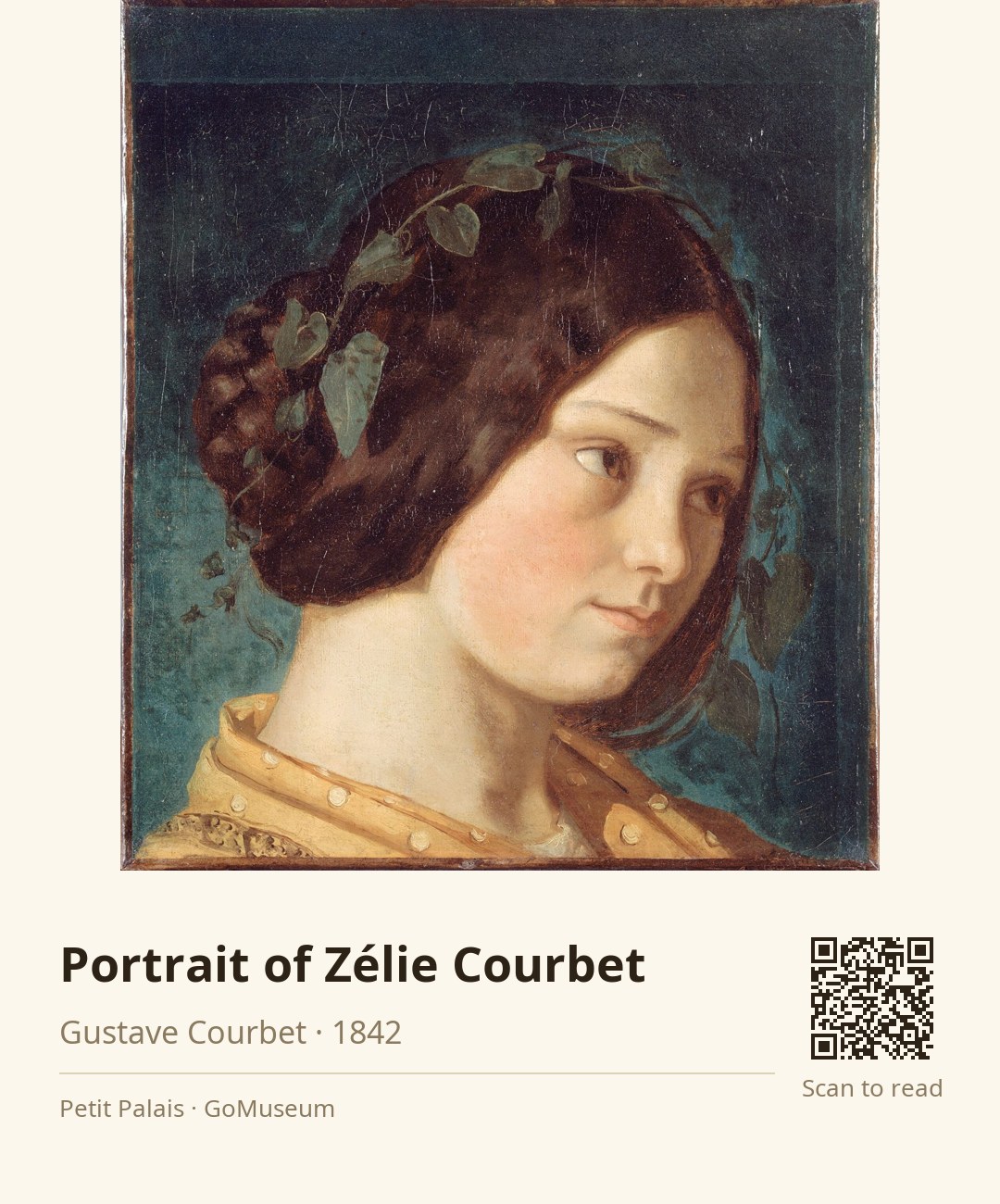
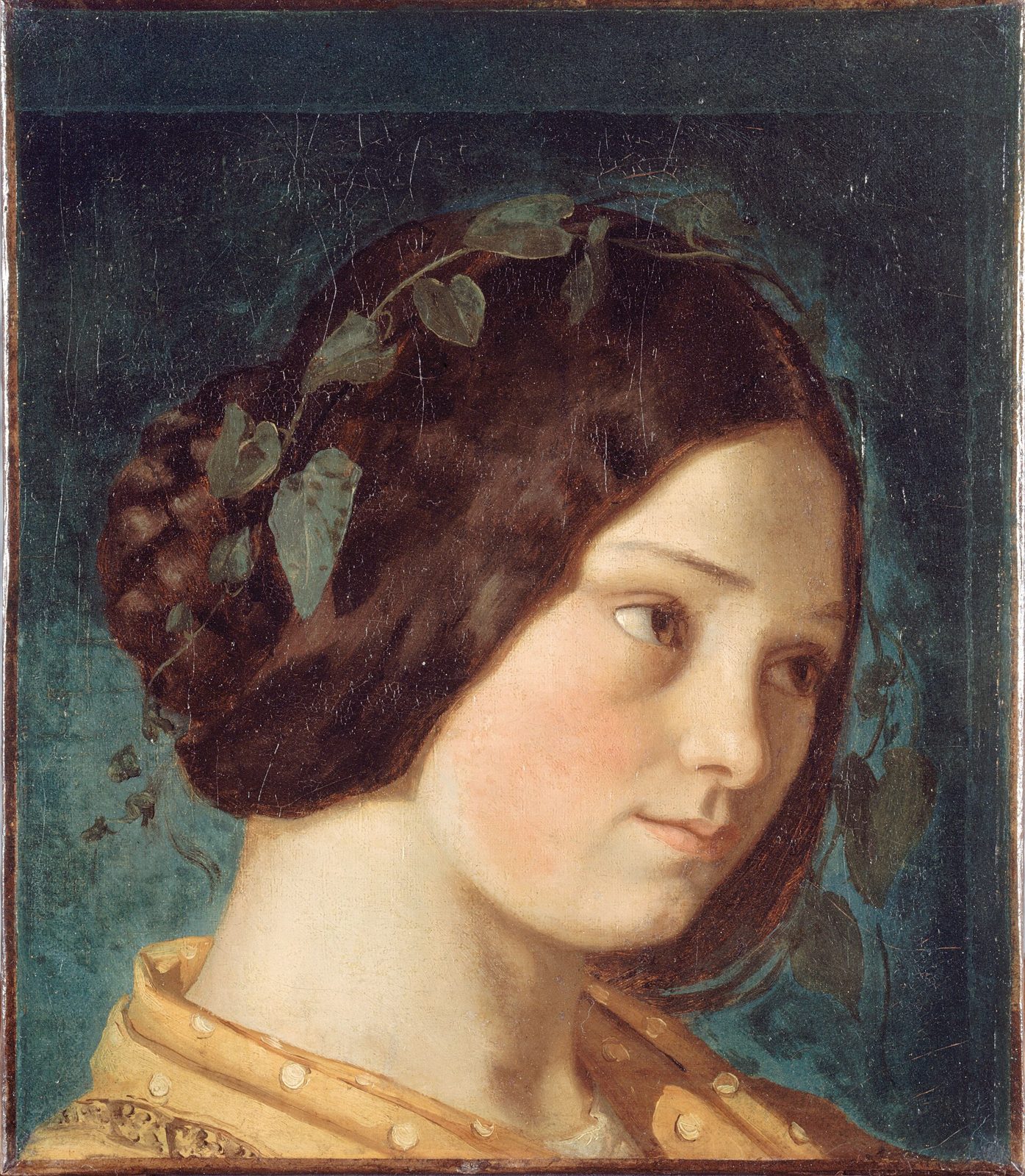
🎧 This work has audio narration — listen in the appZélie Courbet, the artist's sister, gazes serenely from this portrait, her dark hair intricately braided and adorned with delicate green leaves. The golden hue of her garment, decorated with circular patterns, contrasts beautifully against the muted blue background, which enhances her fair complexion and soft features.
This close-up composition captures not just her likeness but also a moment of intimacy and connection between the artist and his subject, reflecting the bond of family. Courbet's smooth brushwork emphasizes the gentle contours of her face, inviting viewers to appreciate the subtleties of her expression. The absence of additional elements in the foreground or background allows for a focused contemplation of Zélie, highlighting her as the sole subject of this intimate portrayal.
Created in 1842, this painting represents a significant moment in Courbet's early career, showcasing his commitment to realism and his ability to convey emotion through the depiction of everyday life.
Gustave Courbet, born on June 10, 1819, in Ornans, France, was a pioneering painter who championed the Realism movement in 19th-century art. Rejecting the conventions of academic painting and the idealism of Romanticism, he focused on depicting the world as he observed it, often portraying unidealized peasants and workers in monumental compositions. His early works gained recognition, notably "After Dinner at Ornans," which won him a gold medal at the Salon of 1849, allowing him to exhibit without jury approval.
Courbet's commitment to realism was revolutionary; he believed that art should stem from personal experience rather than historical or mythological themes. His bold approach often sparked controversy, challenging societal norms and addressing social issues, which resonated with later movements like Impressionism and Cubism. Despite facing criticism and imprisonment for his political involvement during the Paris Commune, Courbet continued to create until his death on December 31, 1877, in Switzerland.
His legacy endures as a transformative figure in art history, whose unflinching depictions of everyday life laid the groundwork for modern artistic expression. Today, Courbet is celebrated for his vigorous and uncompromising work, which continues to engage audiences with its raw honesty and depth.
Gustave Courbet painted the 'Portrait of Zélie Courbet' in 1842, a pivotal year in his early career. The painting was later gifted to the Petit Palais in Paris by another sister in 1909, ensuring its preservation. The reception of Courbet's work during his lifetime was mixed; while some critics lauded his realism, others were scandalized by his departure from academic norms. This piece, however, reflects a quieter moment in his oeuvre, focusing on personal connection rather than social commentary, a contrast to his more politically charged works that would follow.
Courbet's technique in this portrait is strikingly smooth, a deliberate choice that enhances the serene expression of Zélie. His brushwork is refined, allowing for soft transitions across her fair complexion and the delicate contours of her face. The golden hue of her garment is not just a color choice; it serves to draw the viewer's eye, contrasting beautifully with the muted blue background. This background is not merely a backdrop but a canvas that amplifies Zélie's presence, isolating her in a moment of quiet intimacy. The close composition, focusing on her head and shoulders, invites you to engage deeply with her expression, making the viewer feel as if they are part of a private moment shared between siblings.
Courbet's sisters, Zoé, Zélie, and Juliette served as his initial models, significantly influencing his early artistic development.
Courbet was imprisoned for six months due to his involvement in the Paris Commune and subsequently lived in exile in Switzerland until his death.