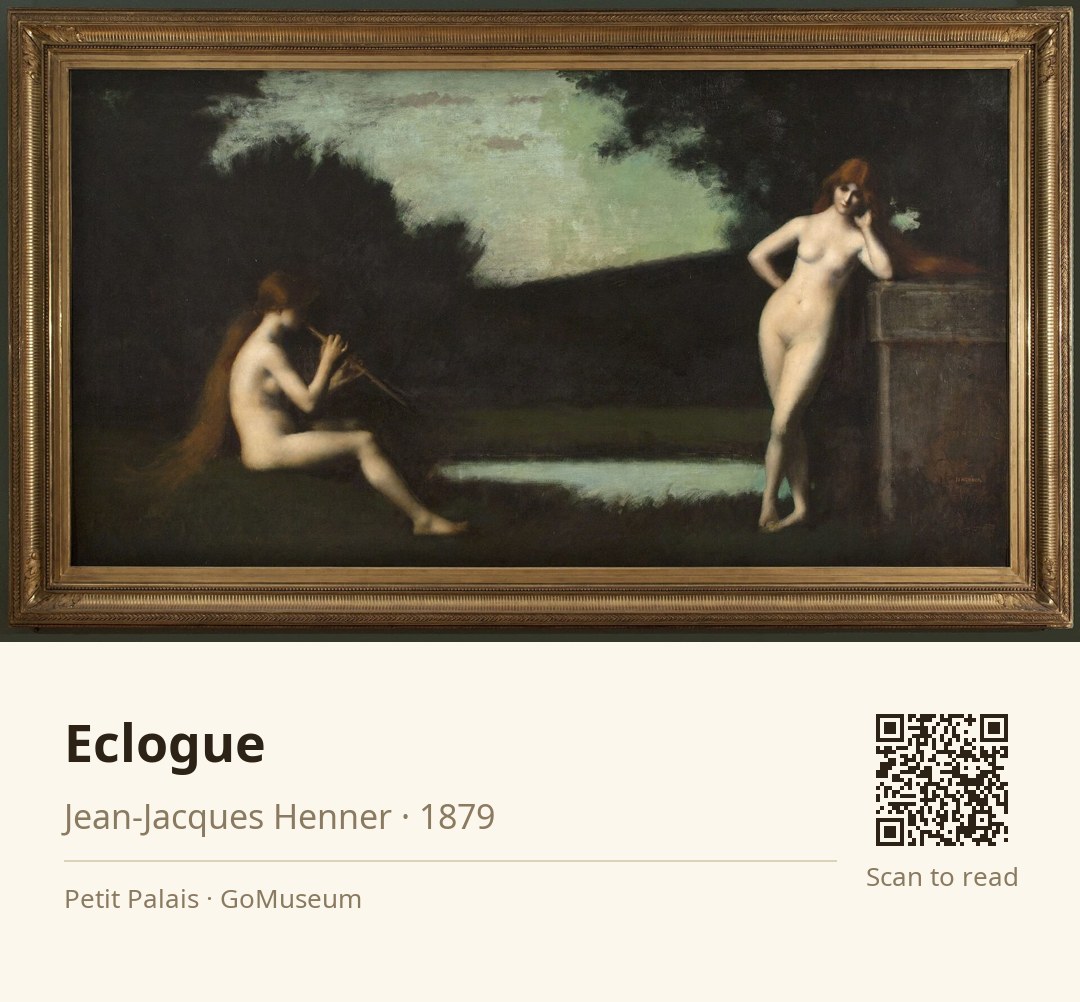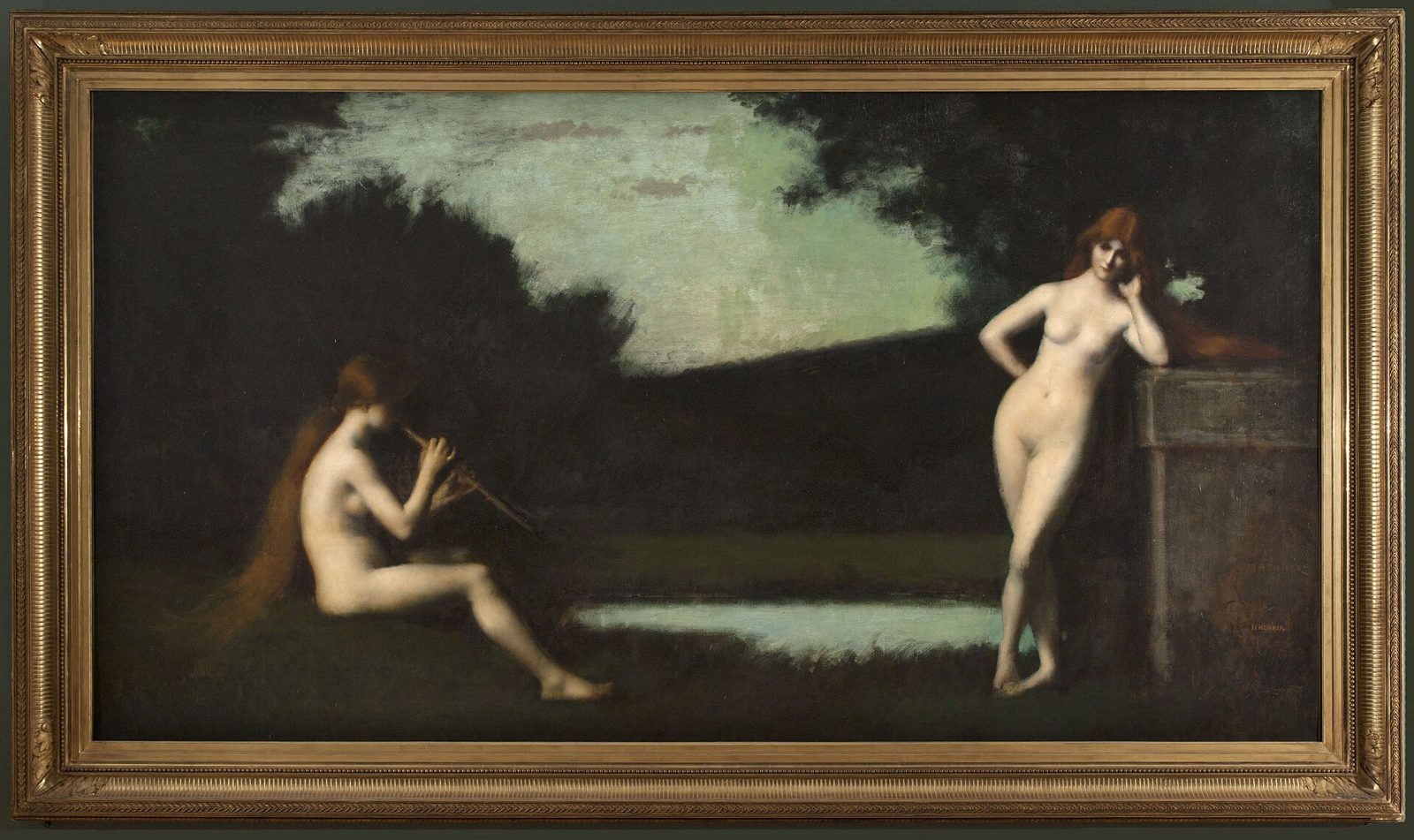
The two figures in this painting by Jean-Jacques Henner invite you into a serene moment of connection and contemplation. On the left, the seated musician plays a flute, their long hair flowing down their back, while the figure on the right leans against a stone structure, gazing thoughtfully at the music. The small body of water between them reflects the muted colors of the surrounding landscape, enhancing the dreamlike quality of the scene.
Henner's use of subdued tones and soft brushwork creates a sense of intimacy and depth, drawing the viewer into this tranquil moment. The dark trees and cloudy sky in the background add a layer of melancholy, suggesting a world beyond the figures that is both beautiful and mysterious. This composition reflects Henner's mastery of sfumato and chiaroscuro, techniques he honed throughout his career to evoke emotion and atmosphere in his works.
Born in 1829, Henner became known for his nudes and portraits, often featuring pale-skinned women with flowing red hair. His career flourished after he won the Prix de Rome in 1858, leading to significant recognition in the art world. He continued to exhibit his work until his death in 1905, leaving behind a legacy that includes this evocative painting from 1879.
Jean-Jacques Henner was a prominent French painter born on March 5, 1829, in Bernwiller, Alsace. He studied under notable artists and won the Prix de Rome in 1858, which allowed him to refine his craft in Italy. Known for his mastery of sfumato and chiaroscuro, Henner became celebrated for his depictions of nudes, religious themes, and portraits, particularly his iconic painting of Saint Fabiola. His works often featured pale-skinned women with flowing red hair, embodying a dreamy, ethereal quality.
Henner's career flourished after his return to Paris, where he gained recognition at the Salon, particularly with his patriotic piece, "L'Alsace, elle attend," created in response to the Franco-Prussian War. He was a member of the Académie des beaux-arts and received numerous accolades, including the Legion of Honour. Despite his success, he remained somewhat detached from contemporary artistic movements. Henner passed away on July 23, 1905, leaving a legacy that continues to influence artists today, as seen in the extensive collection of copies of his works, particularly "Fabiola."
This painting by Jean-Jacques Henner was completed in 1879, a period when Henner was already gaining significant recognition in the art world. He had won the prestigious Prix de Rome in 1858, which allowed him to study in Italy and refine his techniques. The work was likely influenced by his experiences during this time, as he immersed himself in the beauty of the Italian landscape and the mastery of the old masters. Henner's career took off after he exhibited at the Salon, where he became known for his evocative nudes and portraits. His works were well-received, and he continued to exhibit until his death in 1905. This particular painting reflects his ongoing exploration of the human form and emotional depth, a hallmark of his style.
An intriguing anecdote about Henner is that he taught at a unique studio for women artists in Paris from 1874 to 1889, a time when women were largely excluded from formal art education. This initiative not only provided opportunities for female artists but also allowed Henner to work closely with his models, some of whom became his pupils. This connection between teaching and modeling highlights the personal relationships he fostered and the progressive steps he took in a male-dominated field.
Henner contributed to women's art education by teaching at a unique studio for women artists in Paris from 1874 to 1889.
'L'Alsace, elle attend' helped Henner gain popularity after the defeat of France in 1871.