Light Effect in the Ruins
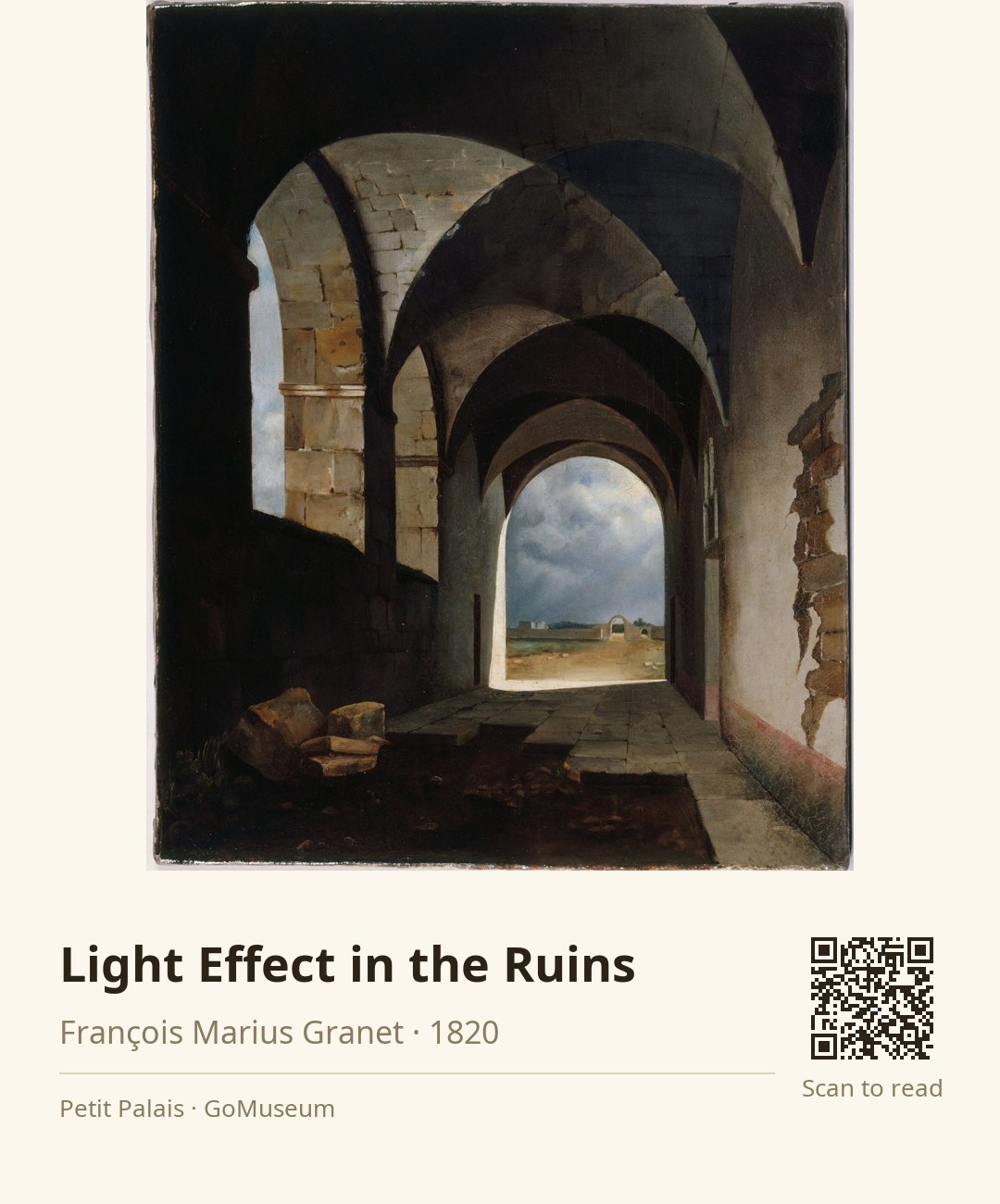
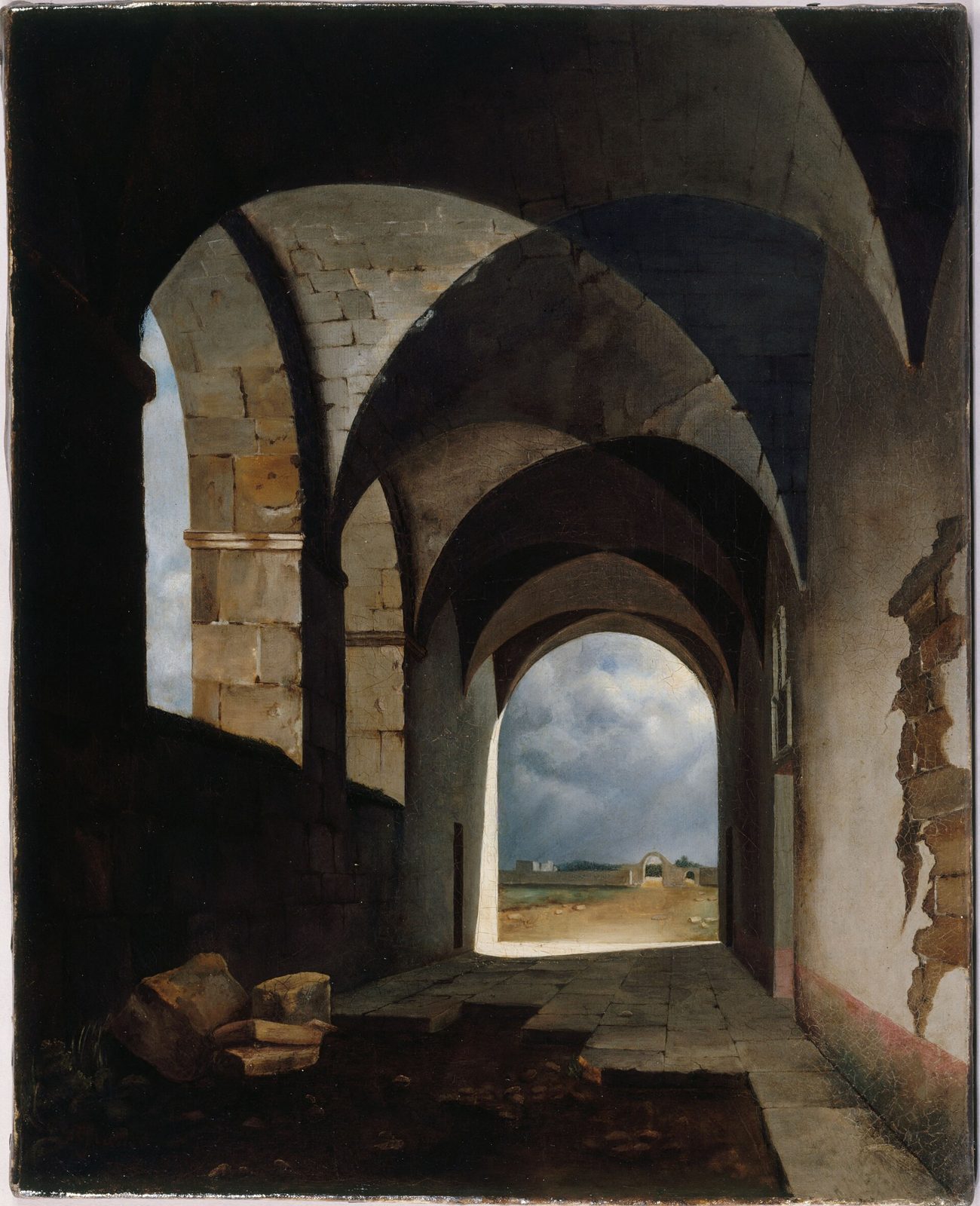
🎧 This work has audio narration — listen in the appThe vaulted passageway in François Marius Granet's "Effet de lumière dans les ruines" draws you in with its intricate arches, leading your eye toward a sunlit landscape beyond. Inside, the shadowed stone walls and the partially damaged surface on the right create a sense of history and decay, while the large stone slabs on the floor, scattered with debris, hint at the passage of time and neglect.
This contrast between the dark interior and the bright exterior not only highlights Granet's mastery of light but also evokes a feeling of hope and renewal, as the viewer is invited to step from the shadows into the warmth of the sunlit world outside. The expansive sky in the background, dotted with clouds, suggests a vastness that transcends the confines of the ruins, a metaphor for the enduring beauty of nature despite human impermanence.
Created in 1820, this painting reflects Granet's fascination with architectural subjects, a theme he explored throughout his career. His works often blend the human experience with the structures that surround it, capturing moments where light and architecture intersect. Granet's legacy continued long after his death on November 21, 1849, as he bequeathed his collections to his hometown, which later honored him by naming a museum after him.
François Marius Granet, born on December 17, 1775, in Aix-en-Provence, was a notable French painter known for his architectural subjects. His artistic journey began under the guidance of Jean-Antoine Constantin and later flourished in Paris, where he became a pupil of Jacques-Louis David. Granet's passion for capturing the interplay of light and shadow in cloisters and churches earned him a reputation as a master of tone, blending figures seamlessly into architectural settings.
In 1802, he moved to Rome, where he spent nearly two decades, drawing inspiration from the city's ancient monuments and the lives of artists. His works, characterized by a dark, Dutch-inspired palette, gained recognition, including an award at the Salon in 1808. Granet's return to France in 1824 marked a shift as he took on roles as curator at the Louvre and later at Versailles, contributing to the establishment of a historical museum.
Despite his accolades, including being named Chevalier de l'Ordre St Michel, Granet remained deeply connected to Rome and his hometown. After his wife's death in 1847, he returned to Aix, where he passed away on November 21, 1849. He left a significant legacy, with his collections forming the foundation of the Musée Granet, established in his honor. Granet's work remains a testament to the harmony between architecture and human experience in art history.
In 'Effet de lumière dans les ruines,' Granet employs oil paint on canvas, a medium that allows for rich textures and depth. The brushwork is meticulous, with fine details capturing the crumbling stone walls and the play of light filtering through the arches. The contrast between the dark, shadowy interior and the bright, sunlit exterior is striking, achieved through a careful layering of paint that creates a sense of luminosity. Granet's choice of a relatively small scale—41 by 32.7 centimeters—invites viewers to step closer, immersing them in the scene. The composition leads the eye through the vaulted passageway, drawing attention to the architectural elements while simultaneously revealing a landscape that feels both expansive and inviting. This technique not only showcases Granet's skill but also evokes a deeper emotional response, as the viewer is caught between the decay of the past and the promise of renewal beyond the ruins.
The small scale encourages viewers to step closer to the artwork, allowing for a more immersive experience of the scene.