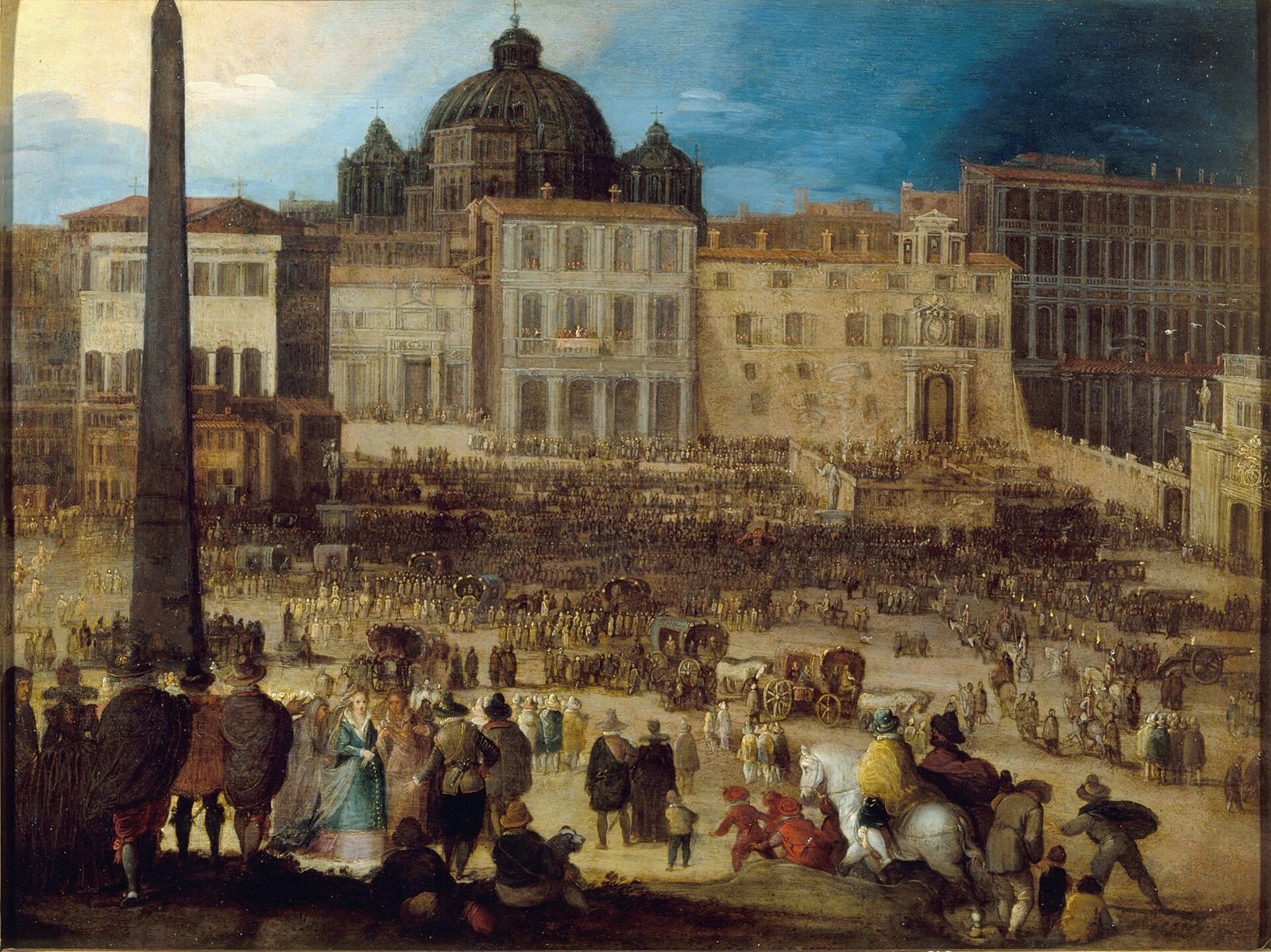
View of St. Peter's Square in Rome during the election of Pope Clement VIII in 1592
🎧 This work has audio narration — listen in the appThe vibrant scene in front of you captures the election of Pope Clement VIII in 1592, a pivotal moment in the history of the Catholic Church. The tall obelisk, a striking feature on the left, stands as a silent witness to the throngs of elegantly dressed figures, including a woman in a flowing blue dress, who fill St. Peter's Square. Their animated expressions and gestures convey a palpable sense of excitement and anticipation, immersing you in the atmosphere of this historic event.
This gathering not only reflects the political significance of the papal election but also showcases the intricate architectural details of the surrounding buildings, hinting at the grandeur of Renaissance Rome. The careful arrangement of figures and the dynamic interplay of light and shadow enhance the lively activity of the square, illustrating how art can capture the essence of a moment in time. Louis de Caullery, the artist, was known for his ability to blend architectural precision with lively human interaction, a skill that is evident in this work.
Born in the late 16th century, Caullery was a Flemish painter who specialized in city views and genre scenes, often drawing inspiration from the works of Italian masters. His innovative use of color and composition reflects a deep understanding of perspective, which was influenced by the architectural designs of his time. In 1600, he completed this painting, which remains one of the few signed works attributed to him, highlighting his unique contribution to the genre of history painting.
Louis de Caullery, a Flemish painter born around 1580 in Caulery, is recognized for his architectural scenes, city views, and genre paintings. His career flourished in Antwerp, where he trained under Joos de Momper and became a master in the Guild of Saint Luke by 1602. Although once thought to have traveled to Italy, it is now believed he developed his style through the study of works by Italian masters rather than direct experience.
Caullery's oeuvre includes only seven signed paintings, with notable works like "Carnival" and "The Five Senses." His genre scenes often depicted lively gatherings, foreshadowing the garden party themes prevalent in later French painting. His figures, characterized by elegance and distinctive postures, reflect the influence of the Fontainebleau School and show a unique blend of Flemish tradition and innovative color palettes.
Despite the limited documentation of his life, Caullery's contributions to the genre of courtly gatherings and his adeptness in architectural representation secured his place in art history, influencing both his contemporaries and future generations of artists. He passed away in Antwerp in 1621, leaving behind a legacy that continues to be appreciated today.
In 1600, Louis de Caullery completed this vibrant portrayal of St. Peter's Square during the election of Pope Clement VIII, a significant moment in the Catholic Church's history. Commissioned likely by a local patron, the painting was shown in various collections over the years, reflecting the growing interest in historical events captured in art. Caullery, a Flemish artist who never traveled to Italy, drew inspiration from the architectural grandeur of Italian cities through prints and the works of other artists. His ability to blend these influences with the bustling life of Antwerp made his work popular among collectors of the time. The reception of this piece was likely enthusiastic, as it not only depicted a pivotal event but also showcased Caullery's skill in capturing the essence of urban life.
Caullery's brushwork is meticulous, capturing the intricate architectural elements of St. Peter's Square with precision. The buildings are rendered with a keen eye for perspective, drawing the viewer into the bustling scene. The figures, though somewhat static, are elegantly posed, their clothing richly detailed, reflecting the fashion of the time. The color palette is innovative for its era, featuring warm ochres and deep blues that bring the scene to life. The composition is carefully balanced, with the tall obelisk anchoring the left side and the crowd creating a dynamic flow across the canvas. This careful arrangement not only showcases the event but also immerses the viewer in the lively atmosphere of the papal election, making it feel almost tangible.
Interestingly, despite the common belief that Caullery traveled to Italy for inspiration, there is no evidence to support this. Instead, his knowledge of Italian architecture and style likely came from studying the works of other artists who had traveled there, showcasing his ability to adapt and innovate without ever leaving his homeland.
Caullery's name may come from his birthplace, a small town on the Scheldt river.
There are only seven signed paintings known to be by Caullery.