Sketch for the Paris City Hall: Apotheosis of Napoleon I
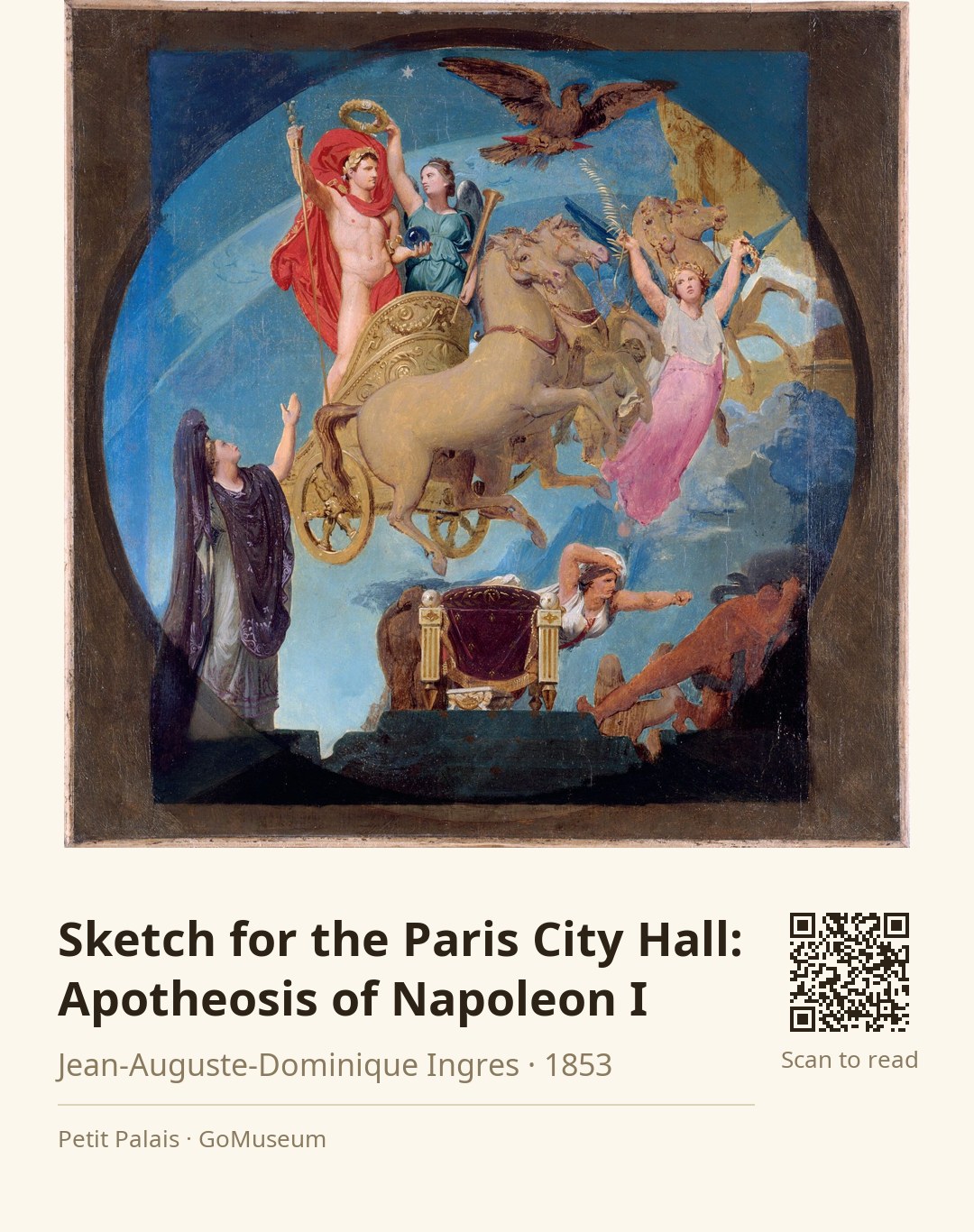
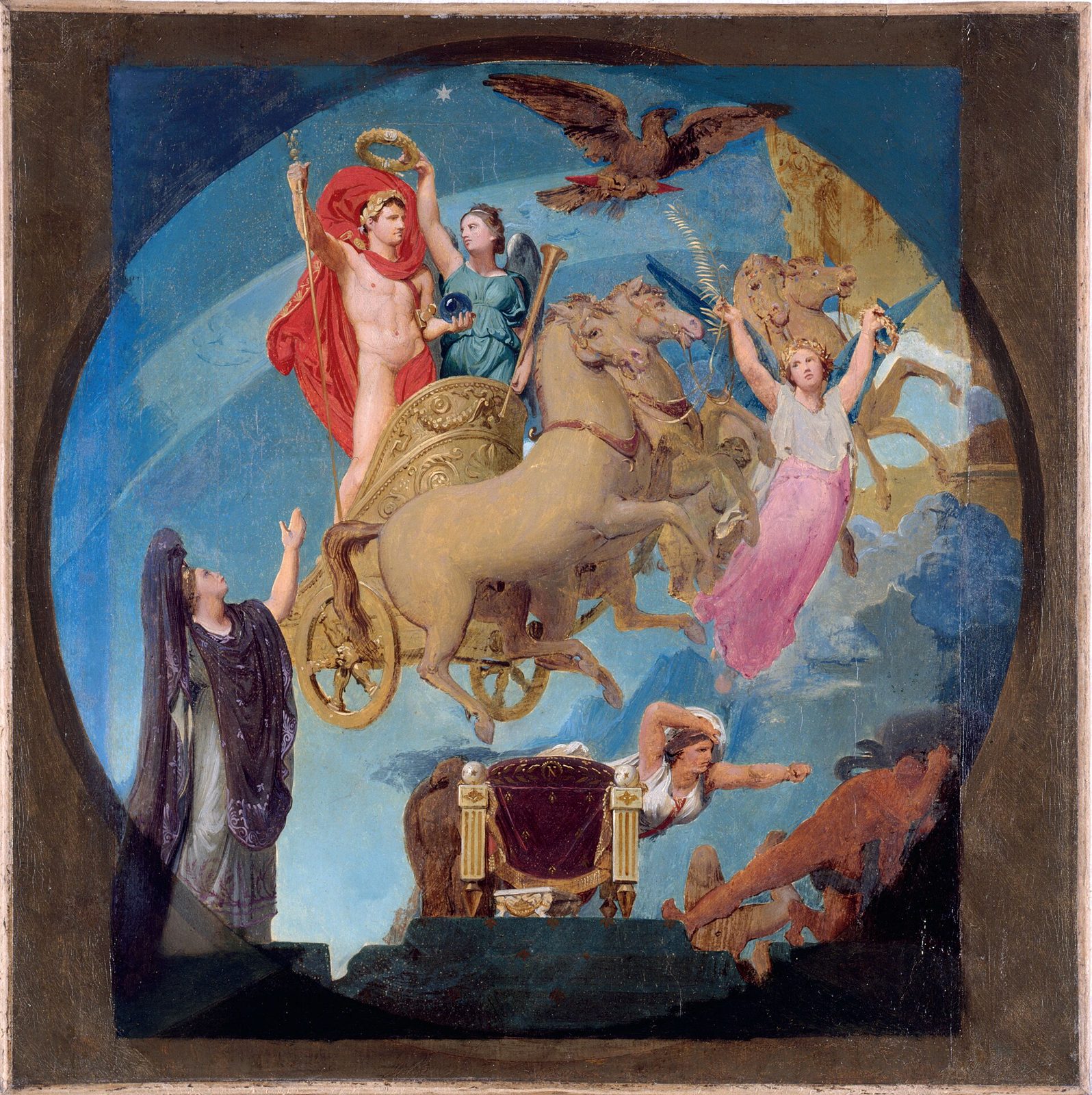
🎧 This work has audio narration — listen in the appThe chariot in this sketch ascends through a vibrant blue sky, drawn by four powerful horses, evoking a sense of triumph and grandeur. At the center, a figure draped in a striking red cloak holds a laurel wreath, symbolizing victory, while another figure beside them, clad in blue, grips a staff, suggesting authority and command. Above, an eagle soars, reinforcing the celestial theme of elevation and glory.
This dynamic composition captures the apotheosis of Napoleon I, a moment meant to celebrate his legacy and elevate him to the status of a demigod. The circular arrangement draws your eye to the central action, emphasizing the movement and energy of the scene. Below, figures gesture and recline, contributing to the narrative of reverence and admiration surrounding Napoleon. The inclusion of women, one in pink flying alongside the chariot, adds layers of symbolism, possibly representing victory or the arts, further enhancing the celebratory atmosphere.
Created in 1853, this sketch served as a preparatory work for a larger mural intended for the Paris City Hall, showcasing Ingres' ambition to immortalize Napoleon's legacy through grand historical narrative.
Jean-Auguste-Dominique Ingres was a pivotal figure in French Neoclassicism, born on August 29, 1780, in Montauban. He was the son of a versatile artist, which nurtured his early artistic inclinations. Ingres studied under Jacques-Louis David in Paris, where he developed a commitment to academic traditions, aspiring to elevate history painting above all genres. His early career was marked by struggles, as critics dismissed his style as archaic, yet he persevered, achieving recognition with works like "The Vow of Louis XIII" in 1824.
His portraits, characterized by expressive distortions, became his most celebrated contributions, influencing modern artists such as Matisse and Picasso. Ingres's time in Italy, from 1806 to 1824, was crucial; he immersed himself in the study of Renaissance masters, which shaped his distinctive style. Despite facing criticism for his meticulous approach, he remained steadfast in his vision of beauty, emphasizing drawing over color.
Later in life, he returned to Paris, where he continued to create significant works, including "The Turkish Bath." Ingres's legacy endures as a bridge between classical traditions and modern art, embodying the tension between adherence to established norms and the evolving landscape of artistic expression. He passed away on January 14, 1867, leaving behind a profound impact on the art world.
Ingres employed a meticulous technique in this sketch, showcasing his mastery of line and form. The brushwork is refined, with smooth transitions that create a sense of movement and energy, particularly in the depiction of the horses and the flowing red cloak of the central figure. The color palette is striking, dominated by vibrant blues and reds, which not only draw the eye but also evoke a sense of drama and elevation. The circular composition is carefully crafted to guide your attention toward the central action, emphasizing the figures in the chariot. Ingres' choice to include a soaring eagle above adds to the celestial quality of the scene, reinforcing the themes of victory and authority. This careful orchestration of elements creates a dynamic interplay that captures the viewer's imagination, making the scene feel alive and triumphant.
Ingres was heavily influenced by past artistic traditions, particularly Neoclassicism, and he aimed to uphold academic standards in opposition to the emerging Romantic style.
Despite his ambition to be a history painter, Ingres is best known for his portraits, which have left a lasting impact on the art world.
Ingres gained significant recognition in 1824 when his painting, The Vow of Louis XIII, received acclaim at the Salon, establishing him as a prominent figure in the Neoclassical movement.