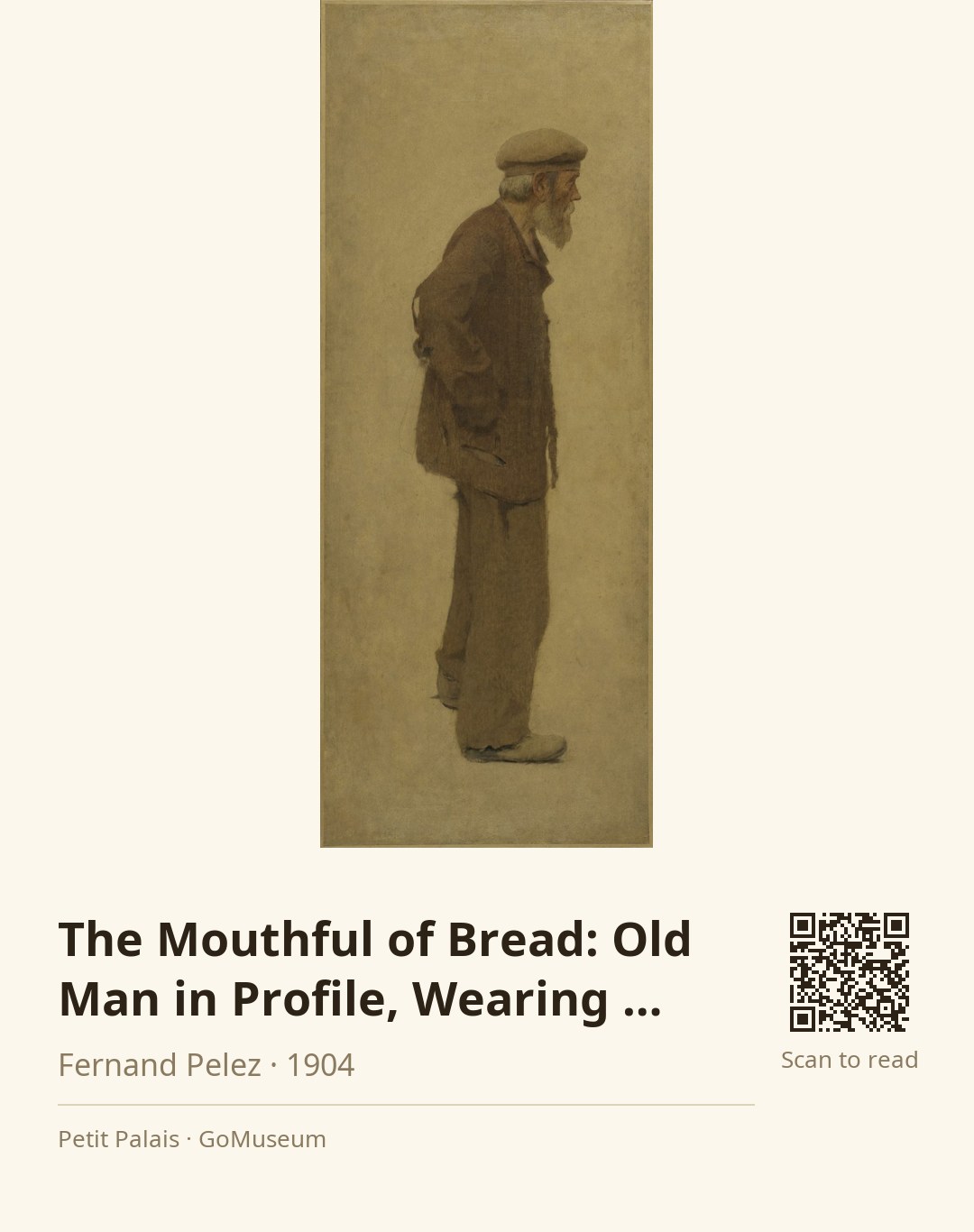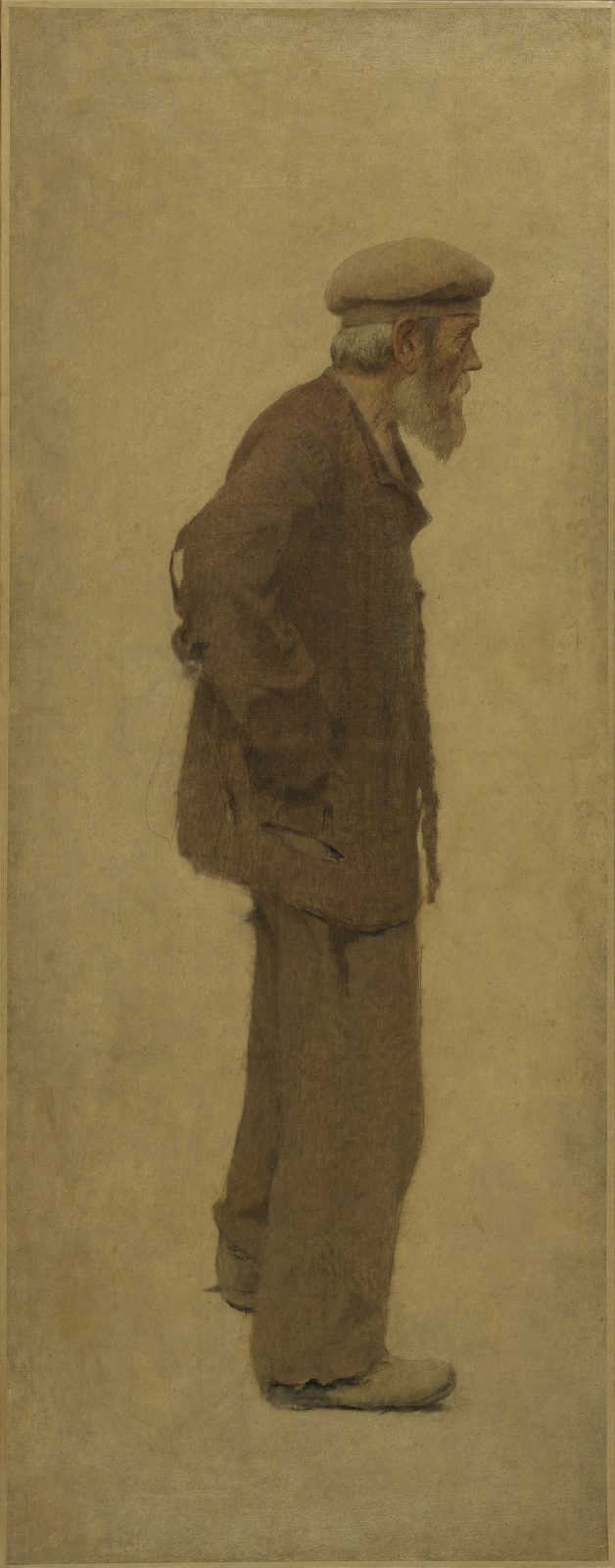
The Mouthful of Bread: Old Man in Profile, Wearing a Beret, Hands in Pockets
🎧 This work has audio narration — listen in the appThe elderly man in profile, dressed in a worn brown jacket and beret, embodies a quiet resilience. His long white beard and hands tucked into his pockets suggest a life of hardship, while the muted beige background draws your focus entirely to him, stripping away distractions. The earthy palette and fine brushwork capture not just the texture of his clothing but also the deep lines etched into his face, hinting at the stories he carries.
Fernand Pelez, the artist, was known for his realistic portrayals of social issues, and this painting, created in 1904, reflects his shift towards representing the struggles of the working class. The simplicity of the composition emphasizes the solitary figure, inviting viewers to ponder the man's life and experiences. Pelez's work often highlighted the dignity of those living on the margins of society, and here, the old man's presence speaks volumes about resilience in the face of adversity.
Pelez, born in Paris in 1848, faced commercial struggles throughout his career, particularly after the failure of his work at the Salon in 1896. Despite this, he continued to create impactful pieces until his death in 1913.
Fernand Pelez was a French painter of Spanish descent, born on January 18, 1843, in Paris. He was the son of a painter and received early artistic training from his father. Initially influenced by academic styles, Pelez later embraced naturalism, focusing on the struggles of the working class and social issues. His notable works include "The Mouthful of Bread" and "Grimaces et Misères," which reflect his deep concern for human suffering and societal inequities. Despite early recognition, including medals at the Salon, his career faltered in the 1880s, leading him to withdraw from public life after the disappointing reception of "L'Humanité" in 1896. Pelez's legacy was revived with a major exhibition at the Petit Palais in 2009, highlighting his contributions to the depiction of marginalized communities in art. His work remains significant in the context of 19th-century realism and social commentary. Pelez passed away on August 7, 1913, in Paris.
In 'The Mouthful of Bread,' Pelez employs oil paint on canvas, allowing for rich texture and depth. The fine brushwork captures the intricate details of the old man's clothing and the weathered lines of his face, creating an almost tactile quality. The earthy palette, dominated by muted browns and beiges, not only emphasizes the figure but also evokes a sense of warmth and humanity. The simplicity of the composition, with the solitary figure against a plain background, draws the viewer's focus entirely to the man's expression and posture, inviting contemplation of his life experiences.
After facing commercial failures, particularly following the rejection of his work at the Salon in 1896, Pelez withdrew from public life and stopped exhibiting or selling his paintings.
A major exhibition showcasing Fernand Pelez's work took place at the Petit Palais in Paris from September 24, 2009, to January 17, 2010.
Fernand Pelez was influenced by his father, Fernand Pelez de Cordova, who was also a painter and one of his teachers.