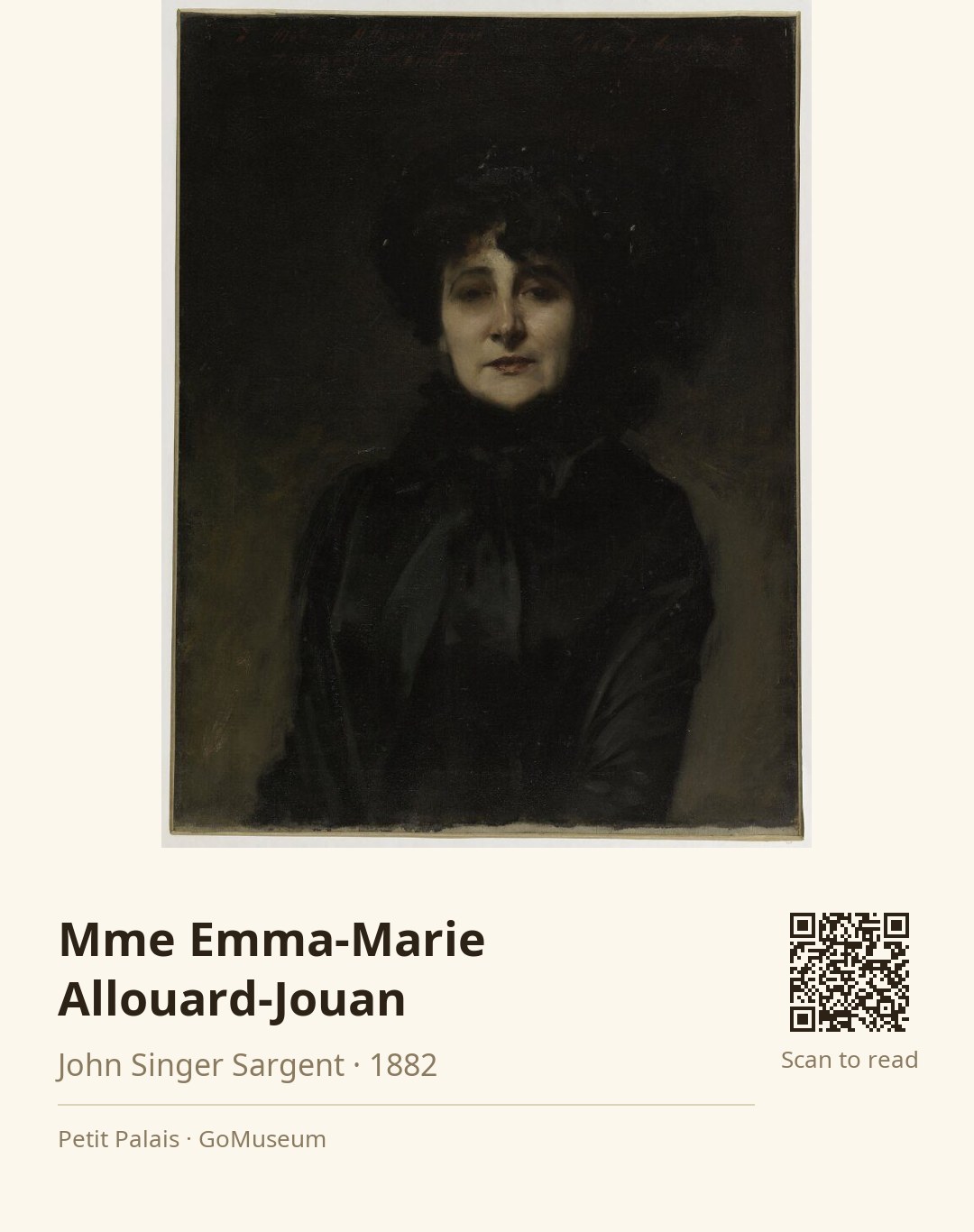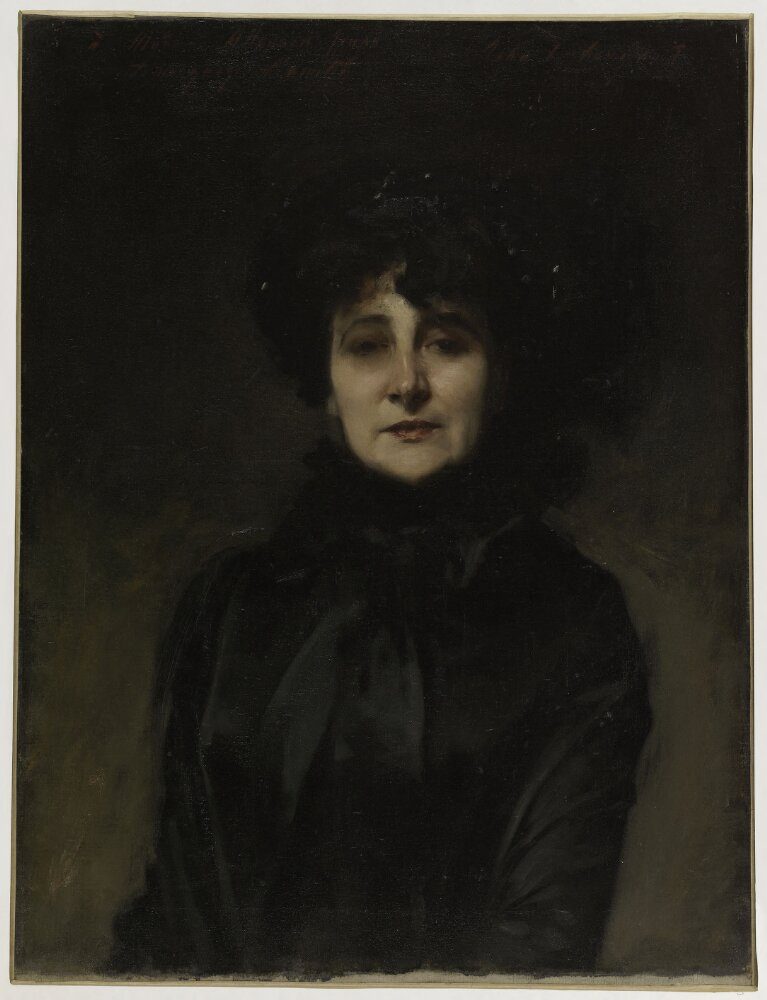
Mme Emma-Marie Allouard-Jouan
🎧 This work has audio narration — listen in the appMadame Allouard-Jouan sits poised in her elegant black dress, her calm expression hinting at a subtle smile beneath the wide brim of her feathered hat. The deep, shadowy brown background envelops her, enhancing the portrait's mysterious aura while the smooth brushwork highlights her features with a refined touch.
This portrayal captures not just her likeness but also the essence of a woman deeply embedded in the artistic and literary circles of late 19th-century France. The choice of dark tones reflects the somber elegance of her character, while the slight highlights on her face suggest a depth of emotion and experience. Sargent's technique, characterized by a masterful command of light and texture, draws the viewer's focus to her serene demeanor, inviting contemplation of her life as a novelist and translator.
Emma-Marie Allouard-Jouan, born in 1836, was known for her literary contributions and for hosting salons that brought together influential figures of her time. Sargent painted this portrait in 1882, and it was later exhibited at the Société internationale de peintres et sculpteurs in December of the same year.
John Singer Sargent was an American painter born on January 12, 1856, in Florence, Italy, to expatriate parents. Renowned as the leading portrait artist of his time, he captured the opulence of the Belle Époque and Edwardian eras through approximately 900 oil paintings and over 2,000 watercolors. Sargent's artistic journey began in Florence and continued in Paris, where he studied under prominent artists, honing his technical skills and developing a unique style that blended traditional portraiture with elements of Impressionism.
His early career was marked by controversy, particularly with the scandal surrounding his painting "Portrait of Madame X," which ultimately led him to settle in England. Sargent's portraits of the elite, including notable figures like Theodore Roosevelt and John D. Rockefeller, showcased his remarkable ability to convey character and emotion. Despite his success, he felt constrained by the demands of formal portraiture, later exploring mural painting and outdoor landscapes.
Sargent's legacy was largely overlooked until the late 20th century, when exhibitions of his male nudes and explorations of themes such as race, gender nonconformity, and same-sex relationships prompted a reevaluation of his work. Today, he is celebrated not only for his artistic brilliance but also for his progressive views, making him a significant figure in the history of art. He passed away on April 15, 1925, in London, leaving behind a rich and diverse body of work that continues to inspire.
John Singer Sargent's portrait of Madame Allouard-Jouan was painted in 1882, a time when Sargent was establishing himself as a leading portrait artist in Paris. The exhibition received notable attention, with American art critic William Brownell praising it as a 'beautiful and charming portrait of a woman' and Henry James lauding Sargent's exquisite modeling of her face. The painting was later gifted to the Petit Palais in Paris in 1918, ensuring its preservation and continued appreciation. Sargent's connection to the vibrant artistic circles of late 19th-century France is evident, as he was introduced to Allouard-Jouan through her salon, a hub for influential figures of the time, including Judith Gautier and Virginie Gautreau.
The smooth brushwork creates a refined texture that enhances the elegance of Madame Allouard-Jouan's features. He employs a limited palette dominated by dark tones, which not only adds depth but also envelops the subject in a rich, atmospheric background. The subtle highlights on her face and dress are strategically placed, drawing the viewer's eye directly to her calm expression. The vertical format of the painting, measuring 75 cm in height and 57 cm in width, allows for a commanding presence, while the composition centers around her face, inviting contemplation.