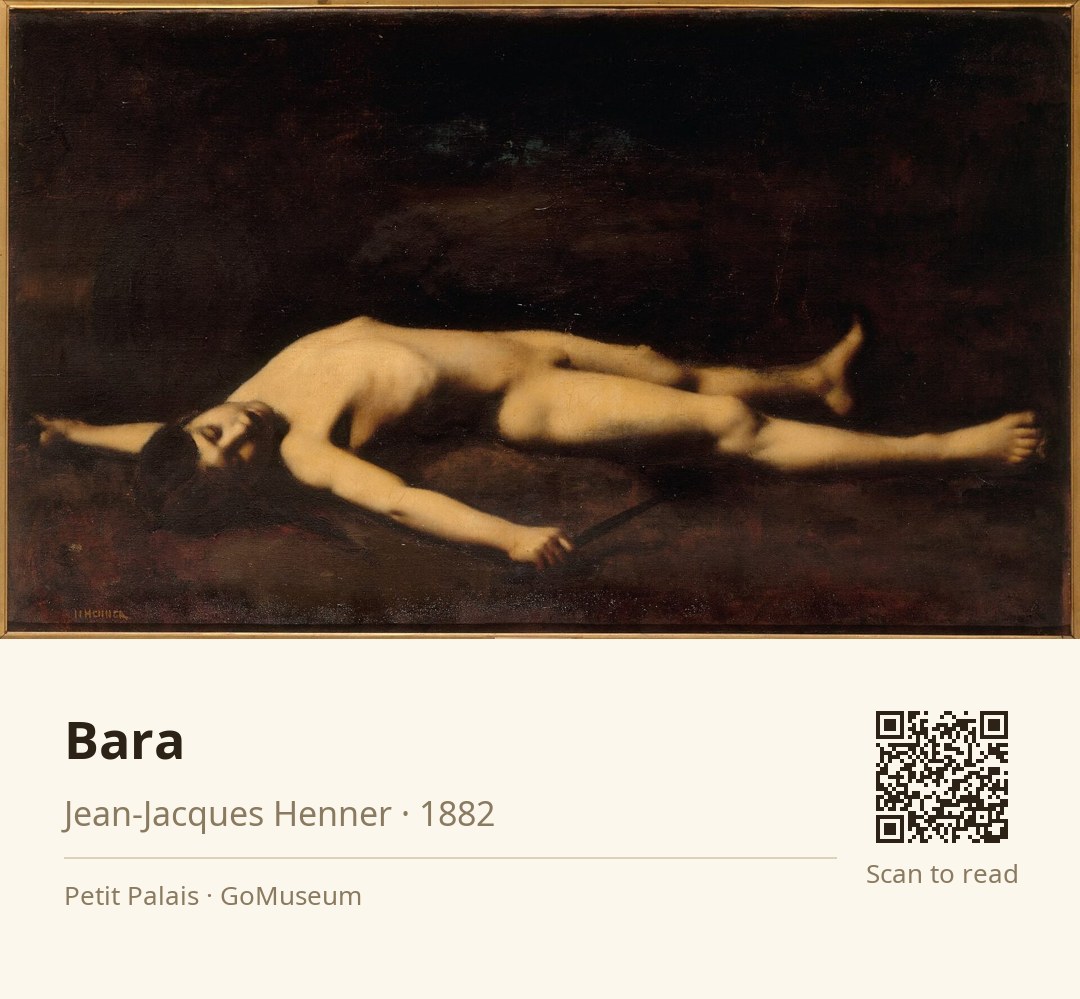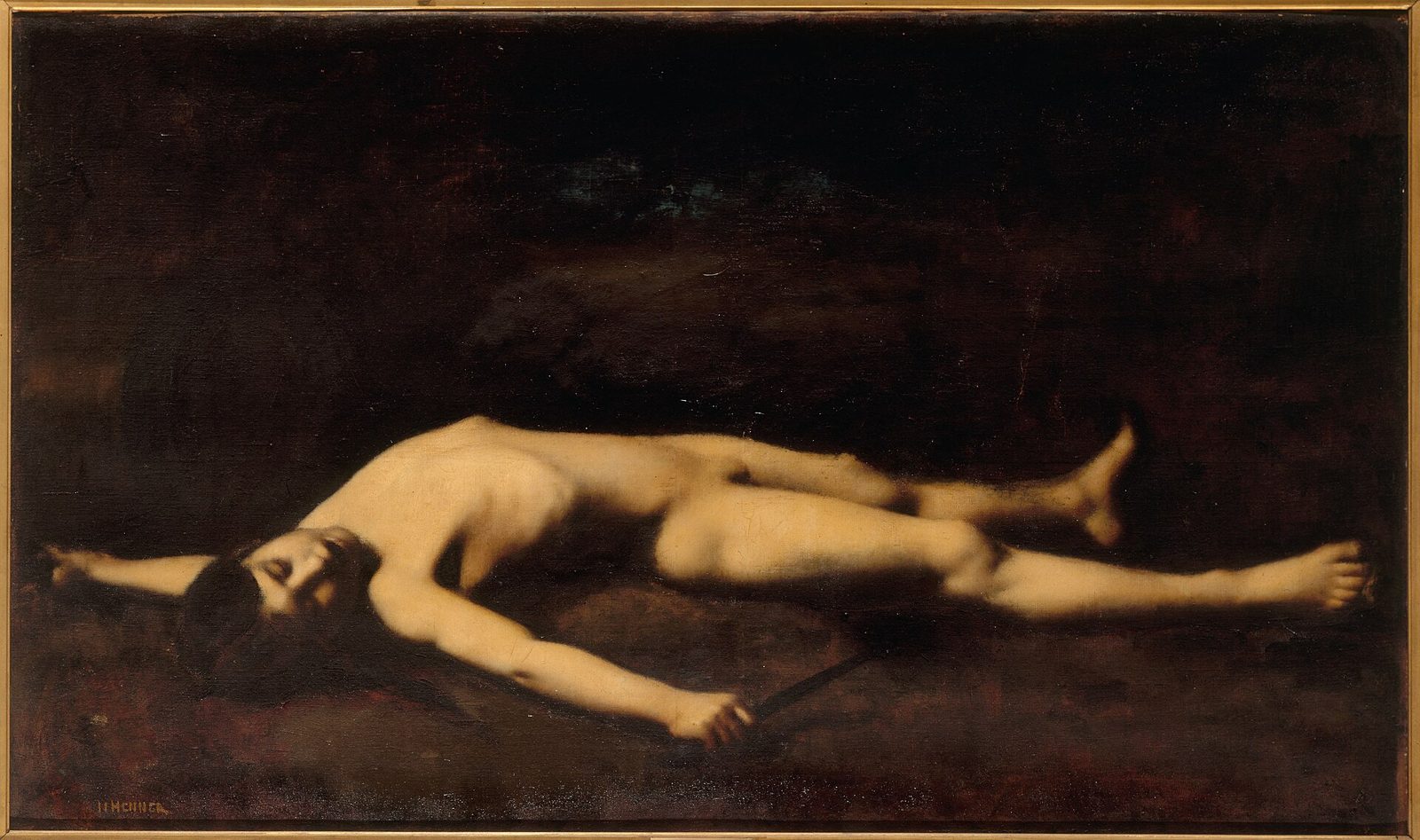
Joseph Bara lies in a dramatic pose, his body stretched out against a dark background that accentuates the pale contours of his skin. The bloodstains in his hair and the drumstick in his hand hint at the violence of his death, while his serene expression evokes a sense of tragic heroism. The smooth brushwork and subtle gradations of light create an almost ethereal quality, contrasting sharply with the somber tones surrounding him.
This portrayal of Bara, a young Republican hero killed during the French Revolution, captures a moment of both beauty and brutality. Henner’s choice to depict him nude, rather than in military attire, strips away the typical symbols of valor and instead emphasizes the vulnerability of youth. The reference to Christ’s crucifixion in his pose adds a layer of profound symbolism, suggesting martyrdom and sacrifice. Henner’s work diverges from his usual mythological themes, presenting a contemporary historical figure in a way that invites both admiration and discomfort.
Created in 1882, this painting was part of a broader cultural movement to revive the memory of revolutionary heroes during the Third Republic. The state commissioned Henner to create this piece as part of an effort to solidify the republican identity in France. Following its exhibition at the Salon, the painting remained in Henner's possession until his death in 1905, after which it was donated to the Musée des Beaux-Arts de la Ville de Paris by his nephew.
Jean-Jacques Henner was a prominent French painter born on March 5, 1829, in Bernwiller, Alsace. He studied under notable artists and won the Prix de Rome in 1858, which allowed him to refine his craft in Italy. Known for his mastery of sfumato and chiaroscuro, Henner became celebrated for his depictions of nudes, religious themes, and portraits, particularly his iconic painting of Saint Fabiola. His works often featured pale-skinned women with flowing red hair, embodying a dreamy, ethereal quality.
Henner's career flourished after his return to Paris, where he gained recognition at the Salon, particularly with his patriotic piece, "L'Alsace, elle attend," created in response to the Franco-Prussian War. He was a member of the Académie des beaux-arts and received numerous accolades, including the Legion of Honour. Despite his success, he remained somewhat detached from contemporary artistic movements. Henner passed away on July 23, 1905, leaving a legacy that continues to influence artists today, as seen in the extensive collection of copies of his works, particularly "Fabiola."
In 1882, Jean-Jacques Henner unveiled 'Bara' at the Salon, a significant event during a period when France was rekindling its revolutionary spirit. Commissioned by the state, the painting aimed to reinforce republican identity by memorializing Joseph Bara, a young hero of the French Revolution. After its debut, the painting remained with Henner until his death in 1905, when it was passed to his nephew, Jules, who donated it to the Musée des Beaux-Arts de la Ville de Paris. The work was part of a broader cultural movement, with other artists also depicting Bara around the same time, reflecting a surge of interest in revolutionary figures. Critics had mixed reactions; while some praised its execution, others questioned Henner's choice to depict Bara nude, a stark departure from the heroic imagery typically associated with military figures.
Henner's technique in 'Bara' is strikingly smooth, with oil paint applied in a way that creates a soft, almost luminous quality to the skin of the figure. The subtle gradations of light and shadow enhance the contours of Bara's body, making it appear both ethereal and vulnerable. The dark background serves to isolate the figure, drawing your attention to the stark contrast between the pale flesh and the deep browns and blacks surrounding it. This choice not only emphasizes the physicality of Bara but also evokes a sense of tragic beauty. The diagonal positioning of the body adds dynamism to the composition, while the careful brushwork captures the delicate details of the figure, from the bloodstains in his hair to the gentle rise of his chest. Henner's decision to represent Bara in this way, devoid of military garb, strips away traditional symbols of valor, inviting viewers to confront the raw humanity of the young martyr.
Interestingly, some critics speculated that Henner may have initially sketched the figure of a sleeping model before deciding to transform it into a representation of Joseph Bara. This speculation raises questions about the artist's intentions and whether he was more focused on the aesthetic qualities of the human form than on the historical significance of his subject.
Some critics suggested that Henner might have originally sketched a sleeping model and later adapted it to depict Joseph Bara.
The painting was created during a revival of interest in Joseph Bara, which included poems and sculptures celebrating his legacy.
After its creation, 'Bara' has been exhibited in various venues, including the Kunsthaus Zürich in 2017-18.