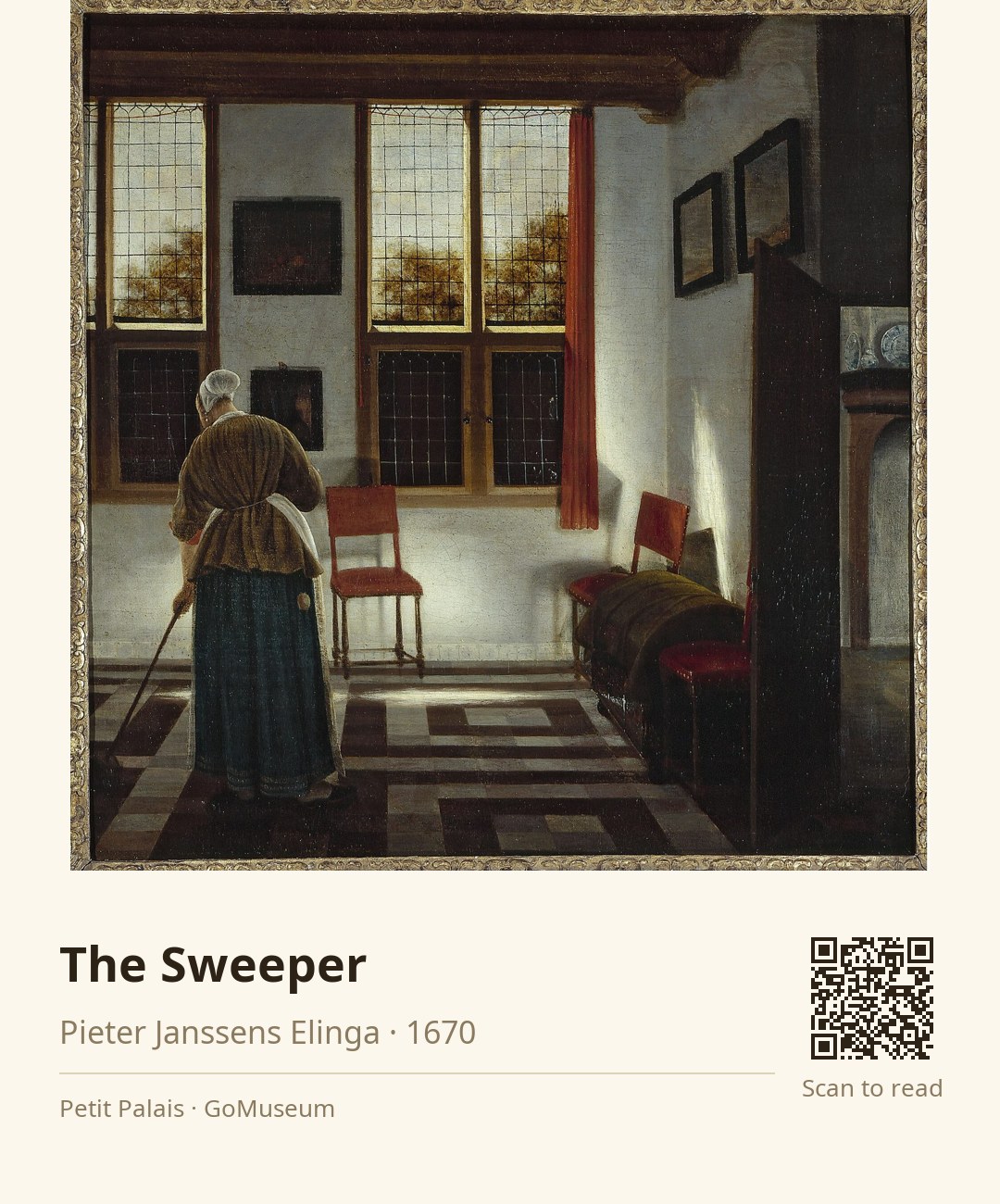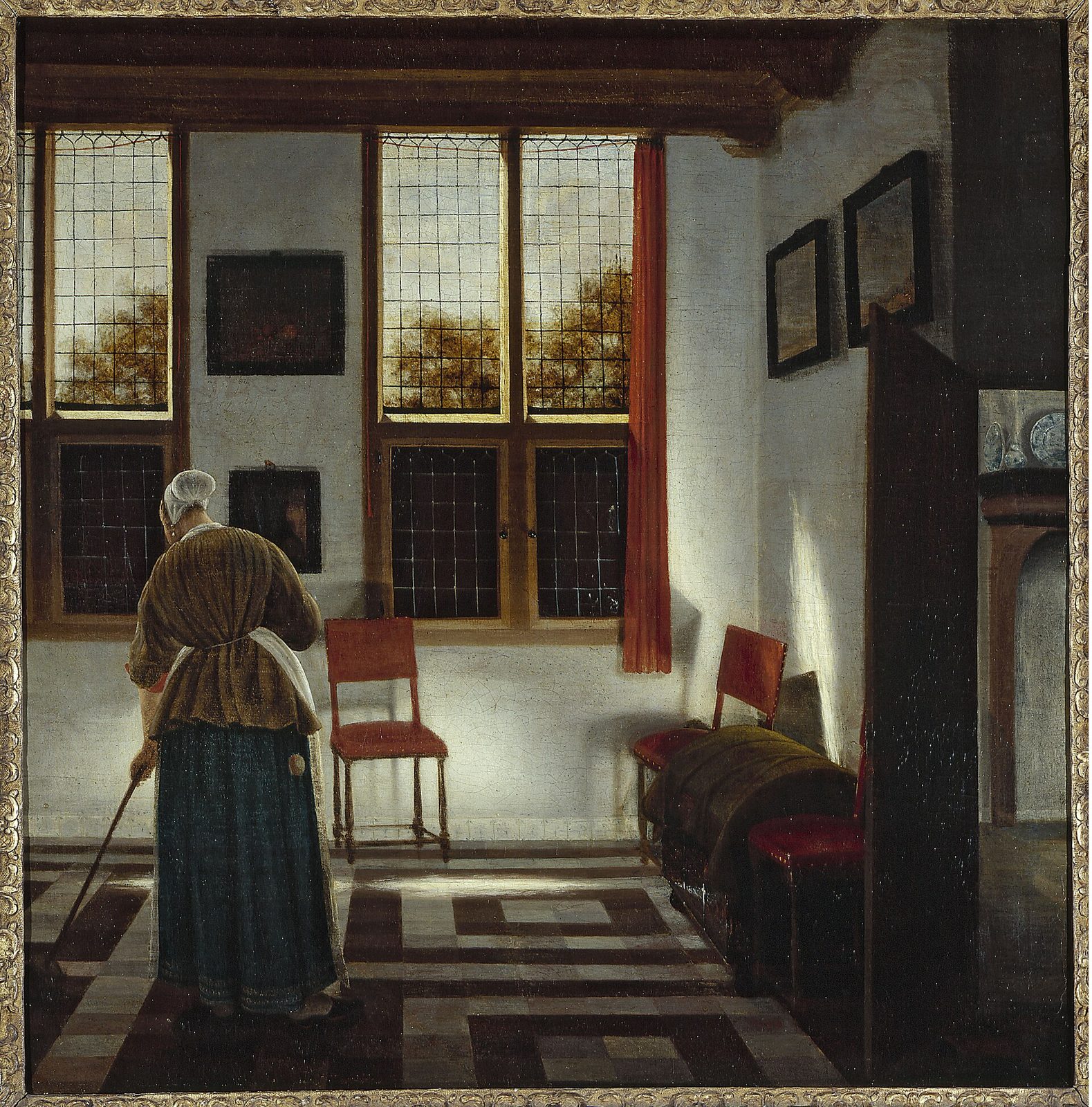
The woman sweeping the floor in this painting by Pieter Janssens Elinga is a quiet yet powerful presence, her back turned to us as she engages in the daily rhythm of domestic life. Dressed in a brown jacket and white apron, she stands on a striking black and white checkered tile floor, which draws the eye and emphasizes the geometric precision that Elinga is known for. The three large windows behind her, framed by red curtains, allow soft light to filter into the room, casting gentle shadows that enhance the serene atmosphere.
This scene captures the essence of 17th-century Dutch domesticity, where the mundane act of cleaning becomes a moment of stillness and reflection. The interplay of light and shadow not only highlights the woman's task but also creates a sense of depth, inviting viewers to appreciate the architectural details of the room. Elinga’s focus on perspective and geometry reflects his training and influences, particularly from artists like Pieter de Hooch, who also celebrated the beauty of everyday life.
Born in Bruges in 1623, Elinga later moved to Rotterdam and then Amsterdam, where he created many of his most recognized works. His dedication to depicting domestic interiors and genre scenes earned him a place among the notable painters of the Dutch Golden Age.
Pieter Janssens Elinga, born in Bruges in 1623, was a notable Dutch Golden Age painter recognized for his domestic interior scenes and still lifes. Likely trained by his father, he moved to Rotterdam in 1653, adopting the name Elinga, and later settled in Amsterdam. His works are characterized by a meticulous attention to geometric elements, particularly in the depiction of windows and floor tiles, reflecting a deep understanding of perspective influenced by contemporaries like Pieter de Hooch and Willem Kalf.
Elinga's legacy is particularly marked by his innovative perspective boxes, rare artistic experiments that combined light, architecture, and the principles of the camera obscura. Only six of these boxes are known to exist today, with one displayed at the Museum Bredius in The Hague. His last recorded activity was in 1657, and he likely passed away before 1682, as his widow was noted in city records that year. Despite his struggles, Elinga's contributions to the genre of interior scenes and still life have secured him a place in art history, showcasing the intricate interplay of light and space in domestic settings.
The use of oil paint on canvas allows for rich color saturation, particularly in the warm browns of the woman's clothing and the vibrant red of the curtains. The checkered floor is not just a backdrop; it serves as a dynamic element that draws the eye and creates a rhythmic pattern across the canvas. Elinga’s careful attention to perspective is evident in the way the three windows frame the light, casting soft shadows that enhance the room's depth. The composition is structured to guide your eye through the space, from the woman sweeping to the inviting fireplace, creating a sense of harmony and tranquility. Each element is thoughtfully placed, showcasing Elinga's skill in balancing geometric precision with the warmth of domestic life.
Elinga's work is significant not just for its aesthetic appeal but also for its contribution to genre art. He was part of a movement that elevated everyday scenes to a place of importance in the art world. His focus on domestic interiors influenced later artists who sought to capture the essence of ordinary life. The legacy of his perspective boxes, which experimented with light and architectural elements, also paved the way for future explorations in perspective and realism in painting. Elinga's work reminds us of the beauty found in the mundane, an idea that resonates through art history.
One surprising fact about Pieter Janssens Elinga is that he created perspective boxes, a unique form of art that combined painting with the principles of optics. These boxes were not just artistic endeavors but also experiments with light and space, showcasing Elinga's innovative approach to visual perception.
A perspective box is a unique art form that combines painting with optical principles, and Elinga is known for creating these boxes as experiments with light and space.
Elinga was influenced by artists Pieter de Hooch and Willem Kalf, who also focused on domestic scenes and still lifes.
After Elinga's death, his widow was registered in a notarized document in 1682, indicating that she was left to manage their affairs.