Landscape with the Port of Santa Marinella
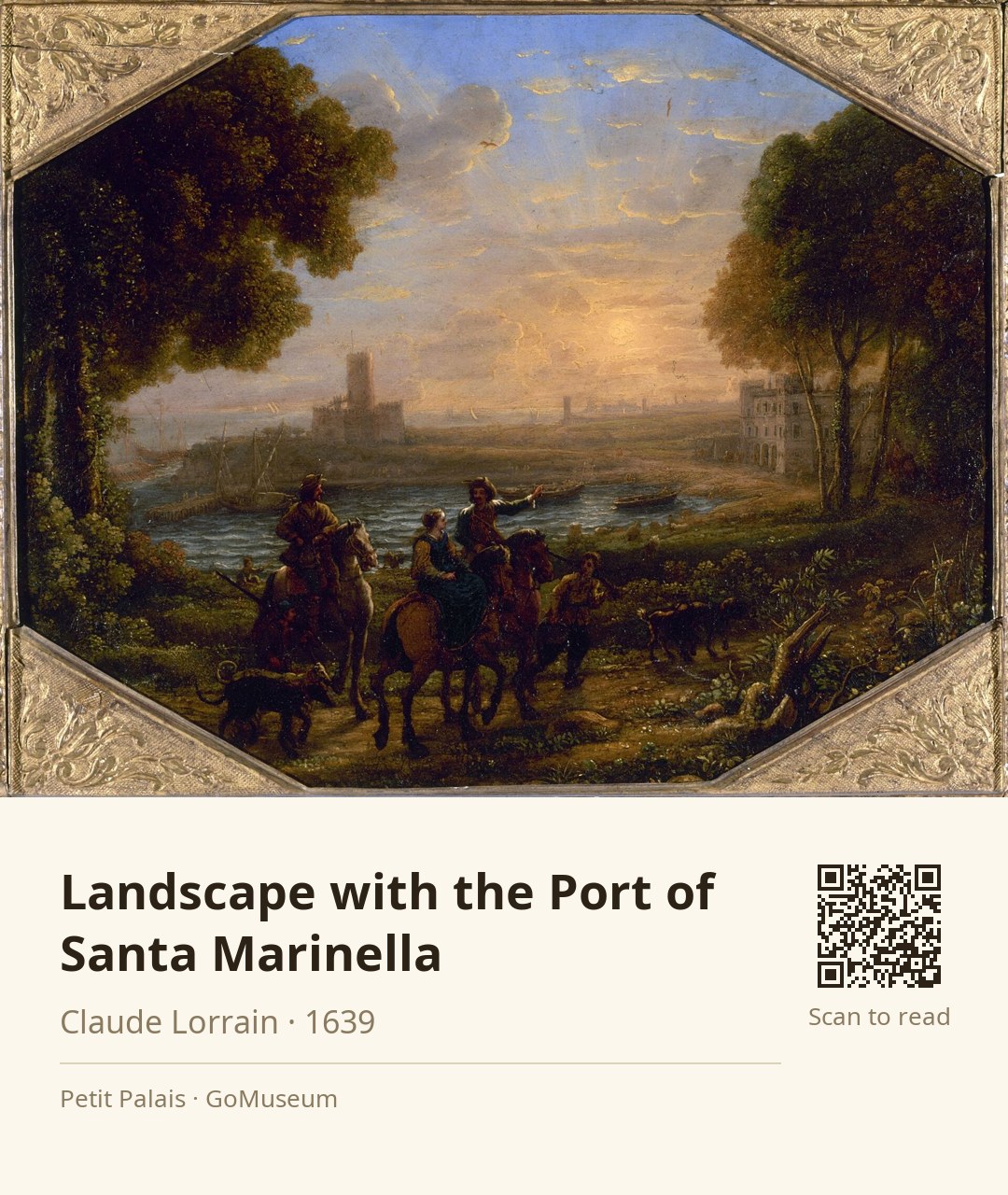
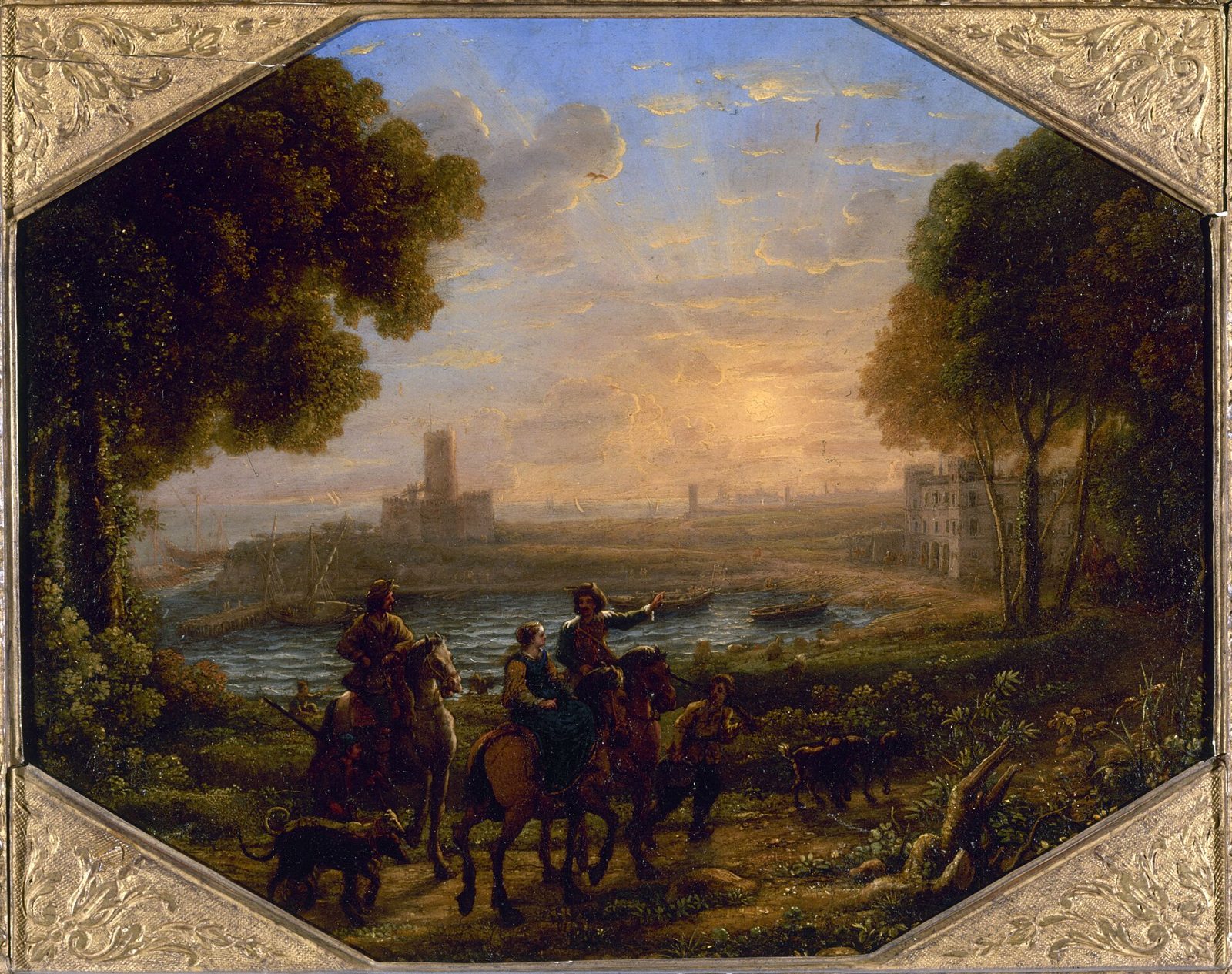
🎧 This work has audio narration — listen in the appThe sun sets over the tranquil waters of Santa Marinella, casting a warm glow that bathes the landscape in golden hues. In the foreground, a group of horsemen, accompanied by dogs, traverse a winding path, while one rider gestures towards the horizon, inviting connection and conversation among the figures. To the right, a grand building with elegant arches stands sentinel, hinting at the human presence in this idyllic scene, while a castle-like structure looms in the background, silhouetted against the vibrant sky.
This painting is not merely a representation of Santa Marinella; it’s an idealized vision crafted by Claude Lorrain, who skillfully blends reality with fantasy. The lush greens and earthy browns of the landscape are enriched by the soft light reflecting off the water, creating a sense of depth and tranquility. Lorrain’s mastery of light not only captures the essence of sunset but also conveys the passage of time, a hallmark of his work. By focusing on the beauty of the scene rather than strict accuracy, he invites viewers into a dreamlike world where nature and architecture harmoniously coexist.
Claude Lorrain, born Claude Gellée around 1600 in the Duchy of Lorraine, was a pivotal figure in Baroque landscape painting. Orphaned at a young age, he was guided by an elder brother who introduced him to art. His journey to Italy marked the beginning of a transformative career, where he apprenticed under notable artists like Goffredo Wals and Agostino Tassi. Lorrain's landscapes, often infused with sunlight, elevated the genre by incorporating small figures that hinted at historical or mythological narratives.
By the late 1630s, he had established himself as Italy's foremost landscapist, commanding significant fees for his meticulously crafted works. He produced an extensive body of drawings and etchings, which influenced future generations of artists. Although not an innovator in the traditional sense, his unique approach to light and composition set him apart. Lorrain's legacy endures, as he became a favorite among English collectors posthumously, solidifying his place in art history as a master of the Roman School and an enduring symbol of French classicism. He passed away in Rome in 1682, leaving behind a rich legacy of over 300 paintings, 1,200 drawings, and 51 etchings.
Lorrain completed it in 1639, showcasing his evolving style. The other painting in the pair, depicting Castel Gandolfo, is housed in the Fitzwilliam Museum in Cambridge. This work was acquired by the Petit Palais in Paris in 1902 as part of the Dutuit bequest. The reception of Lorrain's work was quite favorable, as he was already established as a leading landscapist in Italy, and this piece further solidified his reputation. Interestingly, Lorrain had visited Santa Marinella to sketch, but the painting is more of an idealized representation than a strict depiction of the location, focusing on beauty rather than accuracy.
Lorrain's technique in this painting is a masterclass in oil on copper, allowing for a rich depth of color and detail. The brushwork is dense and meticulous, with layers of pigment that create a luminous quality. The warm golden hues of the sunset reflect off the water, giving the scene an ethereal glow. Lorrain skillfully manipulates light to convey the passage of time, a hallmark of his work. The composition is structured with large trees framing the scene, creating a natural arch that draws your eye into the landscape. The figures on horseback are painted with a sense of movement, engaging with the viewer and each other, while the background structures rise majestically, hinting at human presence in this idyllic setting. This careful balance of natural beauty and architectural elements is what makes Lorrain's landscapes so captivating.
Lorrain visited Santa Marinella to sketch, but he created an idealized representation of the landscape instead of a precise depiction, emphasizing beauty over accuracy.
Yes, there is a drawing of the same subject, which is the same size as the painting, held in the collection of the Metropolitan Museum of Art.
Lorrain's use of oil on copper in this painting is notable for creating a rich depth of color and detail.