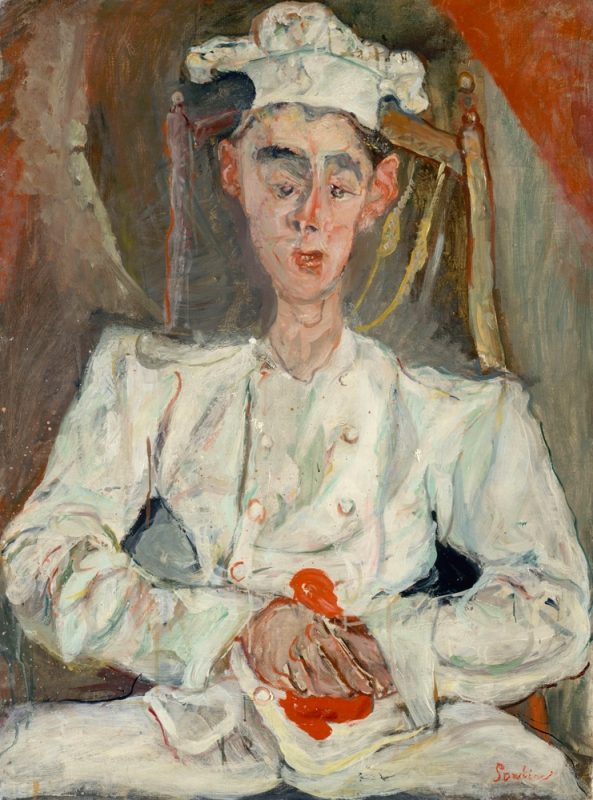
Le petit patissier
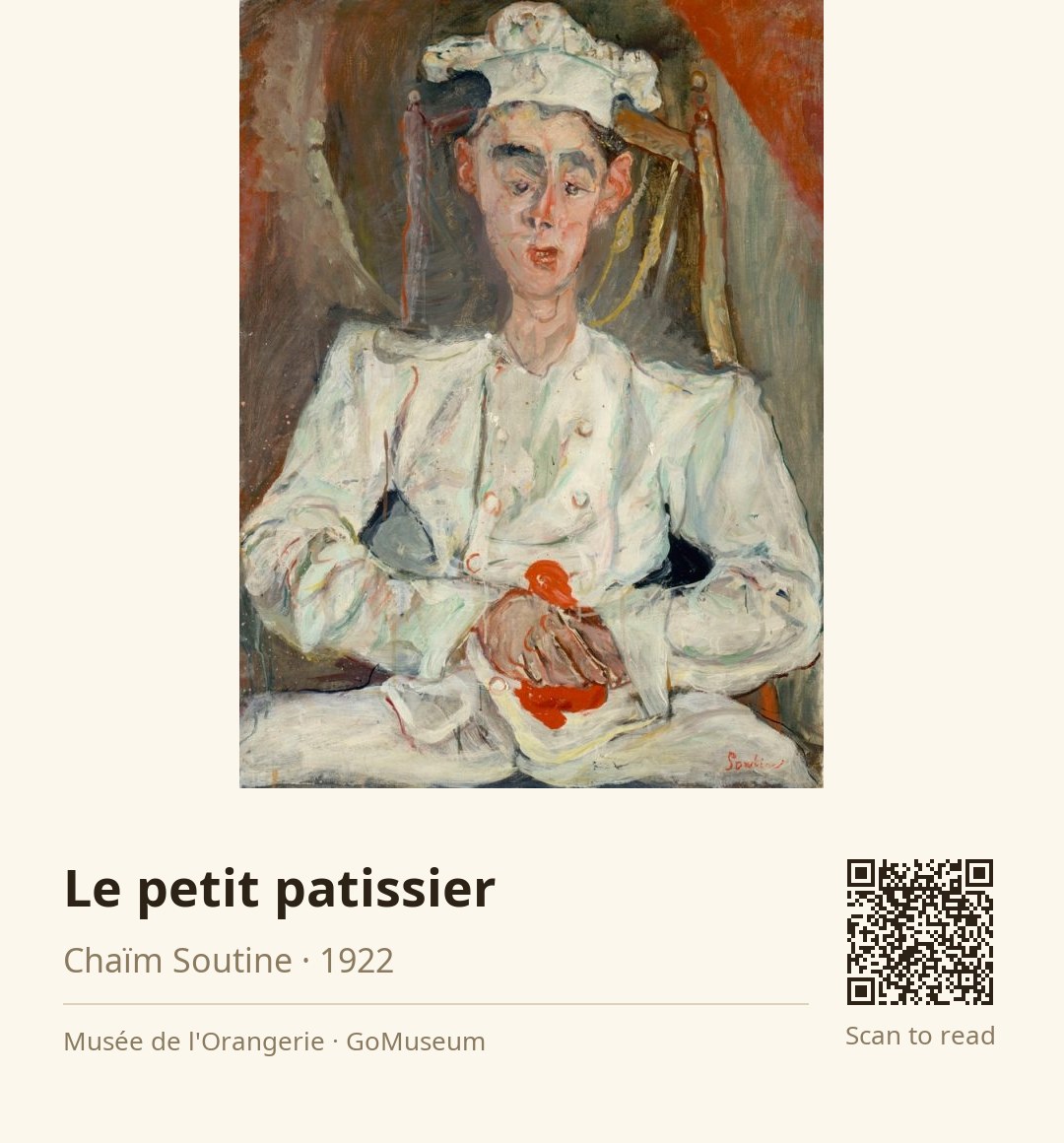
🎧 This work has audio narration — listen in the appThe young pastry chef in "Le petit patissier" captures a moment of quiet contemplation, his elongated face framed by a crisp white chef's uniform and hat. The figure's hands rest gently on his lap, holding a vibrant red object that draws the eye, contrasting with the warm earthy tones of the background. This juxtaposition not only highlights the chef's attire but also evokes a sense of warmth and intimacy, inviting viewers to ponder the life and thoughts of this unknown character.
Soutine's expressive brushwork breathes life into the scene, with visible strokes that create texture and depth, reflecting his unique approach to painting. Rather than focusing solely on realistic representation, Soutine's style emphasizes shape, color, and emotion, bridging traditional techniques with the emerging forms of Abstract Expressionism. His time in Paris, surrounded by fellow artists in Montparnasse, profoundly influenced his work, allowing him to explore his identity and artistic vision amidst a vibrant, often tumultuous environment.
Created in 1922, "Le petit patissier" exemplifies Soutine's ability to convey the essence of his subjects through a dynamic interplay of color and form, marking a significant moment in his artistic journey.
Chaïm Soutine was a Belarusian-Jewish painter who became a significant figure in the Expressionist movement while residing in Paris. Born in 1893 in Smilavichy, he faced a challenging childhood as one of eleven siblings in a poor family. His artistic journey began in Vilnius before he emigrated to Paris in 1913, where he studied at the École des Beaux-Arts. Soutine's time in Montparnasse, particularly at La Ruche, immersed him in a vibrant community of artists, including Modigliani and Chagall.
Despite struggling with poverty and health issues, Soutine developed a unique style that emphasized shape, color, and texture over mere representation. His works, often characterized by vivid, tumultuous colors and distorted forms, bridged traditional painting and the emerging Abstract Expressionism. Although he maintained a distance from artistic movements, his influence grew, particularly after American collector Albert Barnes acquired a significant number of his paintings in the 1920s.
Soutine's life was marked by introversion and a reluctance to share his thoughts, leading to a somewhat enigmatic persona. His art reflects a deep engagement with the medium, often seen as a quest for salvation. Despite his struggles, Soutine's legacy endures, recognized as a precursor to later artistic movements and celebrated for his emotional depth and innovative approach to painting.
Created in 1922, 'Le petit patissier' has a rich history of provenance. It was first owned by Léopold Zborowski in 1928, followed by Jos Hessel in Paris in 1930. Later, it passed through the hands of Paul Guillaume and then to Mme Vve Jean Walter. The painting has been featured in several exhibitions, including a retrospective at the Galerie de France in Paris in 1945 and a display at the Museum of Modern Art in New York in 1950. It was also part of the 1952 exhibition at the Society of the Four Arts in Palm Beach, showcasing Soutine's work to a wider audience.
In 'Le petit patissier', the seated figure is enveloped in a white chef's uniform that starkly contrasts with the warm, earthy tones of the background, which blend oranges and browns. The elongated face, with its exaggerated features, conveys a contemplative expression, drawing you into the chef's inner world. His hands, resting on his lap, cradle a vibrant red object that captures attention, adding a pop of color to the scene. The brushwork is loose and expressive, with visible strokes that create a sense of texture and depth, particularly in the clothing and the background, which enhances the overall emotional impact of the piece.
Soutine learned French in the back of La Rotonde, a café managed by Victor Libion, which served as a gathering place for artists.
When Soutine first arrived in Paris, he experienced extreme poverty, often sleeping in stairways and on benches.