Eglise Saint-Pierre
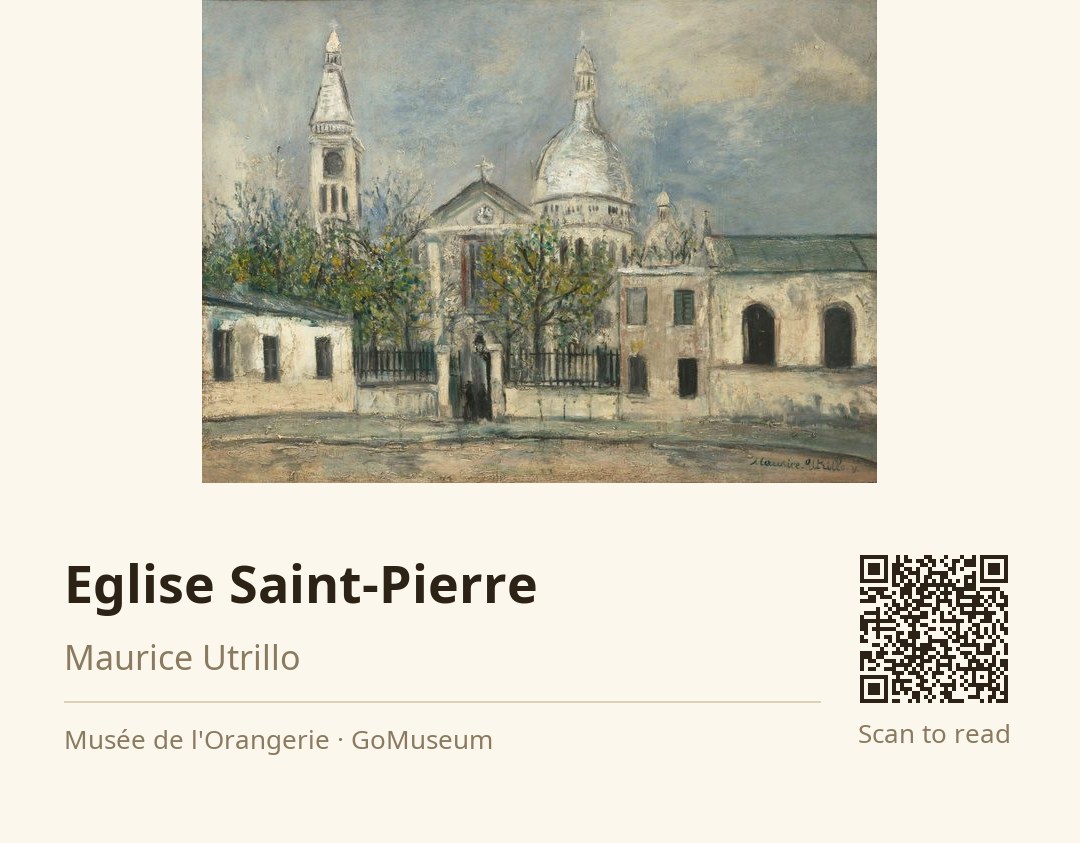
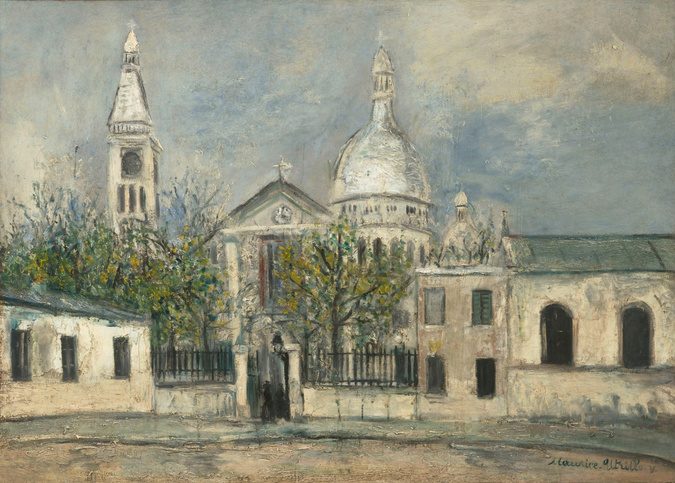
🎧 This work has audio narration — listen in the appThe grand dome of Église Saint-Pierre rises prominently against a muted sky, flanked by a bell tower that adds a sense of verticality to the scene. In the foreground, two figures stand near a gated entrance, their presence grounding the composition amidst the soft brushwork of the trees that suggest a tranquil early spring or late autumn day.
Utrillo's choice of a subdued palette—blues, grays, and earthy browns—creates an atmosphere that feels both reflective and serene, inviting viewers to contemplate the architectural beauty of this Parisian landmark. The gentle handling of the foliage and sky evokes an impressionistic quality, while the central dome draws the eye upward, emphasizing the church's significance in the urban landscape. This balance between the natural and built environment showcases Utrillo's mastery in capturing the essence of Montmartre, where he lived and painted.
Born in 1883, Utrillo was the son of the artist Suzanne Valadon and grew up amidst the vibrant artistic community of Montmartre. His struggles with mental health and alcoholism led him to paint as a form of therapy, ultimately resulting in a prolific career that earned him recognition and acclaim. Église Saint-Pierre, painted in the early 20th century, reflects his deep connection to the architecture of his hometown, immortalizing a piece of Parisian history.
Maurice Utrillo was a French painter born on December 26, 1883, in Montmartre, Paris, where he would later become renowned for his evocative cityscapes. The son of artist Suzanne Valadon, Utrillo faced a tumultuous childhood marked by instability and mental health struggles, including schizophrenia. Encouraged by his mother to pursue painting, he developed a unique style that captured the essence of Montmartre, gaining critical acclaim by the 1920s.
Despite his artistic success, Utrillo battled alcoholism and spent significant time in asylums. His work, characterized by a vivid portrayal of urban landscapes, earned him a place among the notable figures of the School of Paris. In 1928, he received the prestigious Cross of the Légion d'honneur, solidifying his status in the art world.
In his later years, Utrillo embraced religion and married Lucie Valore, though his health continued to decline. He painted from memory and photographs, producing works that remain popular today. Utrillo passed away on November 5, 1955, leaving behind a legacy as a quintessential Montmartre artist whose paintings continue to resonate with audiences worldwide.
Maurice Utrillo's painting, Église Saint-Pierre, was created in the early 20th century, a time when he was deeply entrenched in the artistic milieu of Montmartre. This work was part of a significant exhibition at the Galerie Charpentier in Paris, first shown in 1946 during 'Cent Chefs-d'Oeuvres des Peintres de l'École de Paris,' and later featured in a dedicated exhibition in 1959. Utrillo's connection to Montmartre is profound; he was born there and spent much of his life capturing its essence. The painting's provenance traces back to notable collectors, including Guillaume Paul and Walter Mme Vve Jean, which adds layers to its history.
In Église Saint-Pierre, Utrillo employs oil on cardboard, a choice that allows for a soft yet textured finish. The brushwork is notably gentle, with each stroke contributing to the impressionistic quality of the trees and sky. The muted palette of blues, grays, and earthy browns creates a cohesive atmosphere, enhancing the serene mood of the scene. Utrillo's technique of layering paint adds depth, allowing the dome and bell tower to emerge with a subtle vibrancy against the subdued background. The composition is carefully balanced; the central dome draws the eye upward, while the figures in the foreground anchor the scene, inviting viewers to ponder the relationship between the architecture and its surroundings. This delicate interplay of elements showcases Utrillo's mastery in capturing the spirit of Montmartre.
A curious anecdote about Utrillo's origins involves his mother, Suzanne Valadon, who, after giving birth, sought the opinions of famous artists about her baby. When she brought him to Renoir, he dismissed the child with a comment about his color, and Degas remarked on his form.
Many of Utrillo's paintings, including his popular 1936 work Montmartre Street Corner, are featured on postcards, making them a part of the tourist experience in Montmartre today.
In 2022, a painting by Utrillo that was looted by the Nazis was returned to the heirs of its original owner, showcasing the ongoing impact of his art in discussions about art restitution.