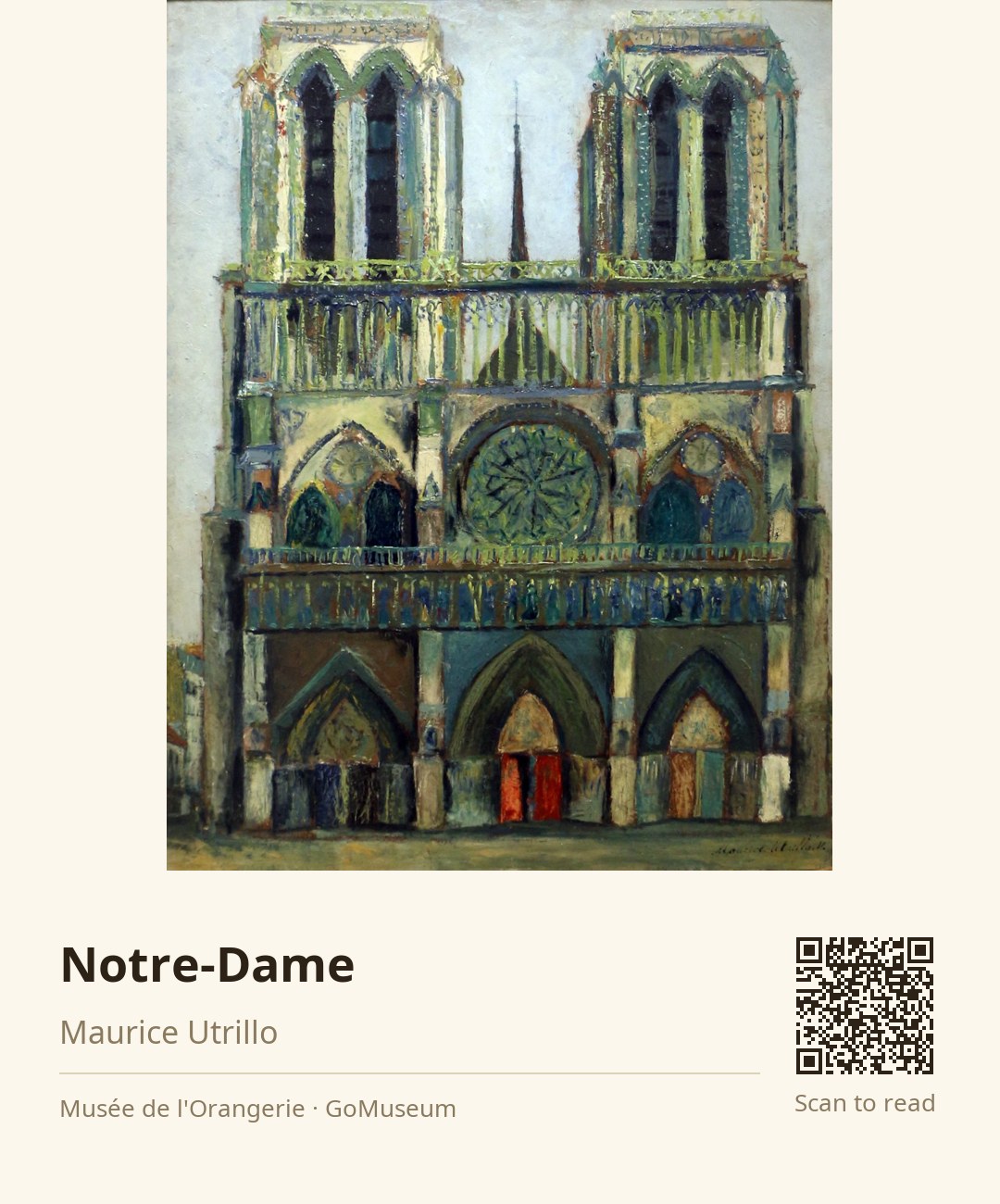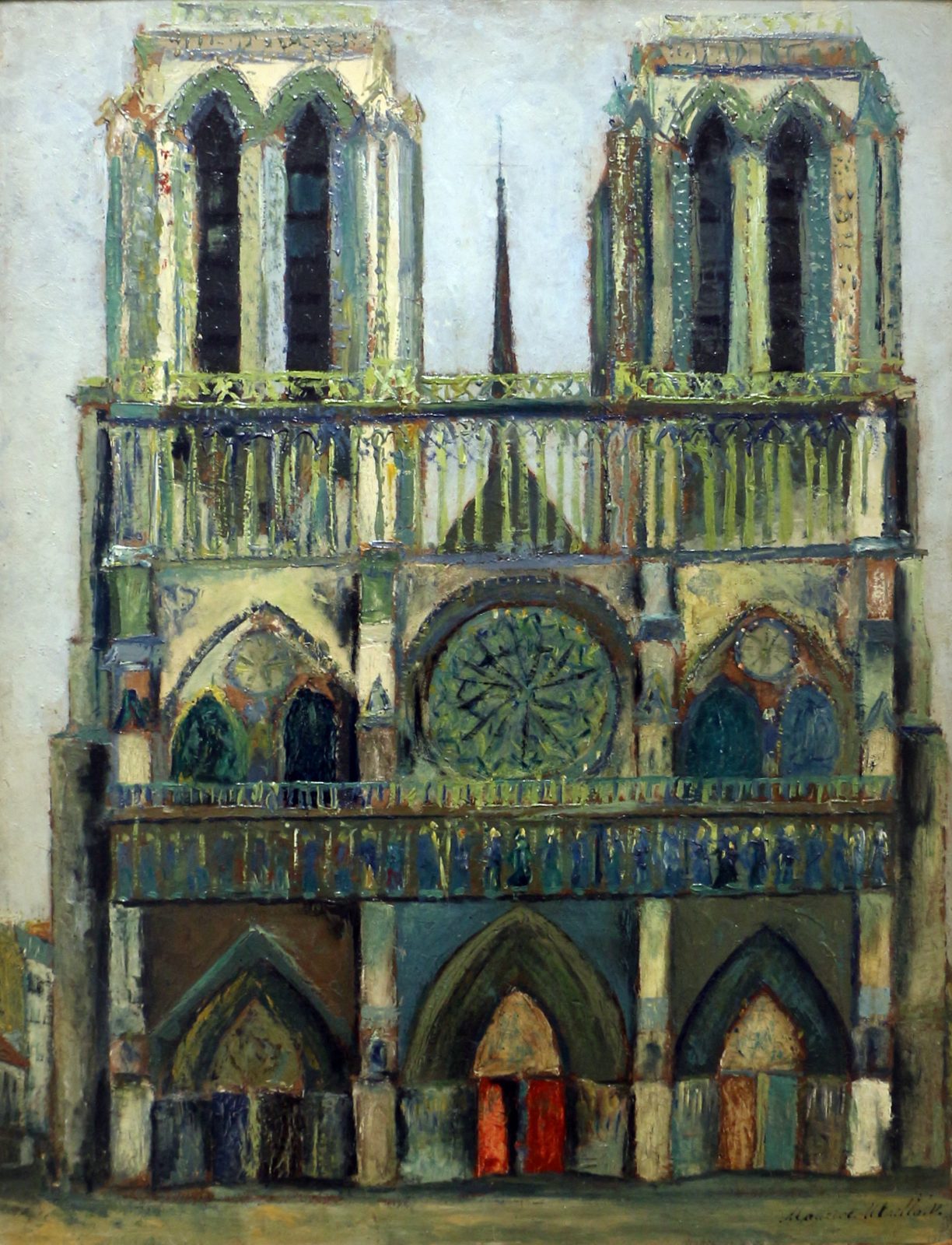
The grand facade of Notre-Dame rises before you, its two prominent towers reaching skyward, a testament to the Gothic architectural style. Pointed arches frame the large circular rose window at the center, while intricate stonework draws your eye to the three doorways below, each adorned with pointed arches. The central doorway, painted in a striking red, adds a vibrant contrast to the muted greens and blues that dominate the palette.
This depiction captures not just the physical structure but also the spirit of Paris in the early 20th century, reflecting a time when artists like Utrillo sought to immortalize the city's iconic landmarks. The textured brushwork enhances the depth of the stone surfaces, inviting you to appreciate the craftsmanship that went into both the cathedral and the painting itself. The overcast gray sky serves as a subtle backdrop, allowing the cathedral's details to stand out, emphasizing its grandeur amidst the urban landscape.
Maurice Utrillo was a French painter born on December 26, 1883, in Montmartre, Paris, where he would later become renowned for his evocative cityscapes. The son of artist Suzanne Valadon, Utrillo faced a tumultuous childhood marked by instability and mental health struggles, including schizophrenia. Encouraged by his mother to pursue painting, he developed a unique style that captured the essence of Montmartre, gaining critical acclaim by the 1920s.
Despite his artistic success, Utrillo battled alcoholism and spent significant time in asylums. His work, characterized by a vivid portrayal of urban landscapes, earned him a place among the notable figures of the School of Paris. In 1928, he received the prestigious Cross of the Légion d'honneur, solidifying his status in the art world.
In his later years, Utrillo embraced religion and married Lucie Valore, though his health continued to decline. He painted from memory and photographs, producing works that remain popular today. Utrillo passed away on November 5, 1955, leaving behind a legacy as a quintessential Montmartre artist whose paintings continue to resonate with audiences worldwide.
Utrillo's technique in 'Notre-Dame' is striking, with his use of oil paint on cardboard allowing for a rich texture that brings the cathedral's stonework to life. The brushwork is both bold and delicate, creating a tactile quality that invites viewers to feel the weight of the stone. The muted greens and blues dominate the palette, but it's the vibrant red of the central doorway that draws your eye, creating a focal point amidst the earthy tones. The composition is carefully balanced, with the two towers framing the rose window, guiding your gaze upward. The overcast gray sky serves not just as a backdrop but enhances the overall mood, emphasizing the grandeur of the cathedral while allowing the intricate details to shine through.
The Exposition universelle in 1937 showcased this painting, highlighting its importance in the context of contemporary art at that time.