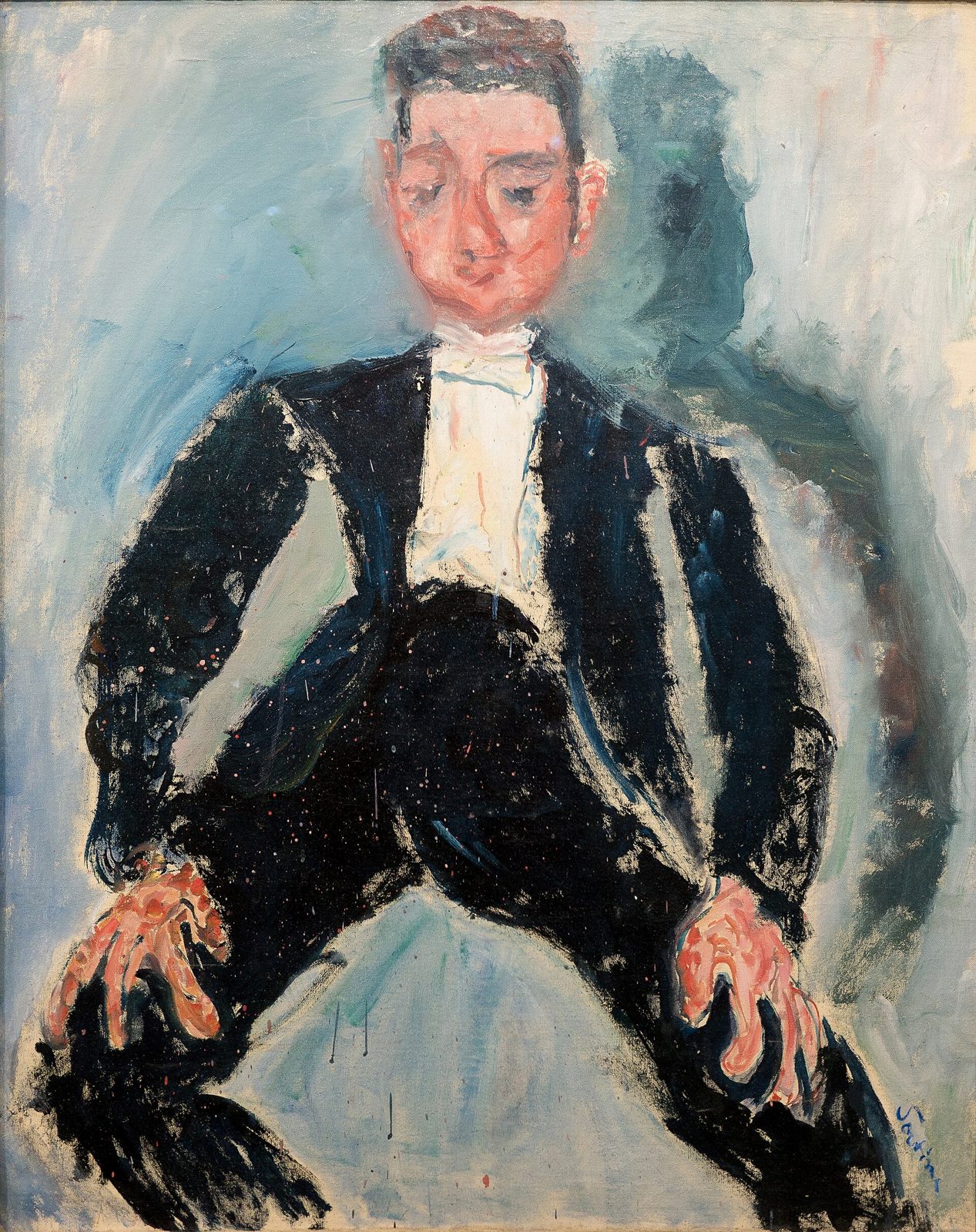
 Image: Chaïm Soutine (1893 - 1943), Coll. Jean Walter et Paul Guillaume, Musée de l'Orangerie, Paris
Garçon d'honneur
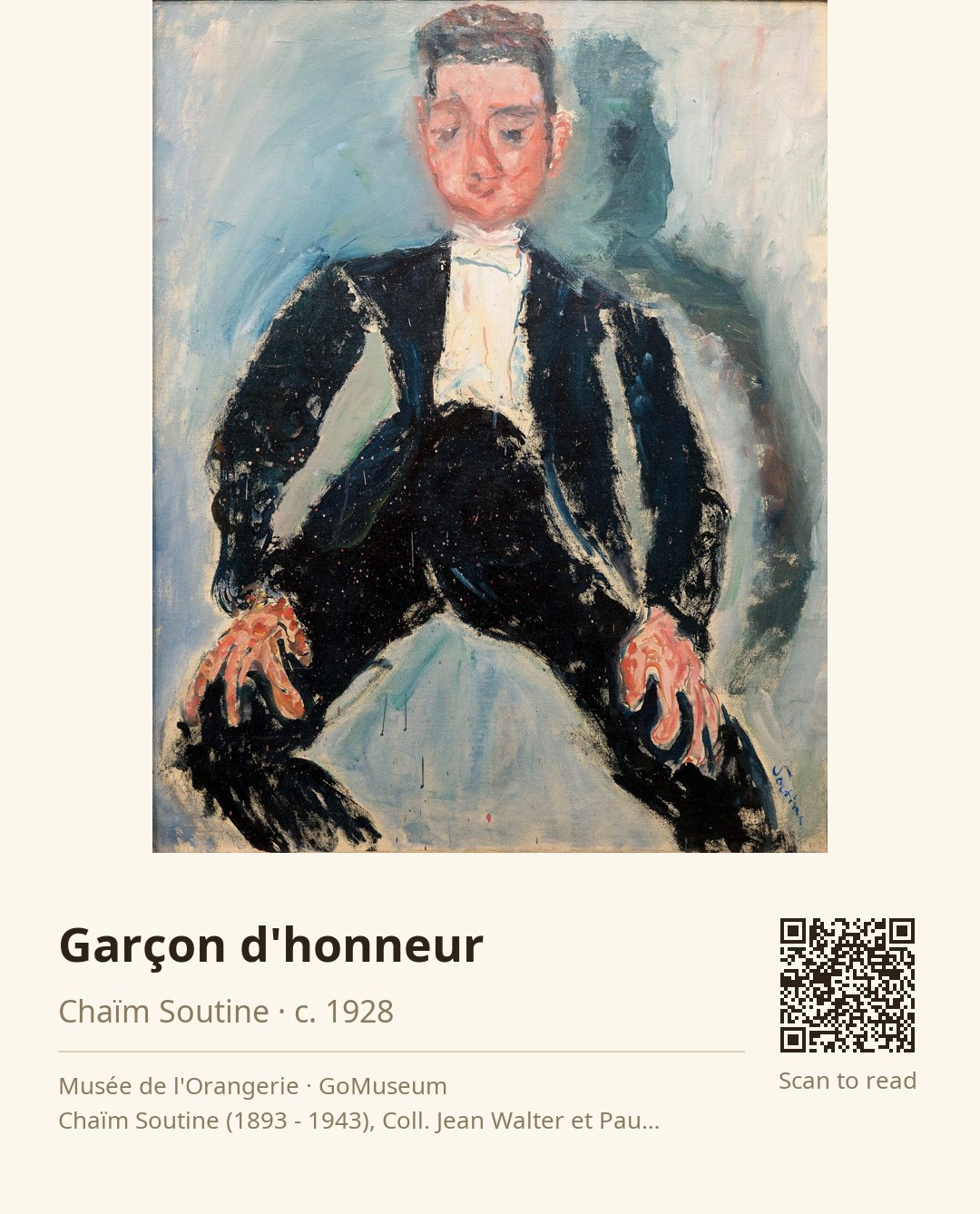
🎧 This work has audio narration — listen in the appThe seated figure in "Garçon d'honneur" wears a formal black suit, the white shirt stark against the dark fabric. His head tilts slightly downward, eyes closed, exuding a serene calmness. The exaggerated fingers resting on his knees draw your attention, their expressive forms contrasting with the abstract blues and grays swirling in the background, creating a sense of depth that envelops him.
This portrayal captures not just a moment but the essence of Soutine's emotional intensity. The loose brushwork and textured surface reflect his unique approach to painting, where color and form take precedence over strict representation. Soutine's style bridges traditional techniques and the emerging Abstract Expressionism, allowing the viewer to feel the weight of the figure's presence and the artist's inner turmoil. The cool palette, punctuated by subtle hints of warmth in the face and hands, suggests a complex emotional landscape, inviting contemplation of the subject's identity and the artist's own struggles.
Born in Belarus and later moving to Paris, Soutine became a pivotal figure in the Expressionist movement. His work, often characterized by dramatic forms and vibrant colors, was recognized only after years of hardship, with significant support coming from art dealers like Paul Guillaume. In the late 1920s, Soutine's artistic vision was solidifying, culminating in pieces like this one, which exemplify his distinctive style and emotional depth.
Chaïm Soutine was a Belarusian-Jewish painter who became a significant figure in the Expressionist movement while residing in Paris. Born in 1893 in Smilavichy, he faced a challenging childhood as one of eleven siblings in a poor family. His artistic journey began in Vilnius before he emigrated to Paris in 1913, where he studied at the École des Beaux-Arts. Soutine's time in Montparnasse, particularly at La Ruche, immersed him in a vibrant community of artists, including Modigliani and Chagall.
Despite struggling with poverty and health issues, Soutine developed a unique style that emphasized shape, color, and texture over mere representation. His works, often characterized by vivid, tumultuous colors and distorted forms, bridged traditional painting and the emerging Abstract Expressionism. Although he maintained a distance from artistic movements, his influence grew, particularly after American collector Albert Barnes acquired a significant number of his paintings in the 1920s.
Soutine's life was marked by introversion and a reluctance to share his thoughts, leading to a somewhat enigmatic persona. His art reflects a deep engagement with the medium, often seen as a quest for salvation. Despite his struggles, Soutine's legacy endures, recognized as a precursor to later artistic movements and celebrated for his emotional depth and innovative approach to painting.
Soutine's technique in 'Garçon d'honneur' is a vivid testament to his emotional intensity and innovative approach. The loose brushwork creates a dynamic surface, where each stroke seems to pulsate with energy. The exaggerated fingers, resting on the knees, are not just a stylistic choice; they convey a sense of vulnerability and expressiveness that draws the viewer in. The cool palette, dominated by blues and grays, contrasts sharply with the subtle warmth in the figure's face and hands, suggesting a complex emotional landscape. Soutine's choice to use thick layers of paint adds a tactile quality, inviting you to feel the weight of the figure's presence. This layering technique, reminiscent of Van Gogh, enhances the painting's depth, allowing the background to swirl around the figure, creating a sense of isolation yet connection to the surrounding space.
Soutine learned French in the back of La Rotonde, a café managed by Victor Libion, which served as a gathering place for artists.
After moving to Paris, Soutine was influenced by French literature, reading works by authors such as Balzac, Baudelaire, and Rimbaud.
Soutine faced severe financial struggles in Paris, which led him to sleep in stairways and on benches.