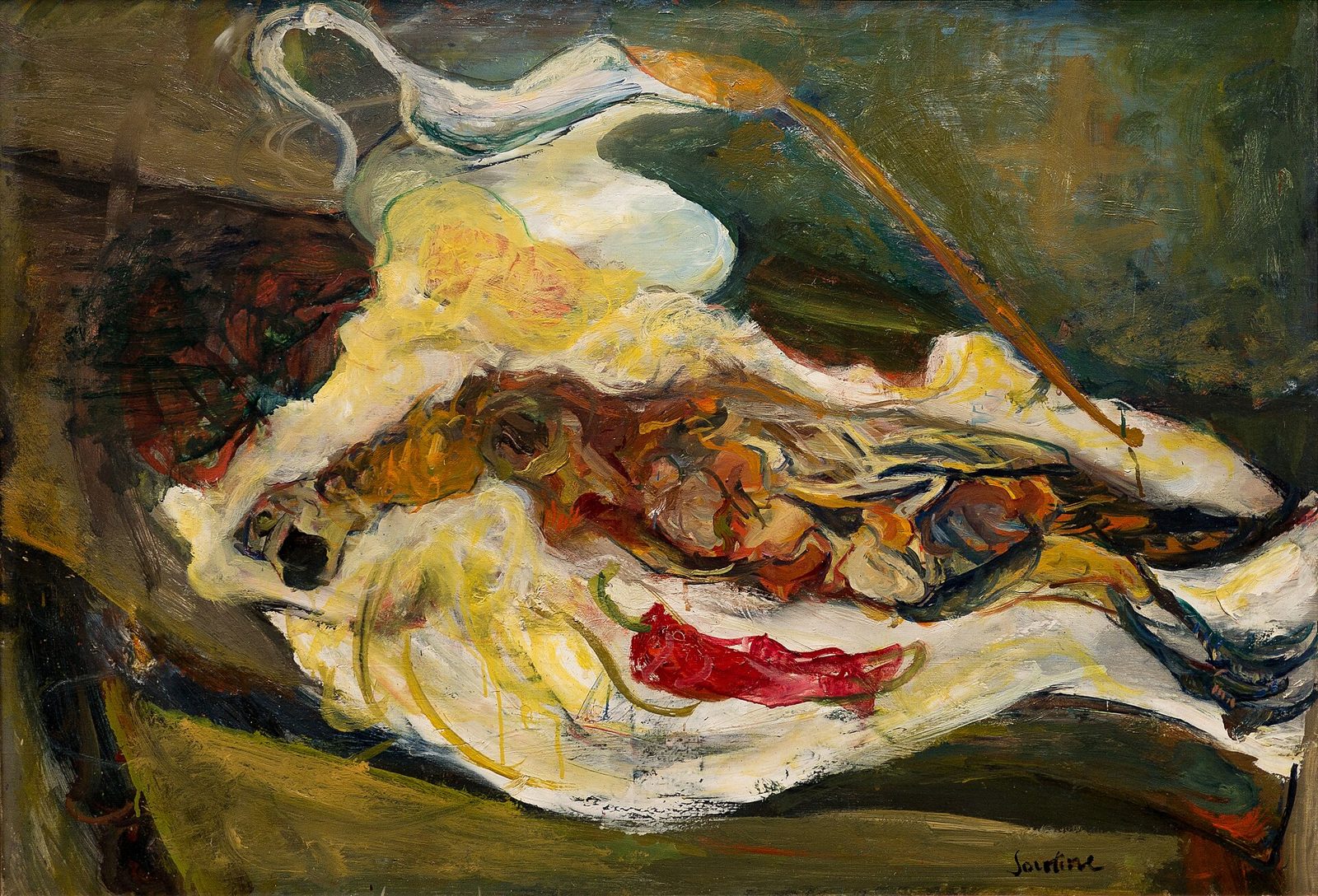
 Image: Chaïm Soutine (1893 - 1943), Coll. Jean Walter et Paul Guillaume, Musée de l'Orangerie, Paris
Nature morte au faisan
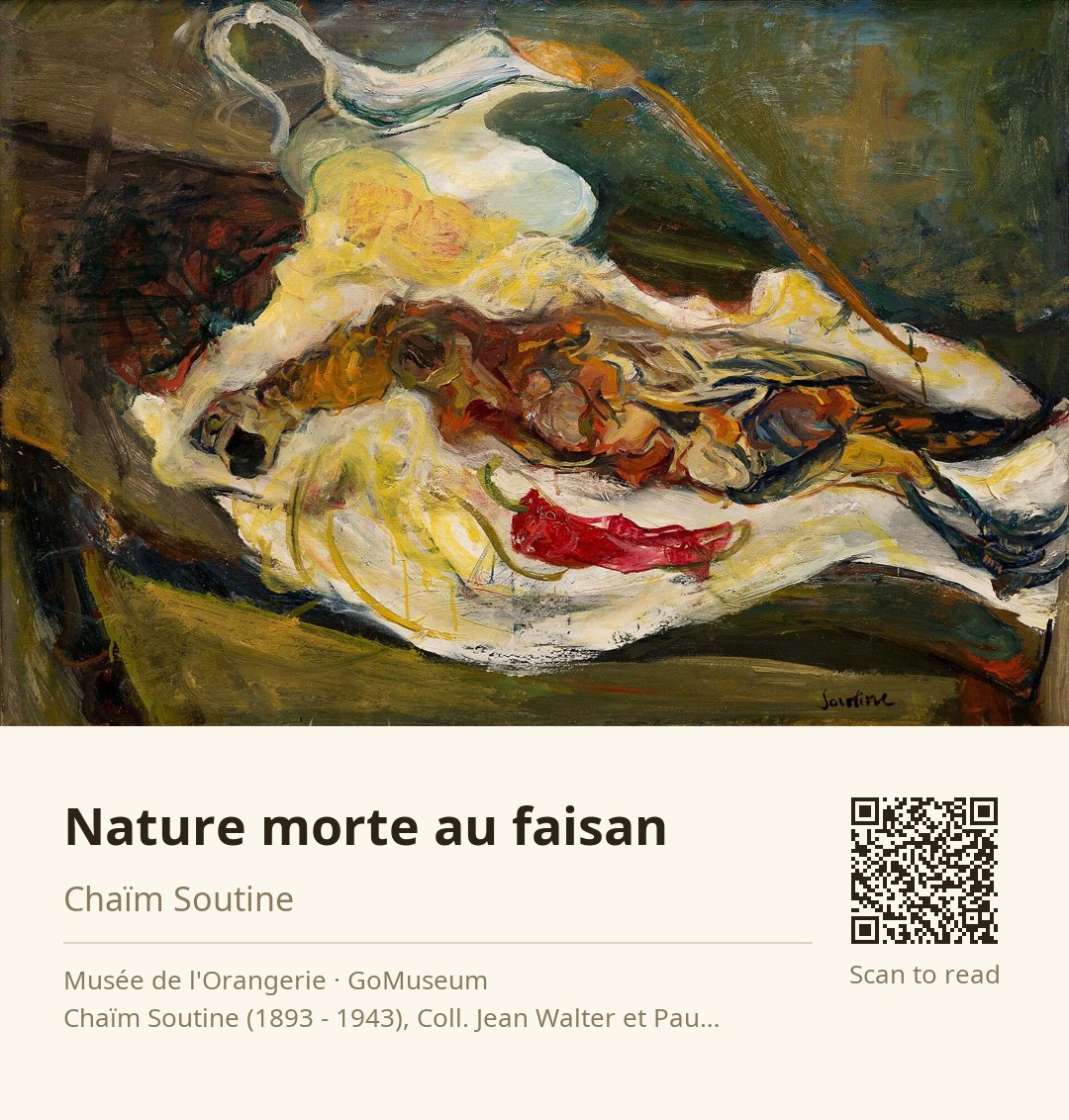
🎧 This work has audio narration — listen in the appA large, white cloth drapes elegantly across the surface, its flowing texture contrasting sharply with the vibrant red pepper and a medley of organic forms scattered atop it. The rich, swirling strokes of orange, brown, and yellow bring these food items to life, while a white pitcher with a curved handle sits poised above, its spout directing attention to the center of this lively composition.
The interplay of colors and textures creates a sense of movement, inviting you to explore the dynamic brushwork that Chaïm Soutine is known for. Each stroke seems to pulse with energy, reflecting the artist's emotional connection to his subjects. The dark greens and browns of the background serve to enhance the vividness of the foreground, emphasizing the importance of the still life as a celebration of everyday objects transformed through Soutine's expressive style.
Painted in the early 20th century, "Nature morte au faisan" exemplifies Soutine's unique approach to still life, where the ordinary becomes extraordinary through his passionate technique. This work is part of a rich legacy that has been exhibited in various prestigious galleries, including the 1942 exhibition at Galerie Georges Moos in Geneva.
Chaïm Soutine was a Belarusian-Jewish painter who became a significant figure in the Expressionist movement while residing in Paris. Born in 1893 in Smilavichy, he faced a challenging childhood as one of eleven siblings in a poor family. His artistic journey began in Vilnius before he emigrated to Paris in 1913, where he studied at the École des Beaux-Arts. Soutine's time in Montparnasse, particularly at La Ruche, immersed him in a vibrant community of artists, including Modigliani and Chagall.
Despite struggling with poverty and health issues, Soutine developed a unique style that emphasized shape, color, and texture over mere representation. His works, often characterized by vivid, tumultuous colors and distorted forms, bridged traditional painting and the emerging Abstract Expressionism. Although he maintained a distance from artistic movements, his influence grew, particularly after American collector Albert Barnes acquired a significant number of his paintings in the 1920s.
Soutine's life was marked by introversion and a reluctance to share his thoughts, leading to a somewhat enigmatic persona. His art reflects a deep engagement with the medium, often seen as a quest for salvation. Despite his struggles, Soutine's legacy endures, recognized as a precursor to later artistic movements and celebrated for his emotional depth and innovative approach to painting.
Chaïm Soutine's "Nature morte au faisan" was painted in the early 20th century, specifically in the second quarter of the 1900s. This piece was part of a vibrant artistic movement that sought to break away from traditional representations of still life. Commissioned by notable collectors, it found its way into the hands of Guillaume Paul and later Walter Mme Vve Jean. The painting gained recognition through various exhibitions, including the 1942 showcase at Galerie Georges Moos in Geneva, where it was displayed as part of the 'art français depuis 1900' exhibition. It continued to be celebrated in subsequent exhibitions, such as 'la vie silencieuse' at Galerie Charpentier in Paris in 1946 and the 1952 Venice Biennale, where it was featured among thirty-five works by Soutine.
In "Nature morte au faisan," Soutine employs a bold and expressive technique that brings the still life to life. The thick, swirling brushstrokes create a sense of movement, almost as if the objects are dancing on the canvas. The vibrant red pepper and the organic forms are painted with a rich palette of orange, brown, and yellow, layered in a way that adds depth and texture. This layering technique not only enhances the visual appeal but also evokes an emotional resonance, inviting viewers to feel the artist's passion for his subjects. The white cloth drapes elegantly, contrasting with the darker greens and browns of the background, which serves to elevate the foreground elements. Soutine's choice of scale, with the cloth dominating the canvas, draws the eye and emphasizes the beauty of everyday objects transformed through his dynamic style.
The large scale of the cloth in the painting draws attention and highlights the beauty of everyday objects, showcasing Soutine's dynamic artistic style.