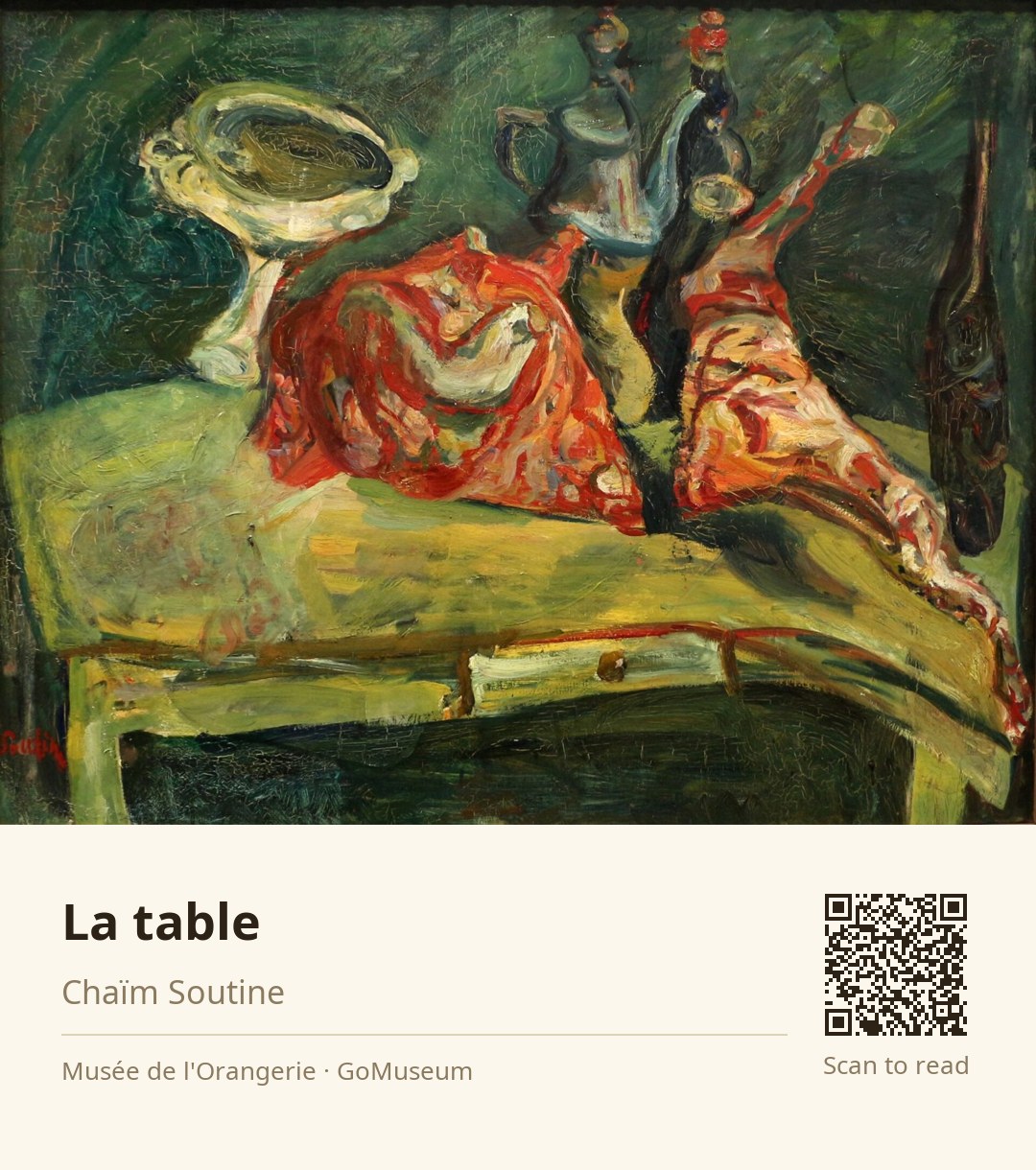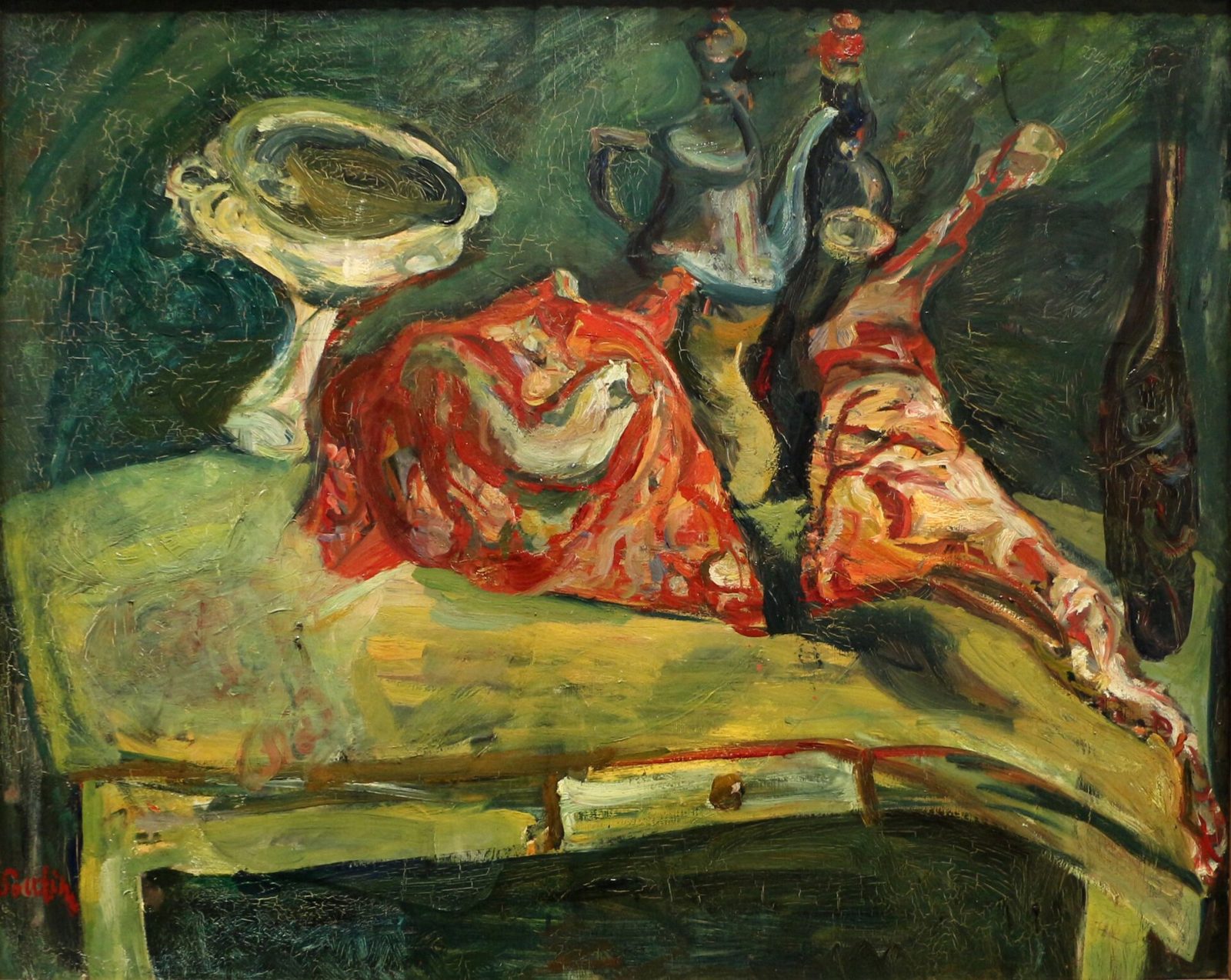
The vibrant piece of meat at the center of "La table" draws your eye immediately, its rich reds and whites almost pulsating with life. Flanking it, a white ceramic dish with a dark interior and two dark bottles create a striking contrast, while the swirling greens and blues of the background add depth and drama to the scene. This bold use of color and texture not only showcases Soutine's mastery of oil paint but also reflects his emotional intensity, transforming a simple still life into a visceral experience.
Rather than merely representing objects, he imbues them with a sense of movement and energy, as if they are alive. The dynamic brushwork and vivid palette invite viewers to engage with the painting on a sensory level, evoking the rawness of the meat and the coolness of the metal teapot. This technique serves as a bridge between traditional representation and the emerging forms of Abstract Expressionism, marking Soutine as a pivotal figure in 20th-century art.
In the early 20th century, Soutine struggled with poverty and isolation as he navigated the vibrant yet challenging art scene of Paris. His work gained recognition in the 1920s, particularly after being championed by influential collectors like Paul Guillaume and Albert C. Barnes. "La table" exemplifies Soutine's unique vision, created during a period when he was establishing his identity as a significant artist in the School of Paris.
Chaïm Soutine was a Belarusian-Jewish painter who became a significant figure in the Expressionist movement while residing in Paris. Born in 1893 in Smilavichy, he faced a challenging childhood as one of eleven siblings in a poor family. His artistic journey began in Vilnius before he emigrated to Paris in 1913, where he studied at the École des Beaux-Arts. Soutine's time in Montparnasse, particularly at La Ruche, immersed him in a vibrant community of artists, including Modigliani and Chagall.
Despite struggling with poverty and health issues, Soutine developed a unique style that emphasized shape, color, and texture over mere representation. His works, often characterized by vivid, tumultuous colors and distorted forms, bridged traditional painting and the emerging Abstract Expressionism. Although he maintained a distance from artistic movements, his influence grew, particularly after American collector Albert Barnes acquired a significant number of his paintings in the 1920s.
Soutine's life was marked by introversion and a reluctance to share his thoughts, leading to a somewhat enigmatic persona. His art reflects a deep engagement with the medium, often seen as a quest for salvation. Despite his struggles, Soutine's legacy endures, recognized as a precursor to later artistic movements and celebrated for his emotional depth and innovative approach to painting.
The painting was exhibited in 1959 at the galerie Charpentier in Paris, as part of a show titled 'cent tableaux de Soutine.' This exhibition helped to further solidify Soutine's presence in the art world, showcasing his unique vision and style. The painting is part of a collection that has passed through notable owners, including Paul Guillaume and Mme Vve Jean Walter, reflecting its journey through the art market and its significance to collectors.
In La table, the striking piece of meat dominates the foreground, rendered with bold, expressive brushstrokes that emphasize its texture and vitality. The white ceramic dish to the left, with its dark interior, contrasts sharply with the vibrant reds of the meat, while the silver teapot and dark bottles introduce vertical elements that guide the eye through the composition. The swirling background of dark greens and blues adds depth, creating a dramatic interplay with the lighter tones of the table and objects. The overall palette is rich and dynamic, with reds, greens, and yellows that pulse with energy, inviting viewers to experience the painting's visceral qualities.
After Soutine sold 60 of his paintings to the prominent American collector Albert C. Barnes in 1923, he was so overwhelmed that he ran into the street and hailed a taxi, instructing the driver to take him to Nice, over 400 miles away.
Soutine learned French in the back of La Rotonde, a café managed by Victor Libion, who supported artists by allowing them to discuss and create without requiring additional purchases.
Soutine experienced extreme poverty in Paris, often having to sleep in stairways and on benches due to his financial struggles.
Élie Faure was a prominent art critic of the time who had a brief but intense friendship with Soutine, highlighting the personal connections Soutine had within the art world.