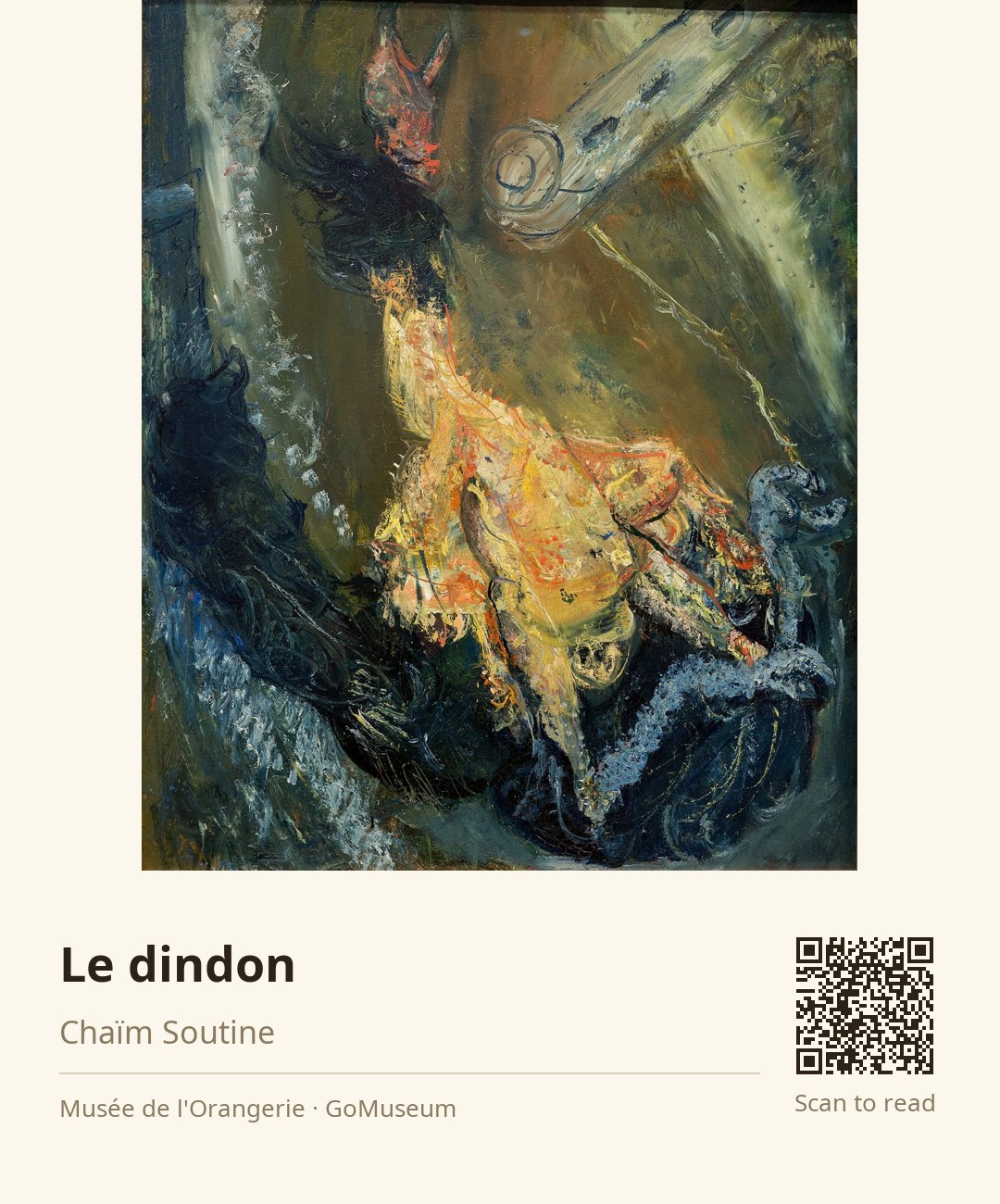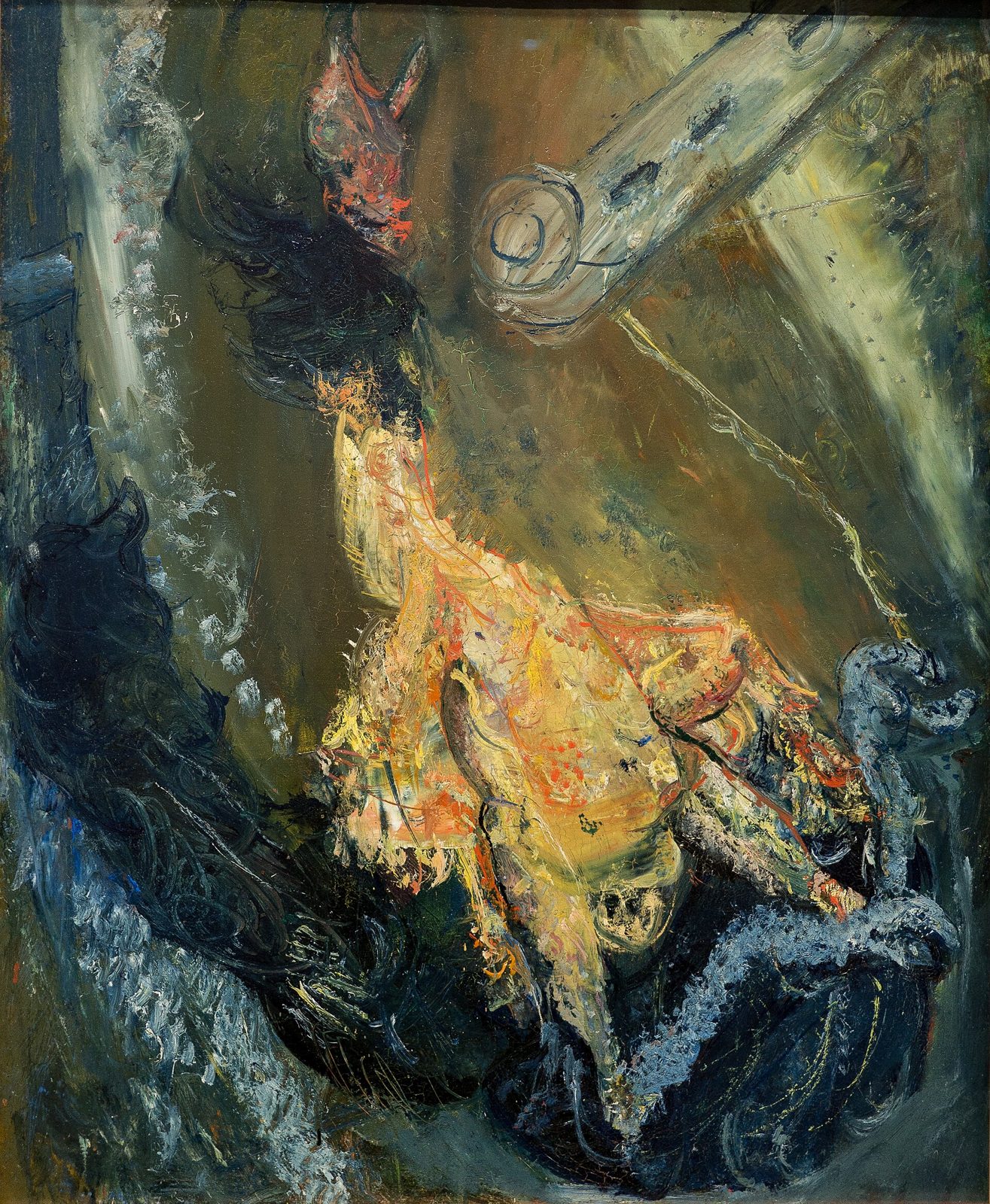
The vibrant chaos of colors in "Le dindon" draws you in, with its central area exploding in yellows, oranges, and reds that pulse with energy. Swirling dark forms, possibly figures or creatures, emerge from the depths of deep blues and blacks, creating a dynamic tension that captures the eye. The striking red, horned shape above adds an unexpected drama, while earthy browns and greens in the background ground the composition, enhancing its complexity.
Soutine's approach to this still life transforms the ordinary into something extraordinary, as the brushwork creates a rich texture that invites exploration. The interplay of light and shadow across the canvas adds depth, suggesting movement even in a static subject. In 1929, it was exhibited at the Galerie Bernheim-Jeune, marking its entry into the contemporary art scene.
Chaïm Soutine was a Belarusian-Jewish painter who became a significant figure in the Expressionist movement while residing in Paris. Born in 1893 in Smilavichy, he faced a challenging childhood as one of eleven siblings in a poor family. His artistic journey began in Vilnius before he emigrated to Paris in 1913, where he studied at the École des Beaux-Arts. Soutine's time in Montparnasse, particularly at La Ruche, immersed him in a vibrant community of artists, including Modigliani and Chagall.
Despite struggling with poverty and health issues, Soutine developed a unique style that emphasized shape, color, and texture over mere representation. His works, often characterized by vivid, tumultuous colors and distorted forms, bridged traditional painting and the emerging Abstract Expressionism. Although he maintained a distance from artistic movements, his influence grew, particularly after American collector Albert Barnes acquired a significant number of his paintings in the 1920s.
Soutine's life was marked by introversion and a reluctance to share his thoughts, leading to a somewhat enigmatic persona. His art reflects a deep engagement with the medium, often seen as a quest for salvation. Despite his struggles, Soutine's legacy endures, recognized as a precursor to later artistic movements and celebrated for his emotional depth and innovative approach to painting.
The reception was mixed; while some praised Soutine's vibrant and chaotic style, others found it challenging. Over the years, 'Le dindon' has been part of several notable exhibitions, including a retrospective at the Galerie de France in 1945 and a showcase at the Venice Biennale in 1952. Its provenance traces back through significant collectors, including Walter and Mme Vve Jean, highlighting its journey through the art world.
Soutine's technique in 'Le dindon' is marked by dynamic brushwork that creates a rich, textured surface, inviting viewers to explore the layers of paint. The vibrant yellows, oranges, and reds in the center pulse with energy, achieved through thick, expressive strokes that suggest movement. The dark forms, swirling in deep blues and blacks, contrast sharply with the brightness, enhancing the painting's dramatic tension. This contrast is not just visual; it evokes an emotional response, pulling you into the chaos. The cylindrical form in the upper right adds a structural element, balancing the composition while maintaining a sense of fluidity. Soutine's choice of a dark palette, punctuated by bright highlights, creates depth and invites the eye to wander across the canvas.
The dark palette, combined with bright highlights, creates a sense of depth in the painting, encouraging viewers to explore the various layers and details within the composition.
The cylindrical form introduces a structural balance to the chaotic elements of the painting, while still allowing for a sense of movement and fluidity throughout the piece.
'Le dindon' has been showcased in important exhibitions such as a retrospective at the Galerie de France in 1945 and at the Venice Biennale in 1952, highlighting its prominence in the art world.