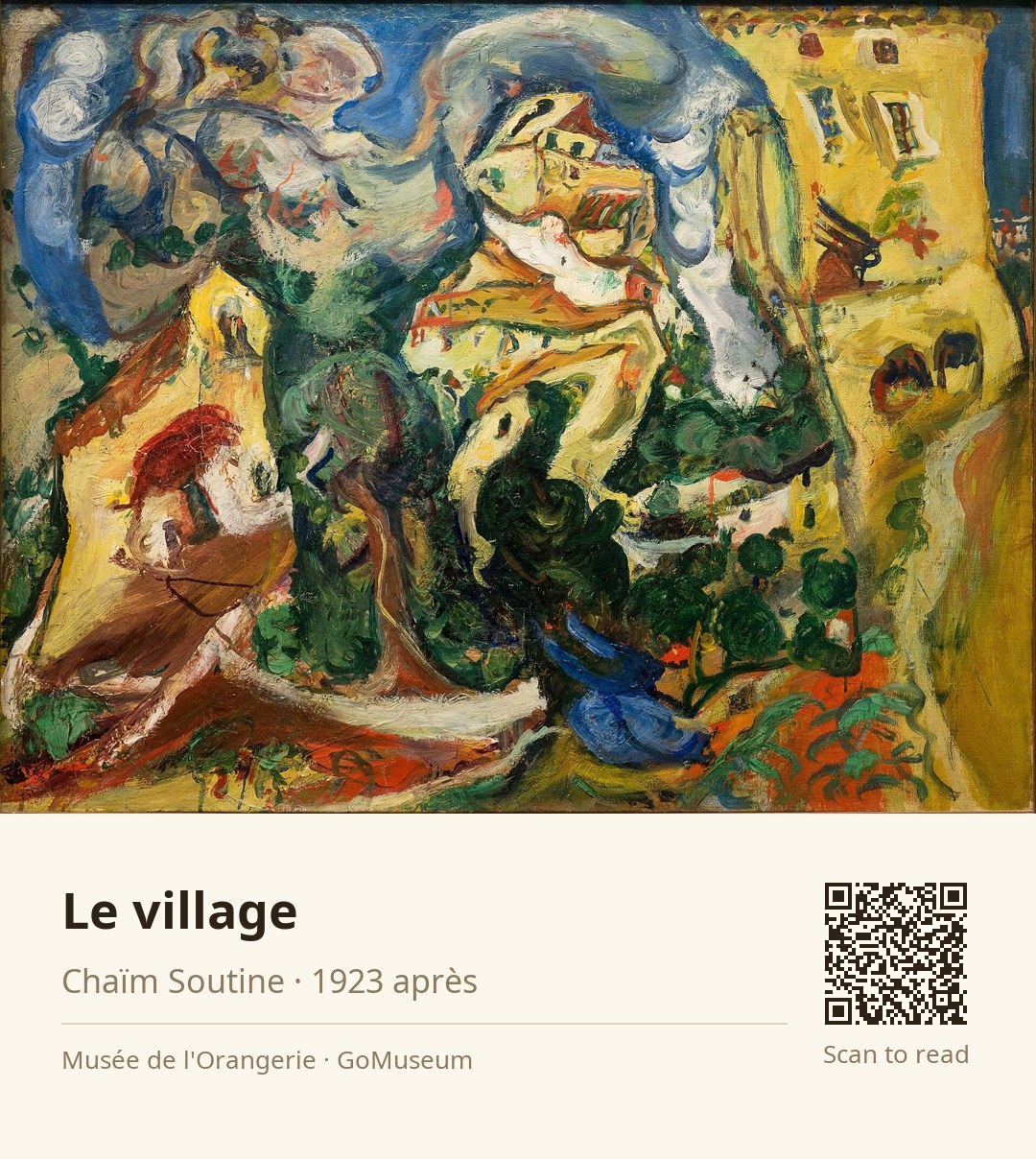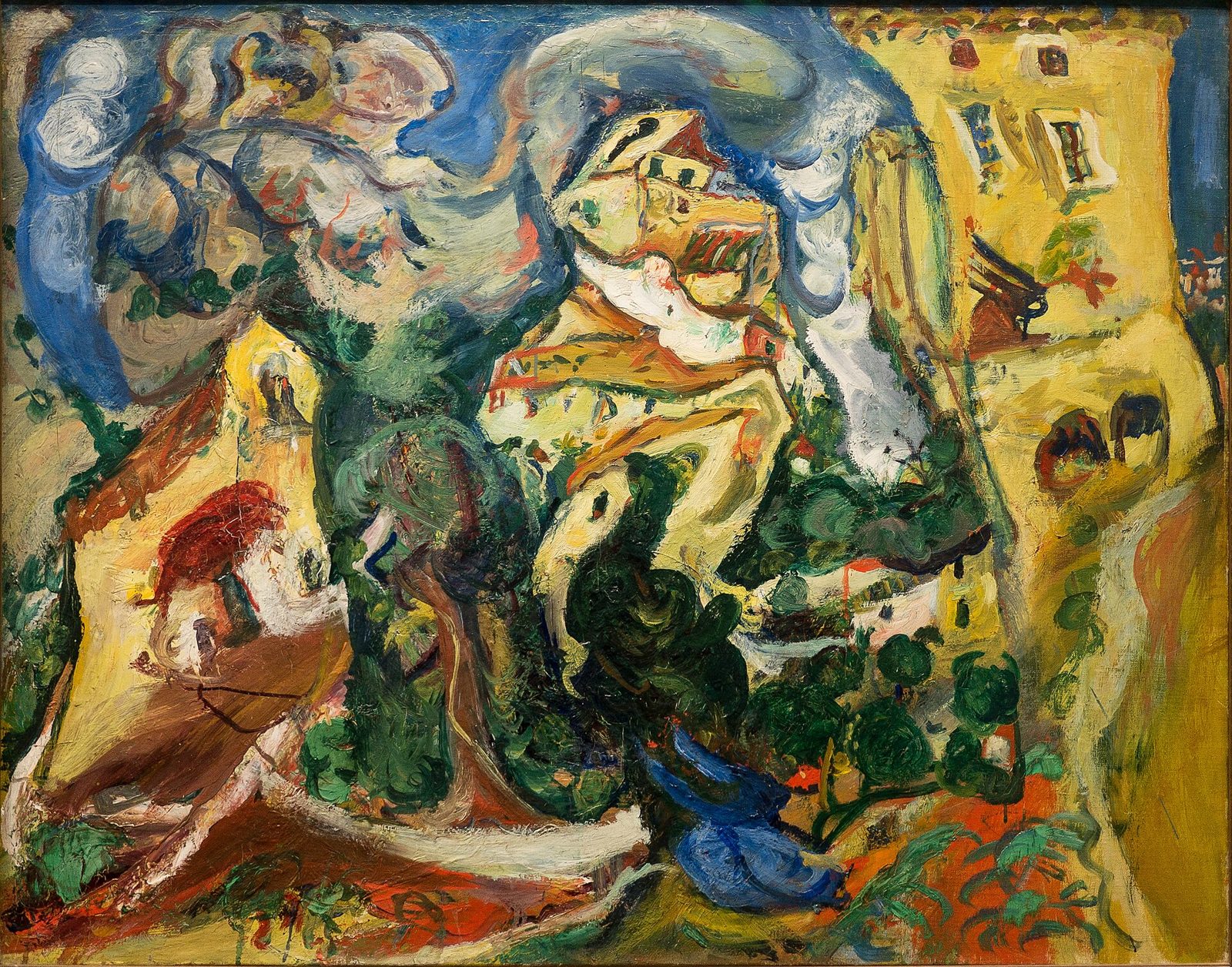
A vibrant red-roofed building stands out in Chaïm Soutine's "Le village," surrounded by lush greenery that seems to pulse with life. The swirling brushstrokes create a dynamic interplay between the structures and the landscape, where trees and houses twist together in a vivid embrace of color—yellows, greens, blues, and reds dominate the canvas. This energetic composition captures not just a village scene but the very essence of movement and emotion, reflecting Soutine's unique approach to expressionism.
The bold, textured strokes evoke a sense of urgency and vitality, transforming the ordinary into something extraordinary. Soutine's technique prioritizes shape and color over precise representation, allowing the viewer to experience the emotional weight of the landscape rather than just its physical attributes. His work often blurs the lines between reality and abstraction, inviting a deeper connection to the scene depicted.
Created in 1923, "Le village" exemplifies Soutine's evolution as an artist during a time when he was gaining recognition in Paris, particularly after being championed by influential art dealer Paul Guillaume.
Chaïm Soutine was a Belarusian-Jewish painter who became a significant figure in the Expressionist movement while residing in Paris. Born in 1893 in Smilavichy, he faced a challenging childhood as one of eleven siblings in a poor family. His artistic journey began in Vilnius before he emigrated to Paris in 1913, where he studied at the École des Beaux-Arts. Soutine's time in Montparnasse, particularly at La Ruche, immersed him in a vibrant community of artists, including Modigliani and Chagall.
Despite struggling with poverty and health issues, Soutine developed a unique style that emphasized shape, color, and texture over mere representation. His works, often characterized by vivid, tumultuous colors and distorted forms, bridged traditional painting and the emerging Abstract Expressionism. Although he maintained a distance from artistic movements, his influence grew, particularly after American collector Albert Barnes acquired a significant number of his paintings in the 1920s.
Soutine's life was marked by introversion and a reluctance to share his thoughts, leading to a somewhat enigmatic persona. His art reflects a deep engagement with the medium, often seen as a quest for salvation. Despite his struggles, Soutine's legacy endures, recognized as a precursor to later artistic movements and celebrated for his emotional depth and innovative approach to painting.
The thick, textured brushstrokes create a sense of movement, almost as if the landscape is alive and breathing. Each stroke is deliberate, layering paint to build depth and energy. The vibrant palette—rich yellows, greens, and reds—evokes emotion rather than mere representation. Soutine's choice to distort forms, allowing buildings and trees to twist and merge, challenges the viewer's perception of reality. This dynamic composition draws you in, inviting you to feel the urgency and vitality of the scene. The swirling clouds in the background enhance this effect, adding to the painting's overall sense of fluidity and chaos, a hallmark of Soutine's expressionist style.
Soutine distorted forms in the painting, making buildings and trees twist and merge, which challenges how viewers perceive reality.
Soutine was born into a Jewish family in a small village in present-day Belarus, where he faced a difficult childhood before moving to Paris.
Paul Guillaume, an influential art dealer, significantly promoted Soutine's work after World War I.