Portrait d'homme
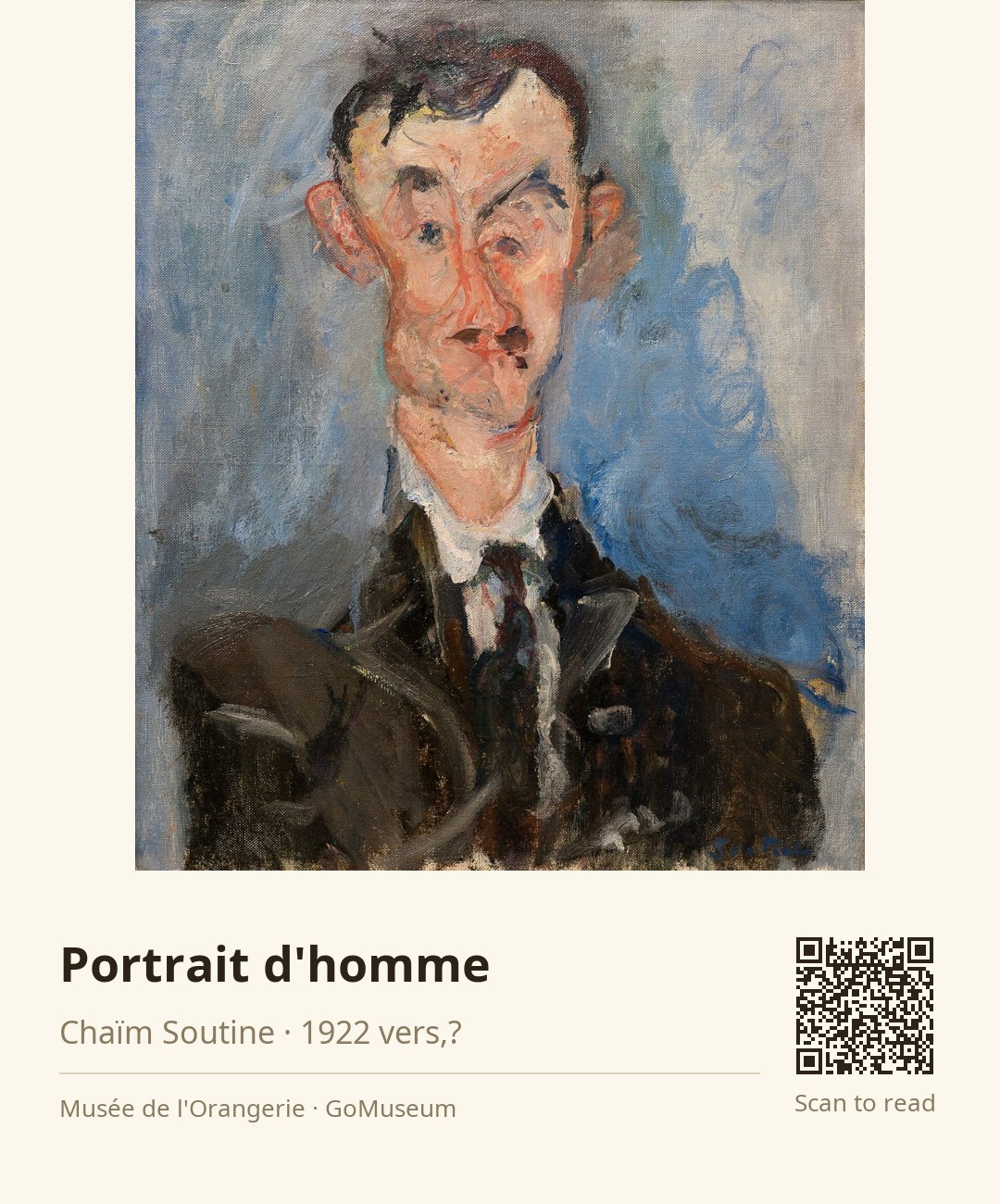
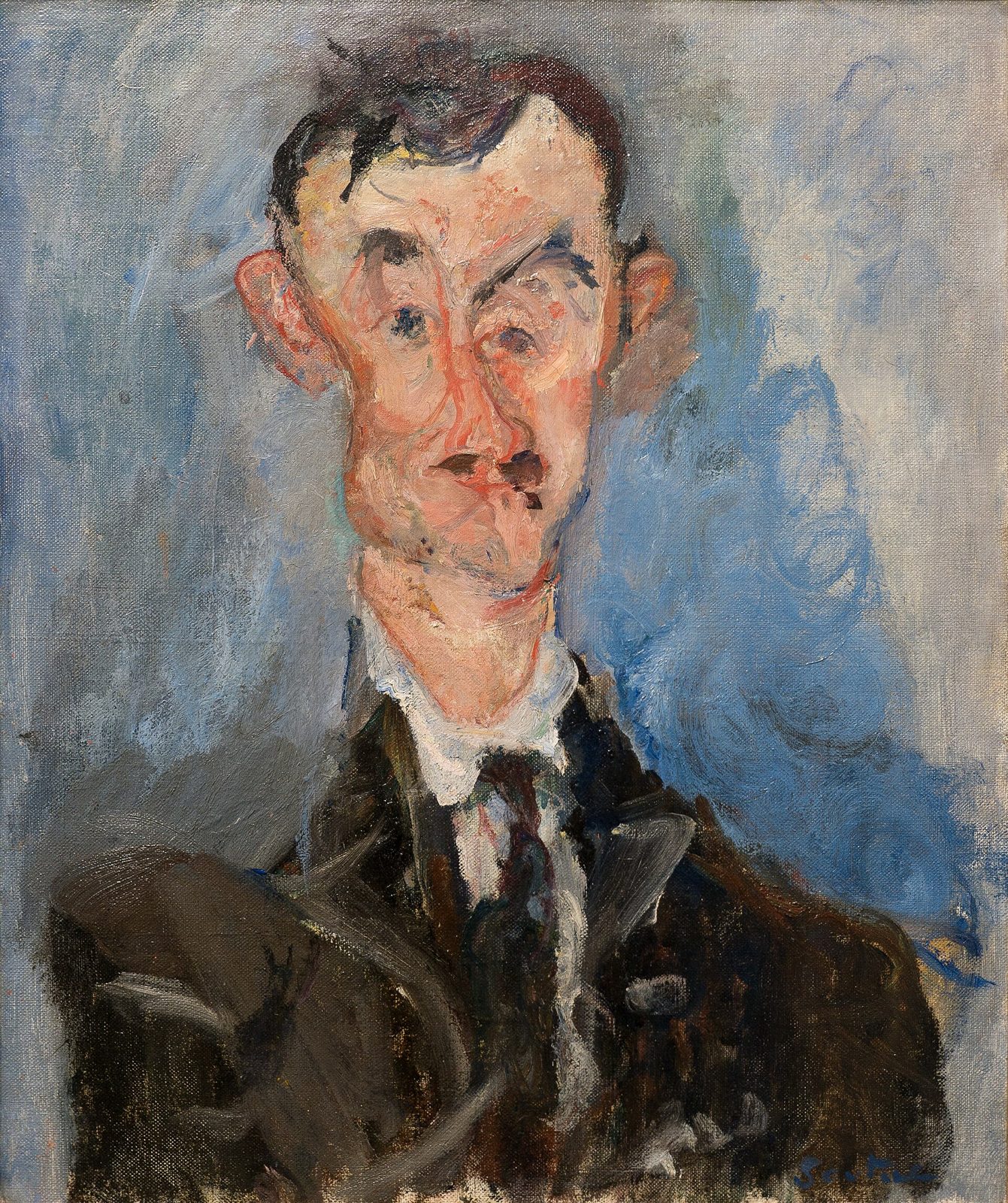
🎧 This work has audio narration — listen in the appThe elongated face of the man in "Portrait d'homme" draws you in with its striking distortion, where his prominent ears and slightly tilted head create an almost surreal presence. The ambiguity of his expression, marked by a small mustache and dark, arched eyebrows, invites you to ponder his thoughts and emotions, as if he’s caught in a moment of introspection.
Soutine’s loose and expressive brushwork enhances the emotional weight of the piece, with muted browns, pinks, and blues swirling around him. This vibrant background contrasts with the dark suit he wears, where visible brushstrokes add texture and depth, making the figure feel alive and dynamic. The overall composition, centered and commanding, emphasizes the man’s presence, transforming him into a focal point that resonates with the viewer.
Created around 1922, this painting reflects Soutine's unique approach to portraiture, where the emotional essence of the subject takes precedence over realistic representation. The work was part of the exhibition "Cent tableaux de Soutine" at the Galerie Charpentier in Paris in 1959.
Chaïm Soutine was a Belarusian-Jewish painter who became a significant figure in the Expressionist movement while residing in Paris. Born in 1893 in Smilavichy, he faced a challenging childhood as one of eleven siblings in a poor family. His artistic journey began in Vilnius before he emigrated to Paris in 1913, where he studied at the École des Beaux-Arts. Soutine's time in Montparnasse, particularly at La Ruche, immersed him in a vibrant community of artists, including Modigliani and Chagall.
Despite struggling with poverty and health issues, Soutine developed a unique style that emphasized shape, color, and texture over mere representation. His works, often characterized by vivid, tumultuous colors and distorted forms, bridged traditional painting and the emerging Abstract Expressionism. Although he maintained a distance from artistic movements, his influence grew, particularly after American collector Albert Barnes acquired a significant number of his paintings in the 1920s.
Soutine's life was marked by introversion and a reluctance to share his thoughts, leading to a somewhat enigmatic persona. His art reflects a deep engagement with the medium, often seen as a quest for salvation. Despite his struggles, Soutine's legacy endures, recognized as a precursor to later artistic movements and celebrated for his emotional depth and innovative approach to painting.
Created around 1922, 'Portrait d'homme' by Chaïm Soutine emerged during a tumultuous time in art history, where traditional forms were being challenged. This painting was part of Soutine's exploration of emotional depth through distortion and abstraction. It was later exhibited in 1959 at the Galerie Charpentier in Paris, under the title 'Cent tableaux de Soutine,' where it captured the attention of critics and art lovers alike. The provenance of the work traces back to notable collectors, including Guillaume Paul and Walter Mme Vve Jean, highlighting its journey through the art world before finding its place in the museum's collection.
Soutine's technique in 'Portrait d'homme' is marked by his loose, expressive brushwork that breathes life into the canvas. The paint handling is dynamic, with thick applications that create a palpable texture, especially in the man's dark suit. This choice not only adds depth but also enhances the emotional intensity of the portrait. The color palette, dominated by muted browns, pinks, and blues, contributes to the overall mood, evoking a sense of introspection. The swirling background, an abstract mix of blues and grays, contrasts with the figure, making him stand out as a focal point. Soutine's decision to elongate the man's face and exaggerate features invites viewers to engage with the emotional essence of the subject rather than a realistic portrayal, a hallmark of his innovative approach to portraiture.
The painting was previously owned by notable collectors Guillaume Paul and Walter Mme Vve Jean.
It represents Soutine's exploration of emotional depth through distortion and abstraction.
The swirling background, with its abstract mix of blues and grays, creates a contrast that makes the figure stand out as a focal point.