 Image: Sailko
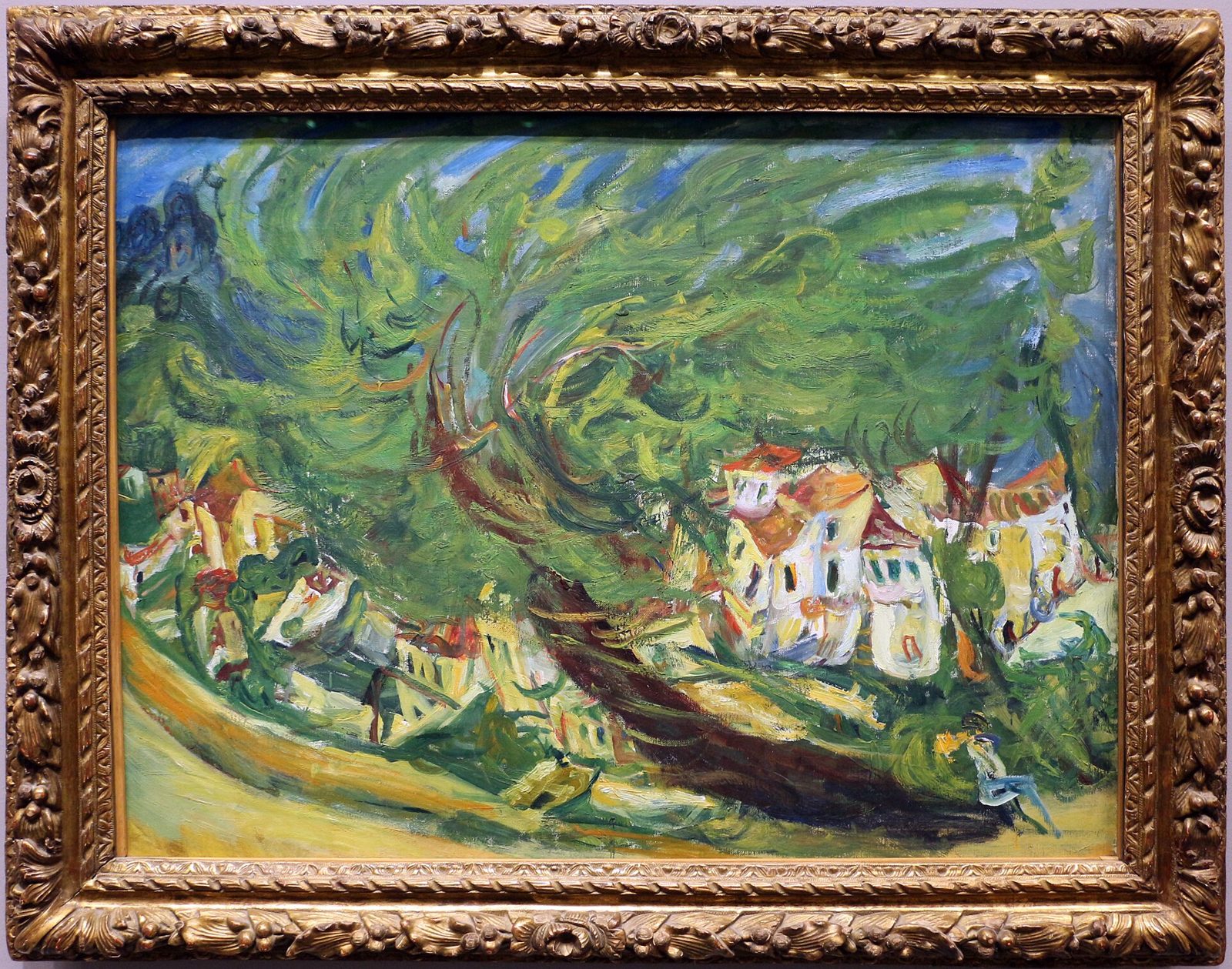
Arbre couché
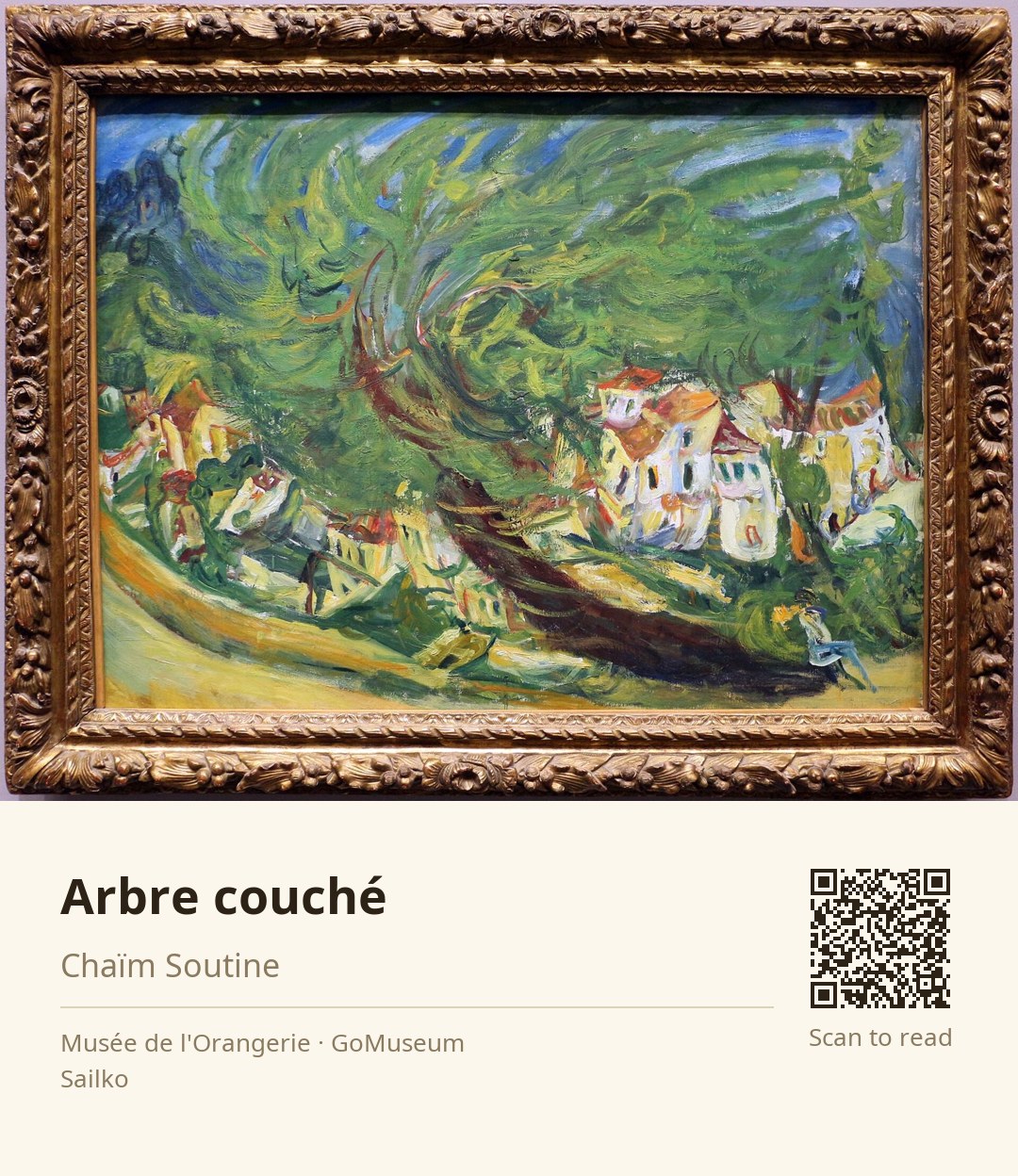
🎧 This work has audio narration — listen in the appA large, swirling tree dominates the foreground of "Arbre couché," its dynamic brushstrokes creating a sense of movement that pulls you into the vibrant landscape. Behind it, a cluster of houses with red-tiled roofs and white walls nestles among lush greenery, suggesting a small village alive with energy. The rolling hills and a sky painted in shades of blue and green complete this lively scene, where the palette of greens, blues, and earthy tones conveys a palpable sense of nature's vitality.
Soutine's expressive brushwork not only captures the essence of the landscape but also reflects his emotional connection to the world around him. This painting, created during the early 20th century, showcases his unique style that bridges traditional representation and the emerging Abstract Expressionism. Influenced by the great masters like Rembrandt and Courbet, Soutine focused on the emotional weight of color and form rather than strict realism, allowing his personal vision to shine through.
Born in Belarus and later moving to Paris, Soutine became a pivotal figure in the School of Paris, often associated with the Expressionist movement.
Chaïm Soutine was a Belarusian-Jewish painter who became a significant figure in the Expressionist movement while residing in Paris. Born in 1893 in Smilavichy, he faced a challenging childhood as one of eleven siblings in a poor family. His artistic journey began in Vilnius before he emigrated to Paris in 1913, where he studied at the École des Beaux-Arts. Soutine's time in Montparnasse, particularly at La Ruche, immersed him in a vibrant community of artists, including Modigliani and Chagall.
Despite struggling with poverty and health issues, Soutine developed a unique style that emphasized shape, color, and texture over mere representation. His works, often characterized by vivid, tumultuous colors and distorted forms, bridged traditional painting and the emerging Abstract Expressionism. Although he maintained a distance from artistic movements, his influence grew, particularly after American collector Albert Barnes acquired a significant number of his paintings in the 1920s.
Soutine's life was marked by introversion and a reluctance to share his thoughts, leading to a somewhat enigmatic persona. His art reflects a deep engagement with the medium, often seen as a quest for salvation. Despite his struggles, Soutine's legacy endures, recognized as a precursor to later artistic movements and celebrated for his emotional depth and innovative approach to painting.
Chaïm Soutine's 'Arbre couché' was created in the early 20th century, a period when the artist was deeply immersed in the vibrant art scene of Paris. This painting was part of significant exhibitions, including the 1952 Venice Biennale, where it was showcased alongside thirty-five of his works, and a 1959 exhibition at the Galerie Charpentier in Paris, featuring a total of one hundred of his paintings. The provenance of 'Arbre couché' traces back to notable collectors like Paul Guillaume and Walter Mme Vve Jean, highlighting its journey through the art world. Soutine's work, initially met with mixed reactions, gained recognition over time, particularly after being championed by influential figures like the American collector Albert C. Barnes, who bought sixty of his paintings in a single transaction in 1923. This pivotal moment marked a turning point in Soutine's career, transitioning him from obscurity to a celebrated artist in the Expressionist movement.
In 'Arbre couché,' Soutine's technique is a whirlwind of expressive brushwork that brings the landscape to life. The dynamic strokes create a sense of movement, almost as if the tree is swaying in the wind. His choice of oil on canvas allows for rich, layered textures, enhancing the vibrancy of the colors. The swirling forms are not just about representation; they embody Soutine's emotional response to the scene. The palette, dominated by greens and earthy tones, is applied with a boldness that evokes the raw energy of nature. The composition is lively, with the tree in the foreground drawing the eye, while the houses and hills recede into a harmonious background. This layering creates depth, inviting viewers to feel as if they are stepping into the landscape rather than merely observing it. Soutine's approach blurs the line between realism and abstraction, showcasing his unique perspective that resonates with the emotional weight of the moment.
In Paris, Soutine interacted with several notable artists, including Archipenko, Chagall, and Modigliani, who became a close friend and painted his portrait.
Soutine learned French at La Rotonde, a café where artists gathered, often taking lessons in the back.