 Image: Sailko
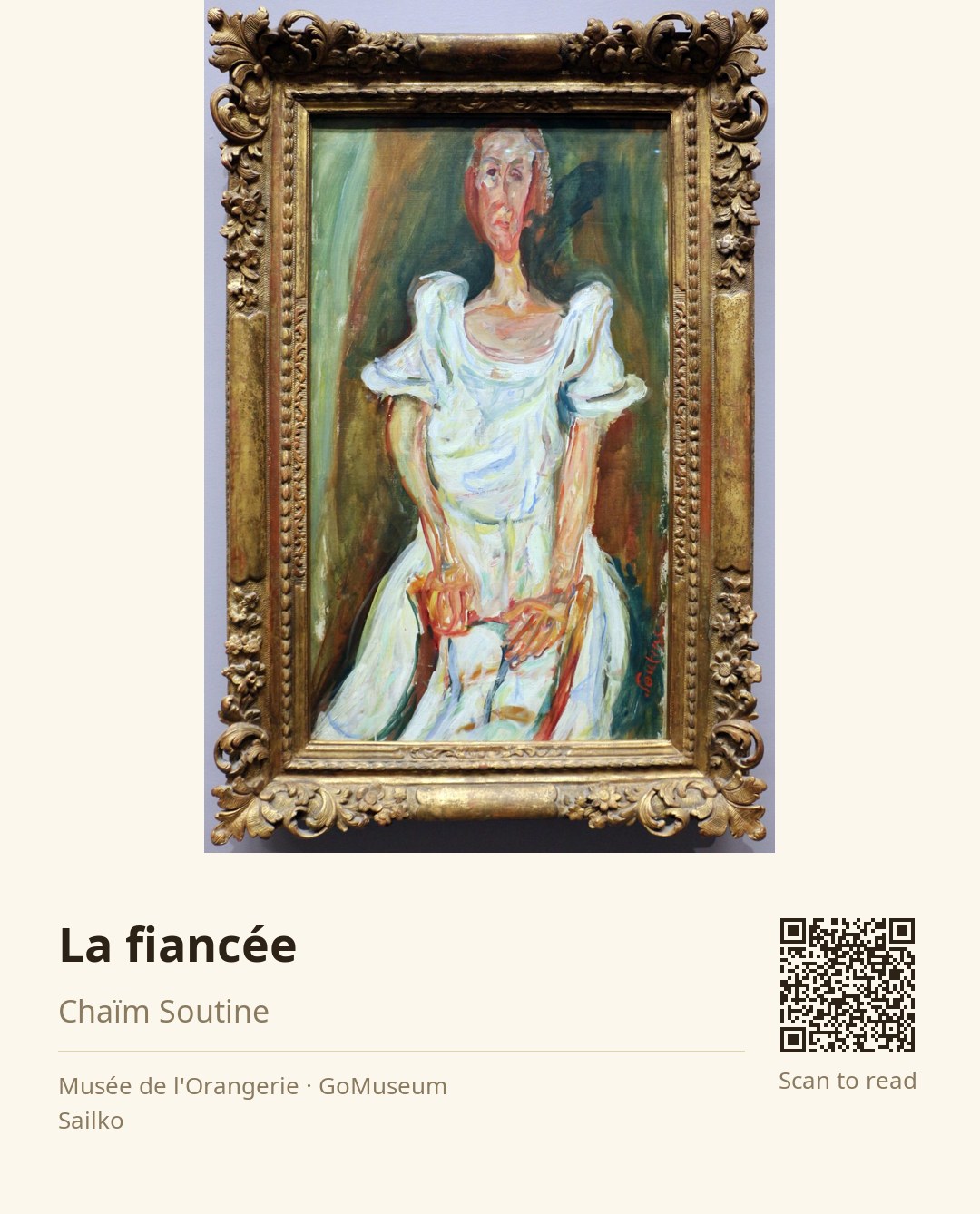
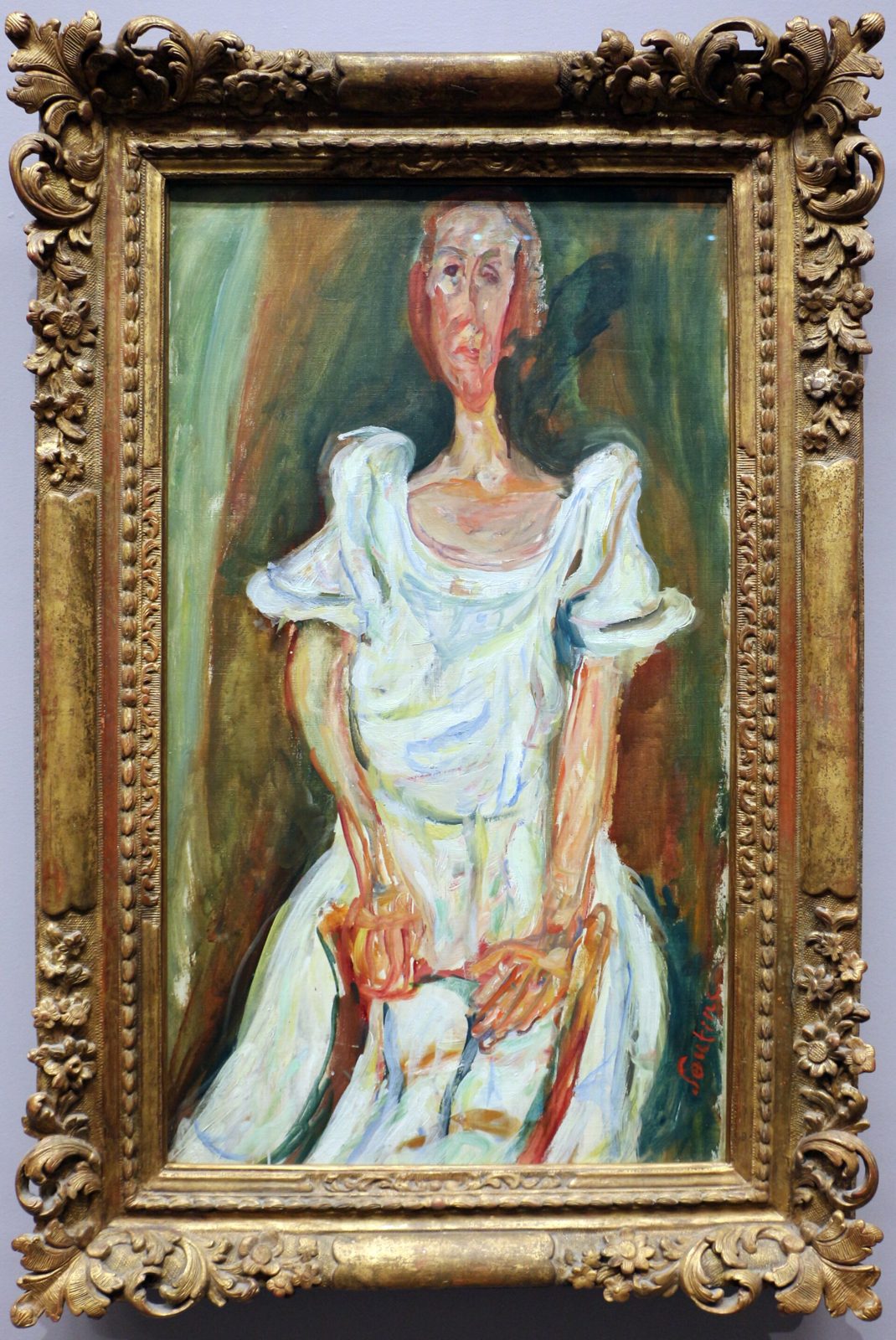
The seated figure in a flowing white dress captures your attention with her elongated face and graceful neck, both rendered in expressive brushstrokes that convey a sense of life. The dynamic strokes of her hands resting on her lap suggest movement, while the dark, indistinct background of greens and browns creates a striking contrast that highlights her presence.
This portrait, titled "La fiancée," showcases Soutine's signature loose brushwork, where form and color take precedence over fine detail. The warm tones of her skin juxtaposed with the cooler whites and blues of her dress evoke a feeling of intimacy and immediacy, inviting you to connect with the unknown woman depicted. The way the figure is centered in the composition draws your eye directly to her, making her the undeniable focal point of the work.
Created in the early 20th century, this painting reflects Soutine's unique approach to portraiture, emphasizing emotional expression over realism. "La fiancée" was exhibited at notable venues, including the Arts Club in Chicago in 1935 and the Galerie Charpentier in Paris in 1959.
Chaïm Soutine was a Belarusian-Jewish painter who became a significant figure in the Expressionist movement while residing in Paris. Born in 1893 in Smilavichy, he faced a challenging childhood as one of eleven siblings in a poor family. His artistic journey began in Vilnius before he emigrated to Paris in 1913, where he studied at the École des Beaux-Arts. Soutine's time in Montparnasse, particularly at La Ruche, immersed him in a vibrant community of artists, including Modigliani and Chagall.
Despite struggling with poverty and health issues, Soutine developed a unique style that emphasized shape, color, and texture over mere representation. His works, often characterized by vivid, tumultuous colors and distorted forms, bridged traditional painting and the emerging Abstract Expressionism. Although he maintained a distance from artistic movements, his influence grew, particularly after American collector Albert Barnes acquired a significant number of his paintings in the 1920s.
Soutine's life was marked by introversion and a reluctance to share his thoughts, leading to a somewhat enigmatic persona. His art reflects a deep engagement with the medium, often seen as a quest for salvation. Despite his struggles, Soutine's legacy endures, recognized as a precursor to later artistic movements and celebrated for his emotional depth and innovative approach to painting.
La fiancée was created by Chaïm Soutine, a key figure in the School of Paris, during the early 20th century, a time when the art world was buzzing with new ideas and movements. This painting was first exhibited at the Arts Club in Chicago in 1935, where it was part of a larger showcase of Soutine's work. It later appeared at the XXVI Biennale in Venice in 1952 and again at the Galerie Charpentier in Paris in 1959. The painting has an intriguing provenance, having passed through the hands of notable collectors like Guillaume Paul and Walter, Madame Vve Jean.
The loose brushwork creates a sense of immediacy, as if the figure could step out of the canvas at any moment. The warm skin tones contrast sharply with the cooler whites and blues of the dress, drawing your eye to the figure’s face and hands. The dynamic strokes of her hands resting on her lap suggest a fleeting moment, as if she’s about to move. The dark, indistinct background of greens and browns serves not just as a backdrop but as a way to elevate the figure, emphasizing her presence and creating a dramatic tension. The scale of the painting, with its height of 81 cm and width of 46 cm, allows for an intimate viewing experience, inviting you to engage closely with the emotional depth of the subject.
The painting was owned by notable collectors such as Guillaume Paul and Walter, Madame Vve Jean.
After its initial exhibition in Chicago, the painting was featured at the XXVI Biennale in Venice in 1952 and again at the Galerie Charpentier in Paris in 1959.