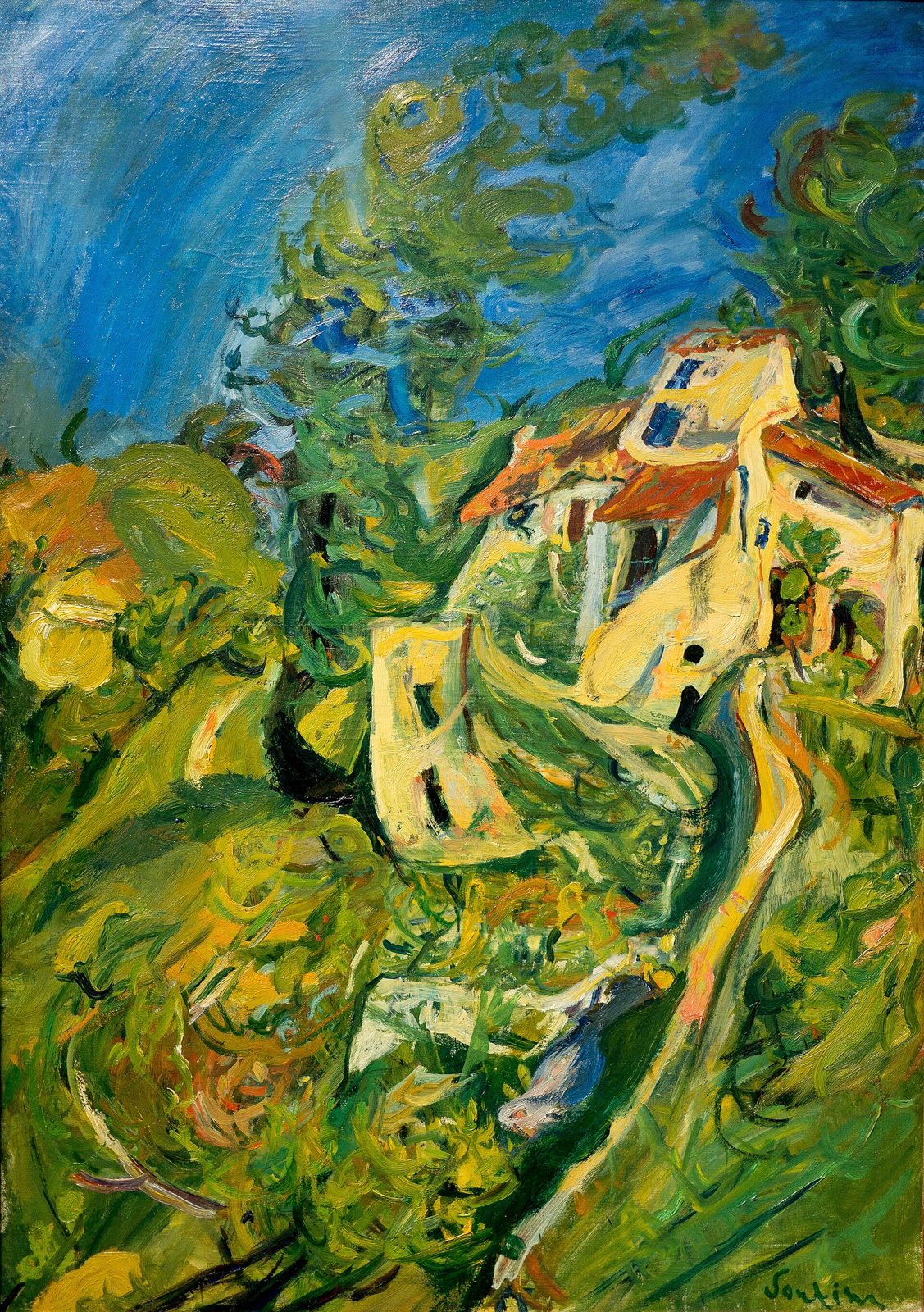
 Image: Chaïm Soutine (1893 - 1943), Coll. Jean Walter et Paul Guillaume, Musée de l'Orangerie, Paris
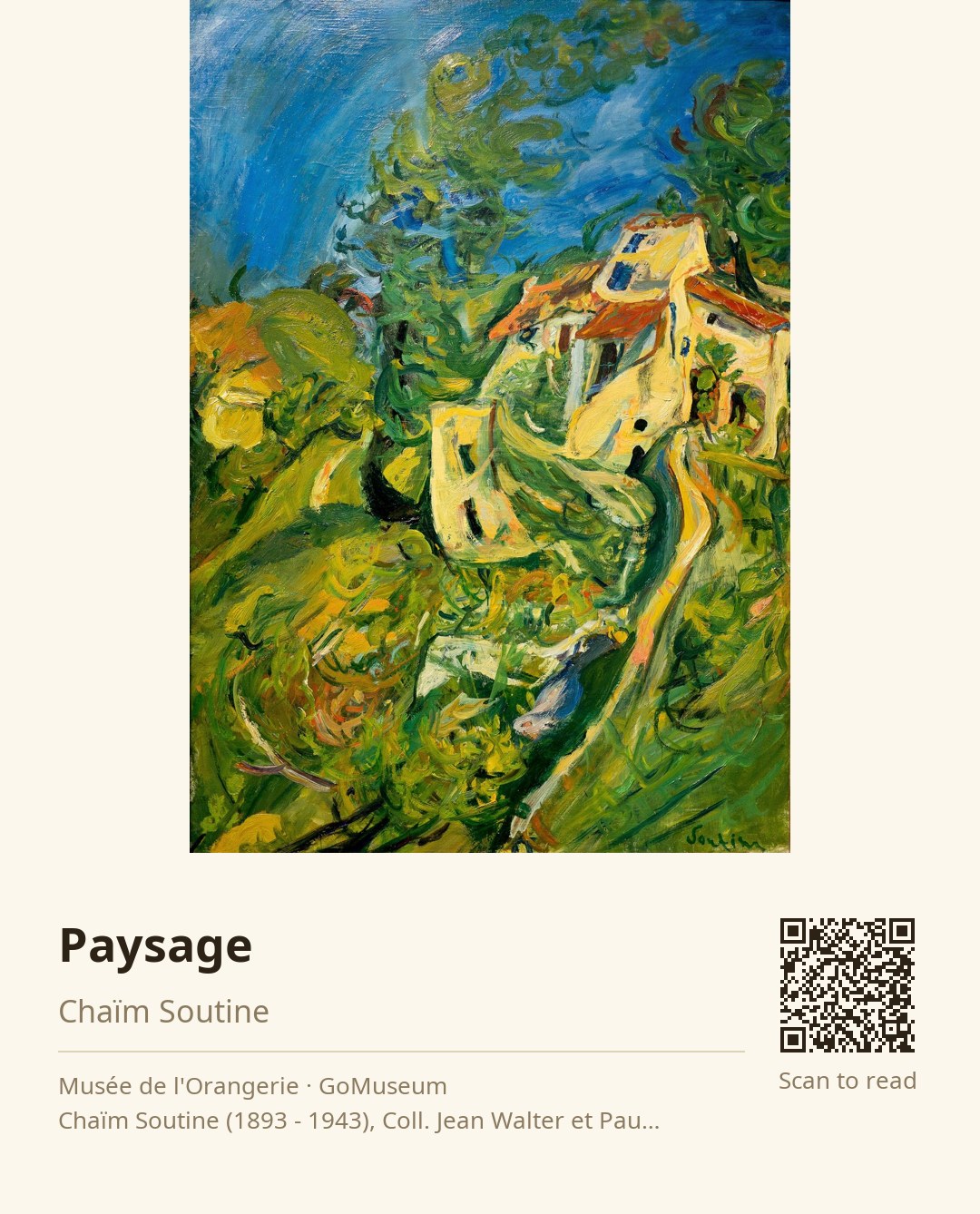
A bright yellow house with a red-tiled roof and blue windows sits nestled among lush greenery in Soutine Chaïm's "Paysage." The vibrant colors and dynamic brushstrokes create a sense of movement, as if the landscape itself is alive, swirling around the structure. The trees and vegetation pulse with energy, their forms bending and twisting, while the deep blue sky above adds a dramatic backdrop to this lively scene.
This expressive style reflects Soutine's unique approach to landscape painting, where he prioritizes emotion and atmosphere over strict realism. The swirling lines and bold hues invite viewers into a world that feels both familiar and dreamlike, capturing the essence of nature in a way that transcends mere representation. Soutine's technique emphasizes the tactile quality of paint, making the surface of the canvas almost as important as the imagery itself.
Chaïm Soutine was a Belarusian-Jewish painter who became a significant figure in the Expressionist movement while residing in Paris. Born in 1893 in Smilavichy, he faced a challenging childhood as one of eleven siblings in a poor family. His artistic journey began in Vilnius before he emigrated to Paris in 1913, where he studied at the École des Beaux-Arts. Soutine's time in Montparnasse, particularly at La Ruche, immersed him in a vibrant community of artists, including Modigliani and Chagall.
Despite struggling with poverty and health issues, Soutine developed a unique style that emphasized shape, color, and texture over mere representation. His works, often characterized by vivid, tumultuous colors and distorted forms, bridged traditional painting and the emerging Abstract Expressionism. Although he maintained a distance from artistic movements, his influence grew, particularly after American collector Albert Barnes acquired a significant number of his paintings in the 1920s.
Soutine's life was marked by introversion and a reluctance to share his thoughts, leading to a somewhat enigmatic persona. His art reflects a deep engagement with the medium, often seen as a quest for salvation. Despite his struggles, Soutine's legacy endures, recognized as a precursor to later artistic movements and celebrated for his emotional depth and innovative approach to painting.
Soutine's 'Paysage' was created in the first half of the 20th century, a period when the artist was exploring his unique style, which combined emotional depth with a vivid palette. This particular piece was exhibited at the Galerie Charpentier in Paris in 1959, where it was part of a larger showcase titled 'Cent Tableaux de Soutine.' The reception was enthusiastic, reflecting a growing appreciation for Soutine's work during a time when his expressive landscapes were gaining traction among art collectors and critics. The painting has since passed through notable hands, including those of Guillaume Paul and later Walter Mme Vve Jean, adding to its rich provenance.
In 'Paysage,' Soutine's brushwork is nothing short of mesmerizing. The thick, expressive strokes create a tactile quality that pulls you into the scene. The vibrant yellows and oranges of the house contrast sharply with the lush greens of the surrounding foliage, while the swirling lines give a sense of movement, almost as if the landscape is alive. Soutine's choice of a deep blue sky enhances the drama, enveloping the house in an atmosphere that feels both dynamic and dreamlike. The composition is not rigid; instead, it flows organically, guiding your eye through the vibrant colors and forms. This technique reflects Soutine's desire to convey emotion over realism, inviting viewers to experience the landscape rather than merely observe it.
The painting has been owned by notable figures such as Guillaume Paul and Walter Mme Vve Jean, which contributes to its rich history.
'Paysage' was part of a significant exhibition titled 'Cent Tableaux de Soutine' at the Galerie Charpentier in Paris in 1959.