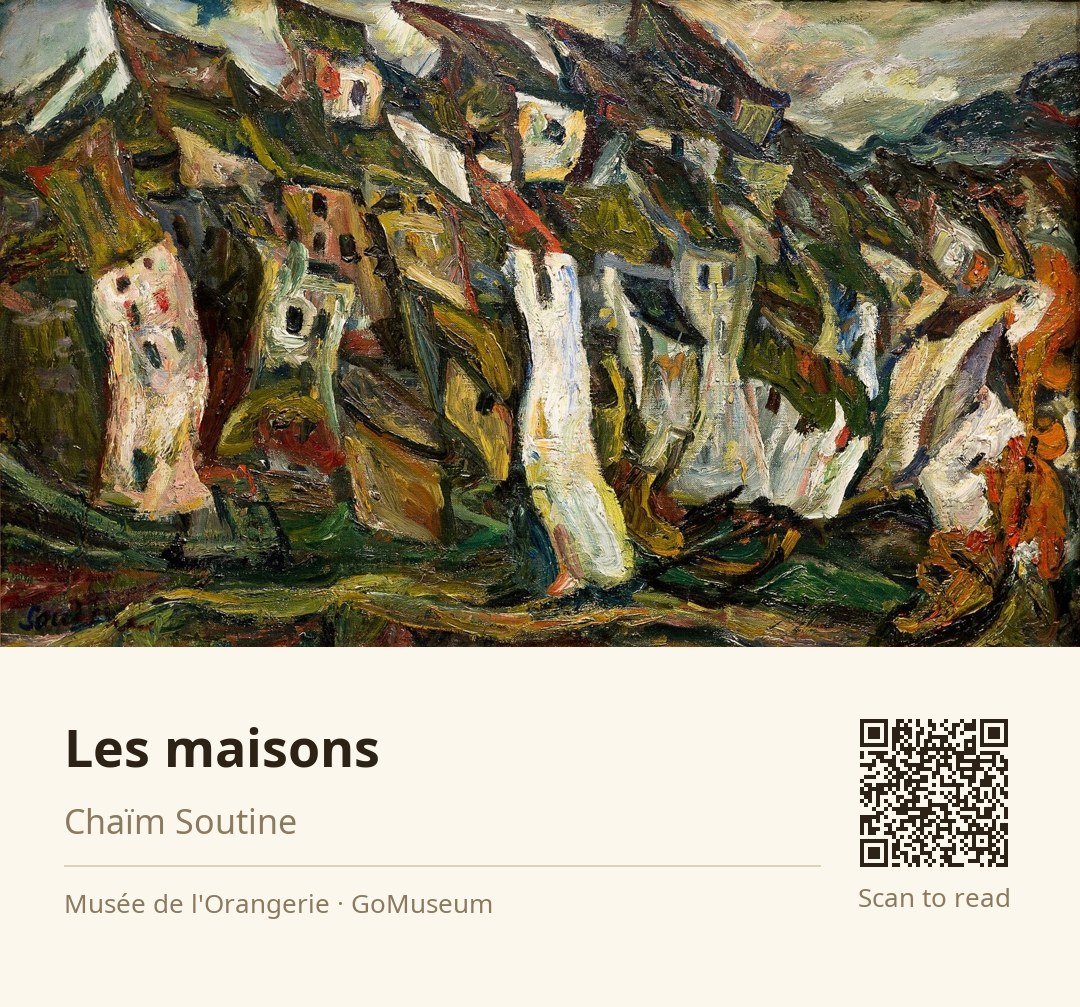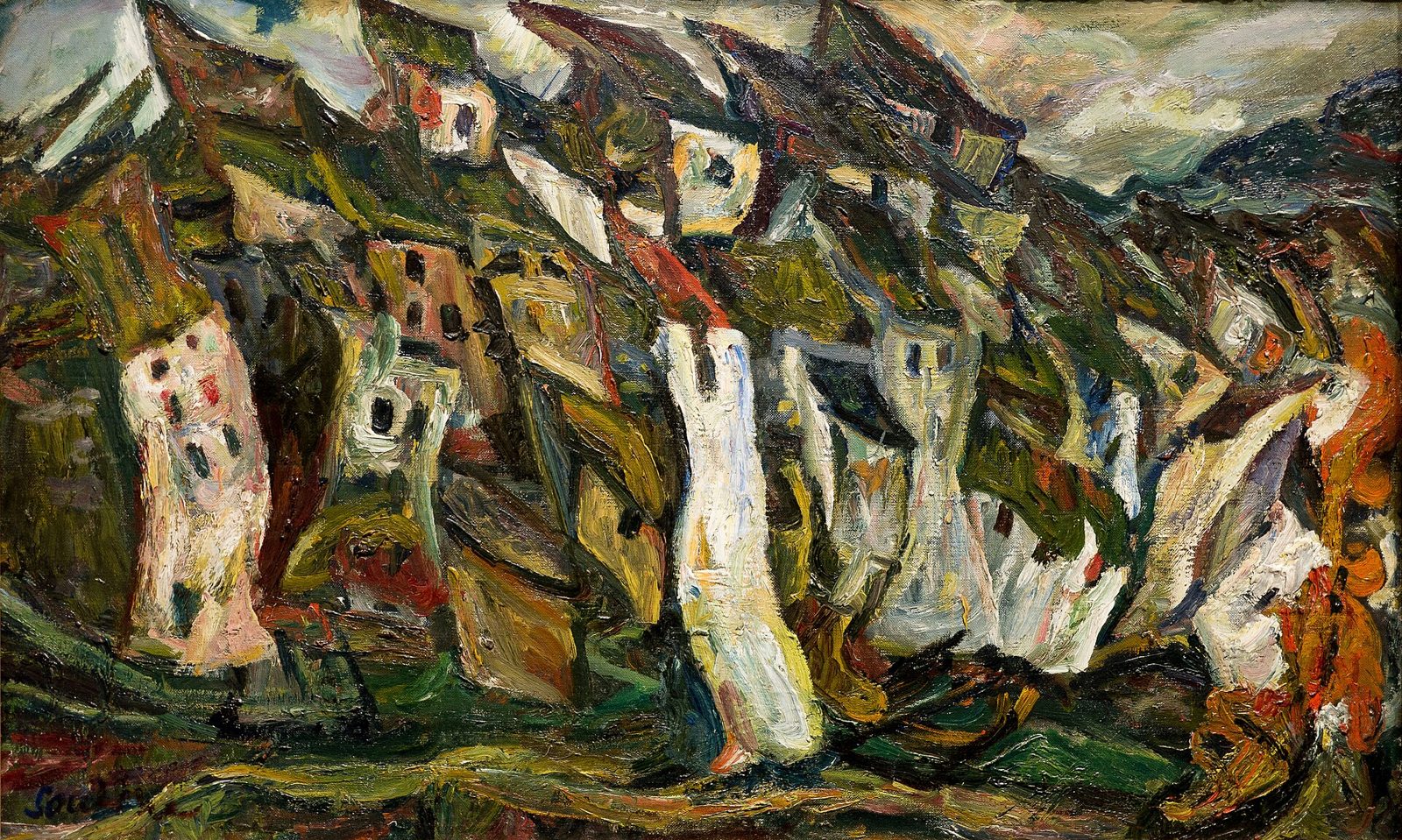
The leaning buildings in Soutine's *Les maisons* seem to defy gravity, stacked in a chaotic dance that captures a moment of instability. Thick, expressive brushstrokes bring these structures to life, with earthy greens and browns dominating the palette, punctuated by flashes of red and blue. The small, dark windows add an eerie quality, while the swirling hills and cloudy sky create a backdrop that amplifies the sense of movement and distortion.
This energetic composition reflects Soutine's fascination with the emotional resonance of landscapes, where the familiar becomes unsettling. The distortion of the houses suggests a deeper commentary on the fragility of existence, as if the very fabric of reality is bending under the weight of perception. In the first half of the 20th century, Soutine's work often explored these themes, pushing the boundaries of traditional representation to evoke raw emotion.
Created during a period of intense experimentation, *Les maisons* exemplifies Soutine's unique approach to landscape painting. The work was exhibited in 1959 at the Galerie Charpentier in Paris, showcasing a pivotal moment in the artist's exploration of form and color.
Chaïm Soutine was a Belarusian-Jewish painter who became a significant figure in the Expressionist movement while residing in Paris. Born in 1893 in Smilavichy, he faced a challenging childhood as one of eleven siblings in a poor family. His artistic journey began in Vilnius before he emigrated to Paris in 1913, where he studied at the École des Beaux-Arts. Soutine's time in Montparnasse, particularly at La Ruche, immersed him in a vibrant community of artists, including Modigliani and Chagall.
Despite struggling with poverty and health issues, Soutine developed a unique style that emphasized shape, color, and texture over mere representation. His works, often characterized by vivid, tumultuous colors and distorted forms, bridged traditional painting and the emerging Abstract Expressionism. Although he maintained a distance from artistic movements, his influence grew, particularly after American collector Albert Barnes acquired a significant number of his paintings in the 1920s.
Soutine's life was marked by introversion and a reluctance to share his thoughts, leading to a somewhat enigmatic persona. His art reflects a deep engagement with the medium, often seen as a quest for salvation. Despite his struggles, Soutine's legacy endures, recognized as a precursor to later artistic movements and celebrated for his emotional depth and innovative approach to painting.
In *Les maisons*, Soutine employs thick, expressive brushwork that creates a palpable sense of movement. The vigorous strokes not only define the chaotic forms of the buildings but also evoke an emotional response, as if the structures themselves are alive. The earthy palette, dominated by greens and browns, grounds the painting in a naturalistic setting, while the splashes of red and blue inject a vibrancy that contrasts with the somber tones. The composition is dynamic, with the leaning buildings appearing to defy gravity, drawing the viewer's eye across the canvas. This sense of instability is heightened by the swirling hills and turbulent sky, which envelop the scene in a dramatic atmosphere.
Soutine's vigorous brushwork gives life to the chaotic forms of the buildings, creating an emotional resonance that suggests the structures are almost animated.
The earthy greens and browns provide a naturalistic foundation for the painting, while the vibrant splashes of red and blue create a striking contrast that enhances the emotional intensity.