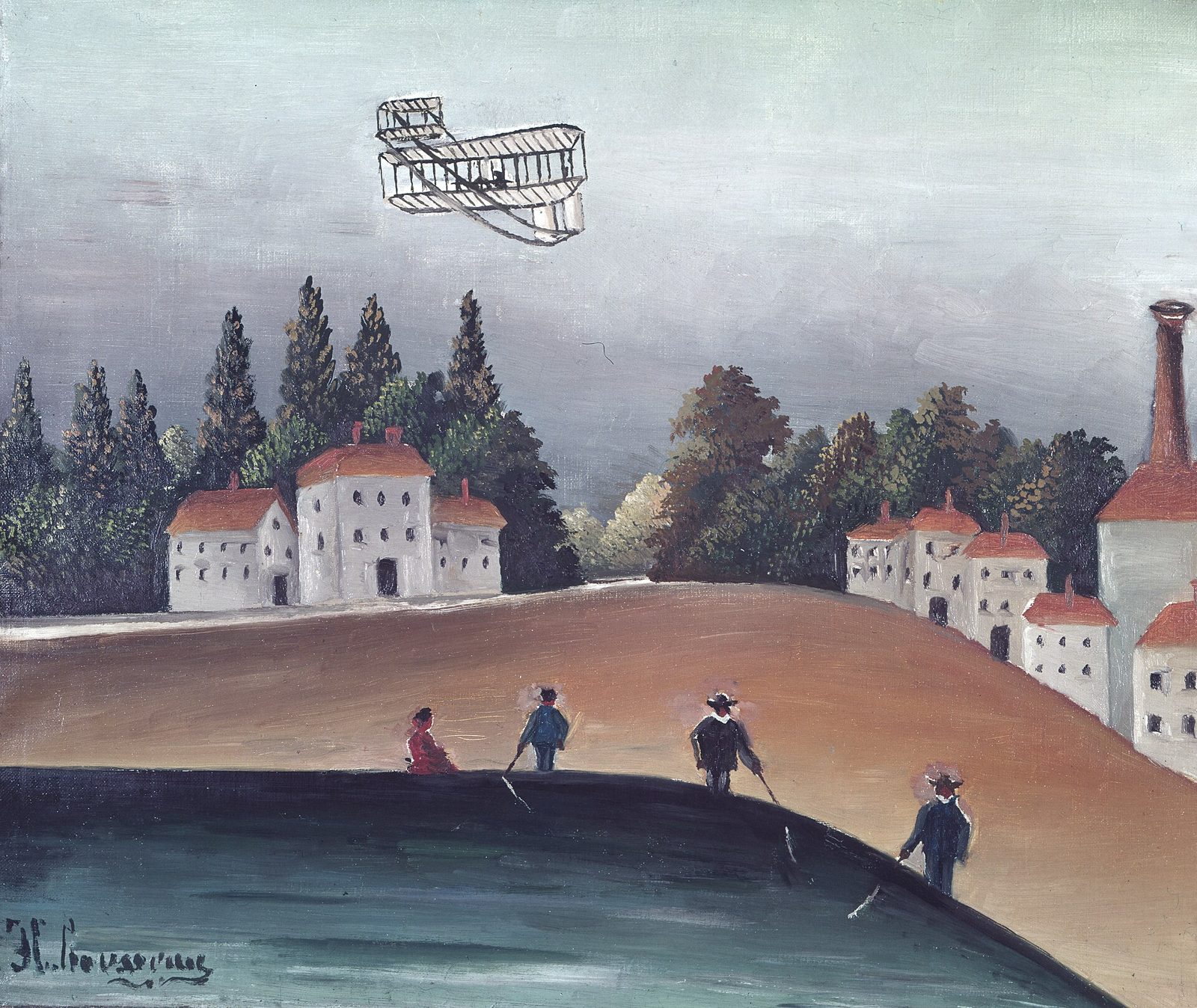
Les pêcheurs à la ligne
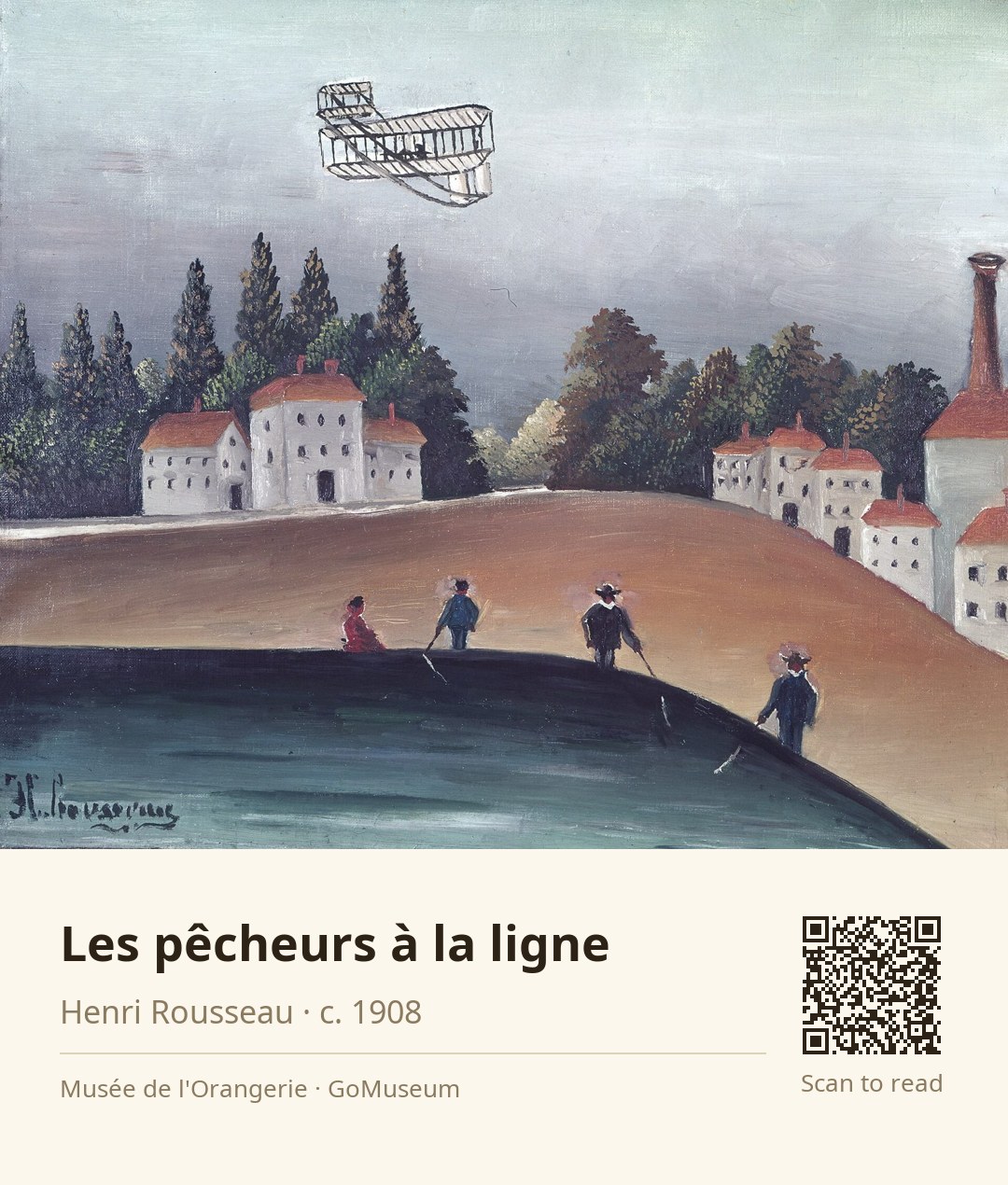
🎧 This work has audio narration — listen in the appA vintage biplane soars through a muted gray sky in Henri Rousseau's *Les pêcheurs à la ligne*, painted around 1908. Below, five figures in dark clothing stroll along a winding path beside a tranquil body of water, their walking sticks in hand, as they navigate the serene landscape dotted with small white buildings topped with red roofs and surrounded by lush, dark green trees.
This juxtaposition of human activity and the flight above captures a moment of peaceful coexistence, where the simplicity of rural life meets the burgeoning technology of the early 20th century. The biplane, rendered in a straightforward style, hints at the era's fascination with flight and progress, contrasting with the timelessness of the figures below. The calmness of the scene, enhanced by the overcast sky, invites reflection on the balance between nature and human innovation.
Rousseau, often celebrated for his naïve style, created this work during a period when he was exploring themes of everyday life and the natural world. His unique perspective and vibrant imagination brought a fresh voice to the art scene, influencing many modern artists. The painting was part of several exhibitions, including a notable showing at the Marie Harriman gallery in New York in 1931.
Henri Rousseau, born on May 21, 1844, in Laval, France, was a self-taught painter who became a pivotal figure in the Naïve art movement. Known as "Le Douanier" due to his job as a customs officer, he began painting seriously in his forties after a modest life marked by early hardship and family responsibilities. Despite facing ridicule from critics during his lifetime, Rousseau's unique style, characterized by vivid colors and dreamlike jungle scenes, garnered a devoted following.
His works, inspired by visits to the Natural History Museum and botanical gardens in Paris, often depicted fantastical landscapes, despite his never having traveled outside France. He exhibited regularly at the Salon des indépendants, where his painting "Surprised!" received acclaim from fellow artists, including Félix Vallotton. By the end of his life, Rousseau was celebrated by avant-garde figures like Pablo Picasso, who recognized his genius and honored him with a banquet in 1908.
Rousseau's influence on modern art is profound, impacting generations of artists, including the Surrealists and the Fauves. His legacy endures as a testament to the power of imagination and the beauty of simplicity in art. He passed away on September 2, 1910, in Paris, leaving behind a body of work that continues to inspire and captivate audiences worldwide.
Rousseau's technique in *Les pêcheurs à la ligne* showcases his distinctive approach to painting. The brushwork is deliberate and confident, with each stroke contributing to the overall clarity of the scene. The use of oil paint allows for a rich texture, enhancing the vibrancy of the colors, particularly in the lush greens of the trees and the warm reds of the roofs. The muted gray sky serves as a backdrop that contrasts beautifully with the more vivid elements below, creating a sense of depth. The composition is carefully balanced, with the figures and the biplane drawing the viewer's eye across the canvas. Rousseau's choice to depict the biplane in a simple, linear style reflects his fascination with the modern world, while the serene landscape anchors the painting in a timeless reality. This juxtaposition of the technological and the natural speaks to the artist's ability to blend different worlds seamlessly, inviting viewers to reflect on the harmony between them.
Rousseau's technique is characterized by deliberate and confident brushwork, with each stroke contributing to the clarity of the scene.
The painting was notably shown at the Marie Harriman gallery in New York in 1931.
At the time of creating this painting, Rousseau was exploring themes related to everyday life and the natural world.