Blonde à la rose
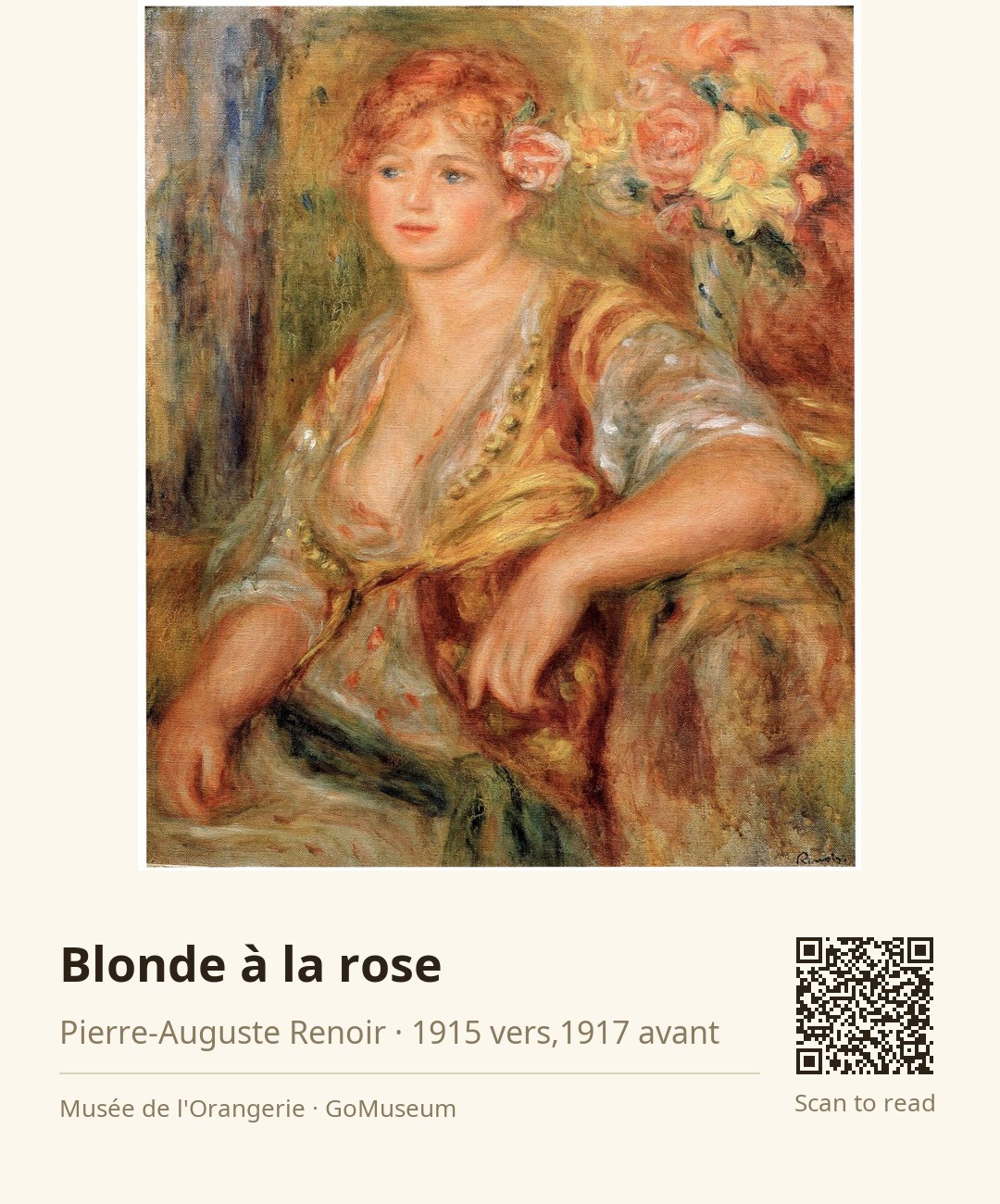
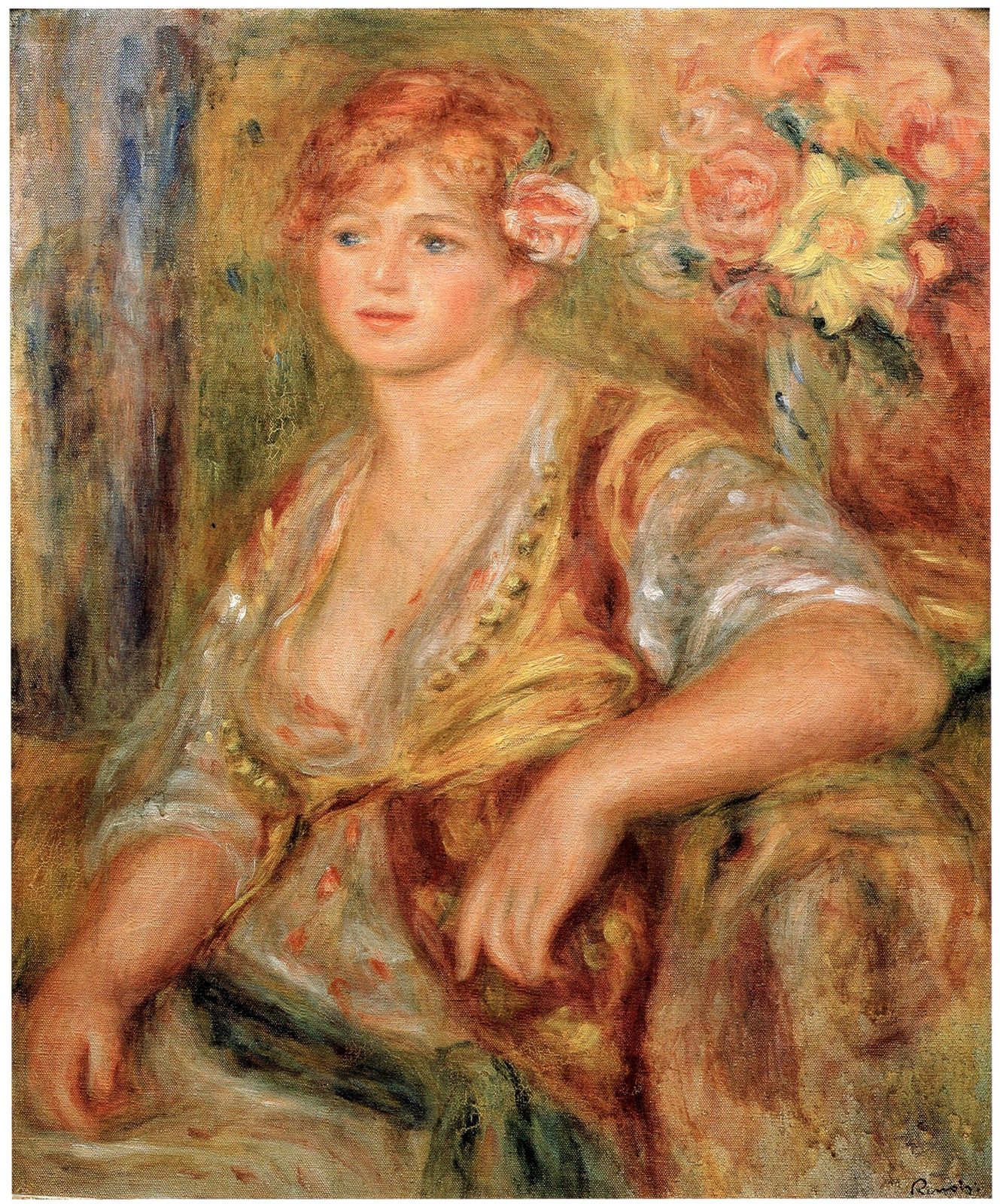
🎧 This work has audio narration — listen in the appThe seated woman in "Blonde à la rose" captures your attention with her striking red hair, crowned by a delicate pink flower. Dressed in a low-neckline gown that melds soft hues of gold, pink, and white, she exudes a sense of calm elegance. Her right arm rests casually, while her left arm bends gracefully, inviting a closer look at her serene expression.
This intimate portrayal reflects Renoir's signature impressionistic style, where the loose, fluid brushwork creates a dreamy atmosphere that envelops the viewer. The warm background, filled with a bouquet of roses and yellow blooms, enhances the sense of tranquility, drawing you into the moment. The way the floral elements frame her adds depth to the composition, suggesting a connection between the figure and her surroundings.
Created around 1915 to 1917, this painting is a testament to Renoir's enduring fascination with beauty and femininity, showcasing his ability to capture the essence of a fleeting moment in time.
Pierre-Auguste Renoir, born on February 25, 1841, in Limoges, France, emerged as a pivotal figure in the Impressionist movement. His early life in a modest family led him to Paris, where he honed his artistic skills amidst the masterpieces of the Louvre. Initially apprenticed in a porcelain factory, Renoir's passion for painting flourished, particularly after studying under Charles Gleyre, where he befriended fellow artists like Monet and Sisley.
Renoir's work celebrated feminine beauty and vibrant social scenes, exemplified in iconic pieces like "Dance at Le Moulin de la Galette." Despite facing criticism early on, he gained recognition, especially after participating in the first Impressionist exhibition in 1874. His style evolved over the years, transitioning towards realism influenced by classical masters like Raphael.
Throughout his life, Renoir balanced personal struggles, including health issues, with a prolific output, reportedly creating around four thousand works. He became a beloved figure in art history, known for his warm palette and expressive brushwork. Renoir passed away on December 3, 1919, leaving a legacy that continues to inspire artists and art lovers alike.
Created between 1915 and 1917, 'Blonde à la rose' is a stunning example of Renoir's late work, a period marked by his continued exploration of beauty and femininity. The painting first appeared in public at the Galerie Flechtheim in Berlin in 1928, where it was featured prominently and received a warm reception. It later traveled to the Galerie Bernheim-Jeune in Paris in 1929, and was exhibited at the Musée Cantini in Marseille in 1963. The painting has changed hands over the years, with notable provenance including Claude Renoir and Paul Guillaume, a significant art dealer of the time, which adds to its rich history.
The brushwork is notably loose and fluid, allowing colors to blend seamlessly, which creates a soft, ethereal quality. This approach gives the painting a sense of movement, as if the woman might shift or speak at any moment. The warm palette, dominated by soft golds, pinks, and whites, enhances the intimate atmosphere. The composition is carefully balanced, with the figure at the center, drawing the viewer's eye, while the surrounding floral elements provide a lush backdrop that frames her beautifully. The low neckline of her gown and the gentle curve of her arms invite a sense of closeness, making the viewer feel as though they are sharing a private moment with her.
Notable previous owners of 'Blonde à la rose' include Claude Renoir, the artist's son, and Paul Guillaume, a prominent art dealer.
The brushwork in 'Blonde à la rose' is loose and fluid, which allows for a seamless blending of colors and contributes to its soft, ethereal quality.