Bouquet de tulipes
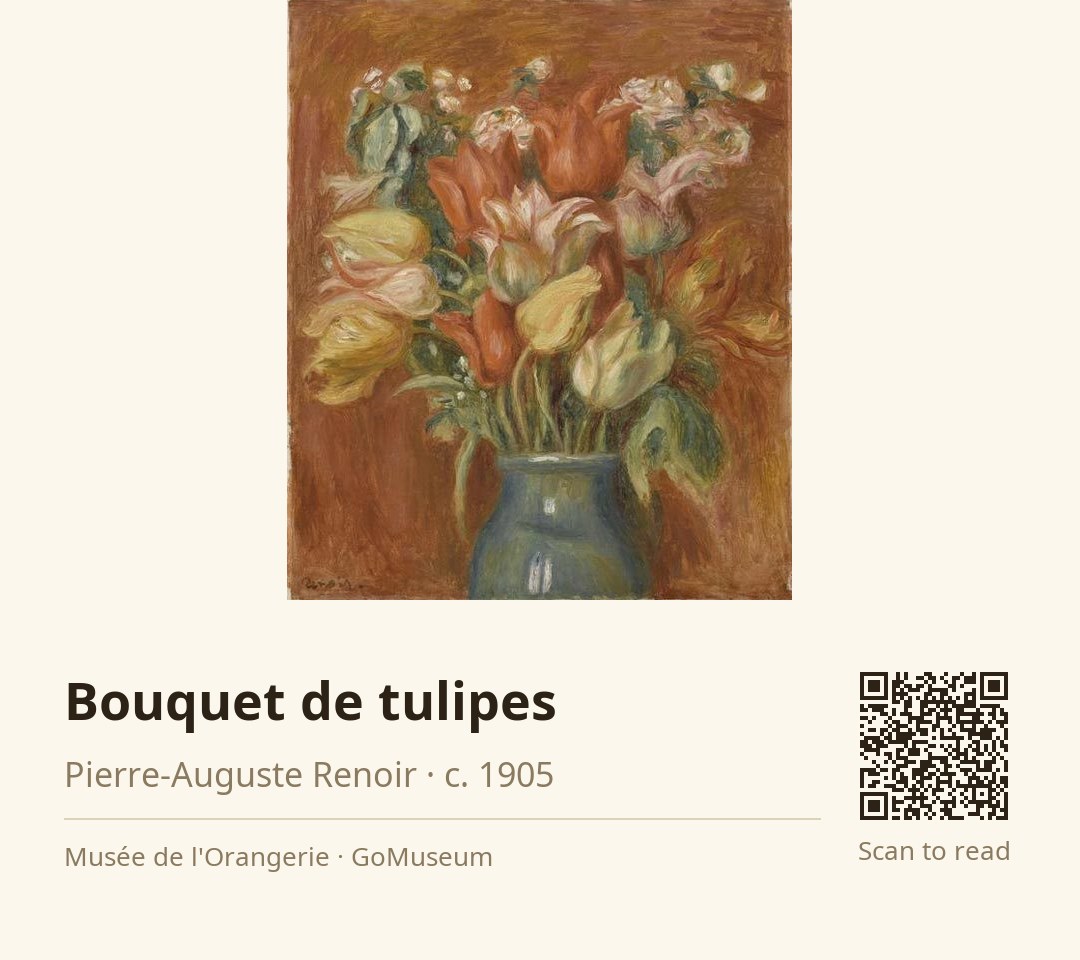
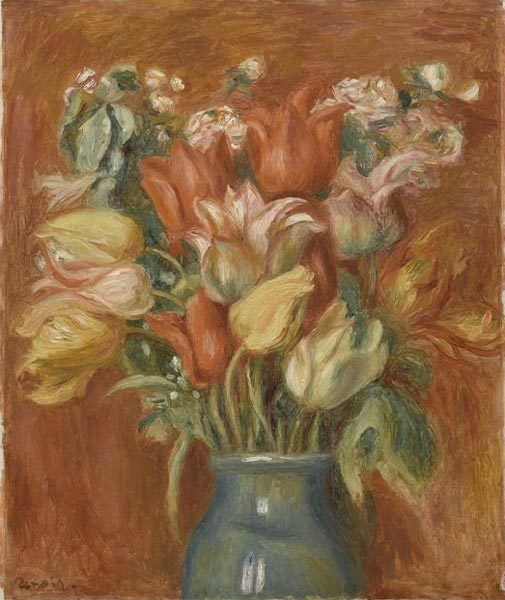
🎧 This work has audio narration — listen in the appThe vibrant bouquet of tulips and roses bursts forth from a blue vase, drawing your eye with its rich reds, oranges, and soft yellows. Each flower seems to dance with life, their colors contrasting beautifully against the warm, earthy brown background that envelops them. The loose, expressive brushwork captures a moment of abundance, inviting you to feel the vitality of nature.
Renoir's approach to still life in "Bouquet de tulipes" reflects his mastery in blending color and form, creating a lively composition that feels almost three-dimensional. The way the flowers spill from the vase suggests a celebration of life, a theme that resonates throughout his work. This painting, created around 1905, showcases Renoir's transition into a more intimate exploration of everyday beauty, moving away from the more rigid structures of earlier periods.
Originally part of Renoir's collection, this piece later passed through the hands of notable figures, including the art dealer Ambroise Vollard and collector Paul Guillaume. It was exhibited in Paris in 1929 and again in 1942, highlighting its significance in the evolution of modern still life.
Pierre-Auguste Renoir, born on February 25, 1841, in Limoges, France, emerged as a pivotal figure in the Impressionist movement. His early life in a modest family led him to Paris, where he honed his artistic skills amidst the masterpieces of the Louvre. Initially apprenticed in a porcelain factory, Renoir's passion for painting flourished, particularly after studying under Charles Gleyre, where he befriended fellow artists like Monet and Sisley.
Renoir's work celebrated feminine beauty and vibrant social scenes, exemplified in iconic pieces like "Dance at Le Moulin de la Galette." Despite facing criticism early on, he gained recognition, especially after participating in the first Impressionist exhibition in 1874. His style evolved over the years, transitioning towards realism influenced by classical masters like Raphael.
Throughout his life, Renoir balanced personal struggles, including health issues, with a prolific output, reportedly creating around four thousand works. He became a beloved figure in art history, known for his warm palette and expressive brushwork. Renoir passed away on December 3, 1919, leaving a legacy that continues to inspire artists and art lovers alike.
Created around 1905, 'Bouquet de tulipes' is a testament to Renoir's evolving artistic vision. Initially part of his own collection, the painting later transitioned to the hands of influential figures in the art world, including the prominent dealer Ambroise Vollard and collector Paul Guillaume. Its first public exhibition took place in 1929 at the Galerie Bernheim-Jeune in Paris, where it was featured in a showcase of contemporary painting. This was followed by another exhibition in 1942 at the Galerie Charpentier, highlighting its continued relevance and appeal.
Renoir's 'Bouquet de tulipes' showcases his signature loose brushwork, which breathes life into the flowers as if they are swaying in a gentle breeze. The oil paint is applied with a deft hand, creating a rich texture that invites you to almost reach out and touch the petals. The vibrant reds and oranges of the tulips contrast beautifully against the soft yellows and pinks of the roses, while the earthy brown background serves to enhance the brightness of the blooms. This choice of color palette not only creates a sense of depth but also evokes warmth and intimacy. The composition, centered around the blue vase, draws your eye inward, making the bouquet feel abundant and overflowing, a celebration of nature's beauty.
The painting was first exhibited in Paris in 1929 at the Galerie Bernheim-Jeune and again in 1942 at the Galerie Charpentier.
Renoir employed loose brushwork, which gives the flowers a lively appearance, as if they are swaying gently.