Femme nue couchée
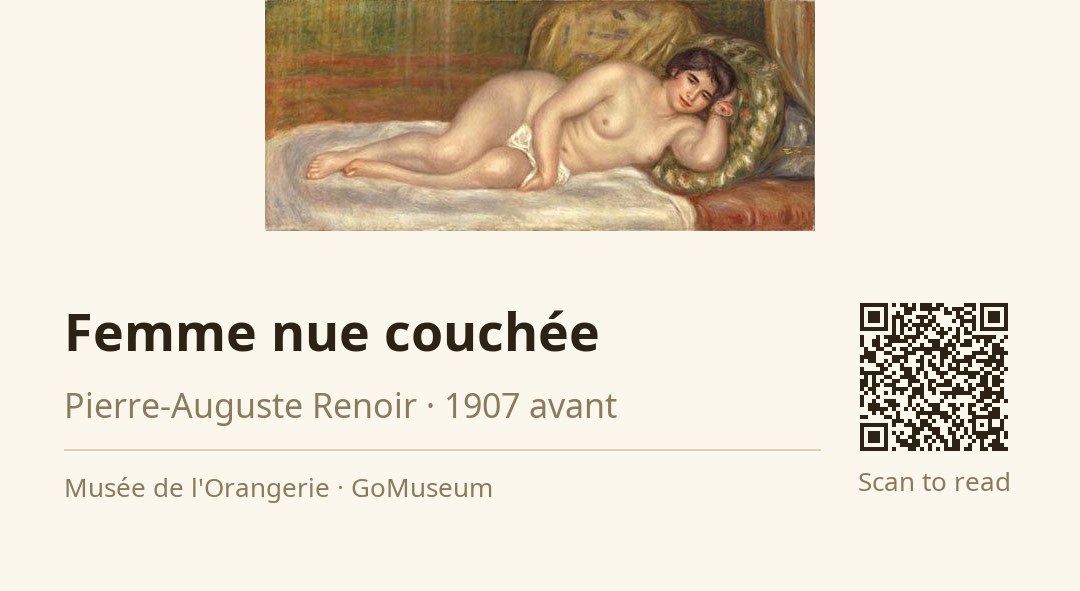
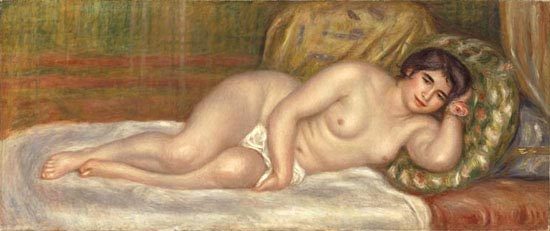
🎧 This work has audio narration — listen in the appThe reclining nude woman in Femme nue couchée captivates with her serene gaze, inviting you into an intimate moment. Her head rests on a patterned pillow, while a white cloth drapes over her lower body, creating a delicate contrast against her smooth skin. The warm earthy tones in the background, with subtle hints of green and brown, enhance the softness of the scene, wrapping the figure in a comforting embrace.
Renoir's brushwork here is particularly noteworthy, as it captures the gentle transitions of light and shadow, highlighting the figure's relaxed pose and tranquil expression. Created in 1907, this work stands as a testament to Renoir's exploration of the female figure during a pivotal time in his career, just before he shifted towards a more abstract style.
Pierre-Auguste Renoir, born on February 25, 1841, in Limoges, France, emerged as a pivotal figure in the Impressionist movement. His early life in a modest family led him to Paris, where he honed his artistic skills amidst the masterpieces of the Louvre. Initially apprenticed in a porcelain factory, Renoir's passion for painting flourished, particularly after studying under Charles Gleyre, where he befriended fellow artists like Monet and Sisley.
Renoir's work celebrated feminine beauty and vibrant social scenes, exemplified in iconic pieces like "Dance at Le Moulin de la Galette." Despite facing criticism early on, he gained recognition, especially after participating in the first Impressionist exhibition in 1874. His style evolved over the years, transitioning towards realism influenced by classical masters like Raphael.
Throughout his life, Renoir balanced personal struggles, including health issues, with a prolific output, reportedly creating around four thousand works. He became a beloved figure in art history, known for his warm palette and expressive brushwork. Renoir passed away on December 3, 1919, leaving a legacy that continues to inspire artists and art lovers alike.
This painting was part of a significant collection, having passed through notable hands like the Galerie Durand-Ruel in Paris, where it was first exhibited. It later belonged to the artist himself and was sold through the renowned dealer Ambroise Vollard. Over the years, it has been showcased in various exhibitions, including a notable one at the Galerie Bernheim-Jeune in Paris in 1927. Its journey continued through several prestigious venues, such as the Musée du Prince Paul in Belgrade in 1939 and the Los Angeles County Museum in 1941, where it was part of a broader narrative on French painting since the Revolution.
Renoir's technique in Femme nue couchée is a masterclass in the use of oil paint, where he employs smooth brushwork to create a seamless blend of colors. The gentle transitions between light and shadow are not just for realism; they evoke a sense of warmth and intimacy, drawing the viewer into the scene. The choice of earthy tones in the background enhances the figure's softness, making her appear almost as if she is part of the surrounding environment. The composition is intimate, focusing on the woman's relaxed pose and serene expression, which Renoir captures with a delicate touch.
Femme nue couchée was first exhibited at the Galerie Durand-Ruel in Paris and later belonged to the artist himself and the dealer Ambroise Vollard.
The painting has been showcased in several significant exhibitions, including one at the Galerie Bernheim-Jeune in Paris in 1927 and at the Los Angeles County Museum in 1941.
Renoir's technique in this painting is notable for its smooth brushwork that creates seamless color blends, enhancing the warmth and intimacy of the scene.