Portrait de deux fillettes
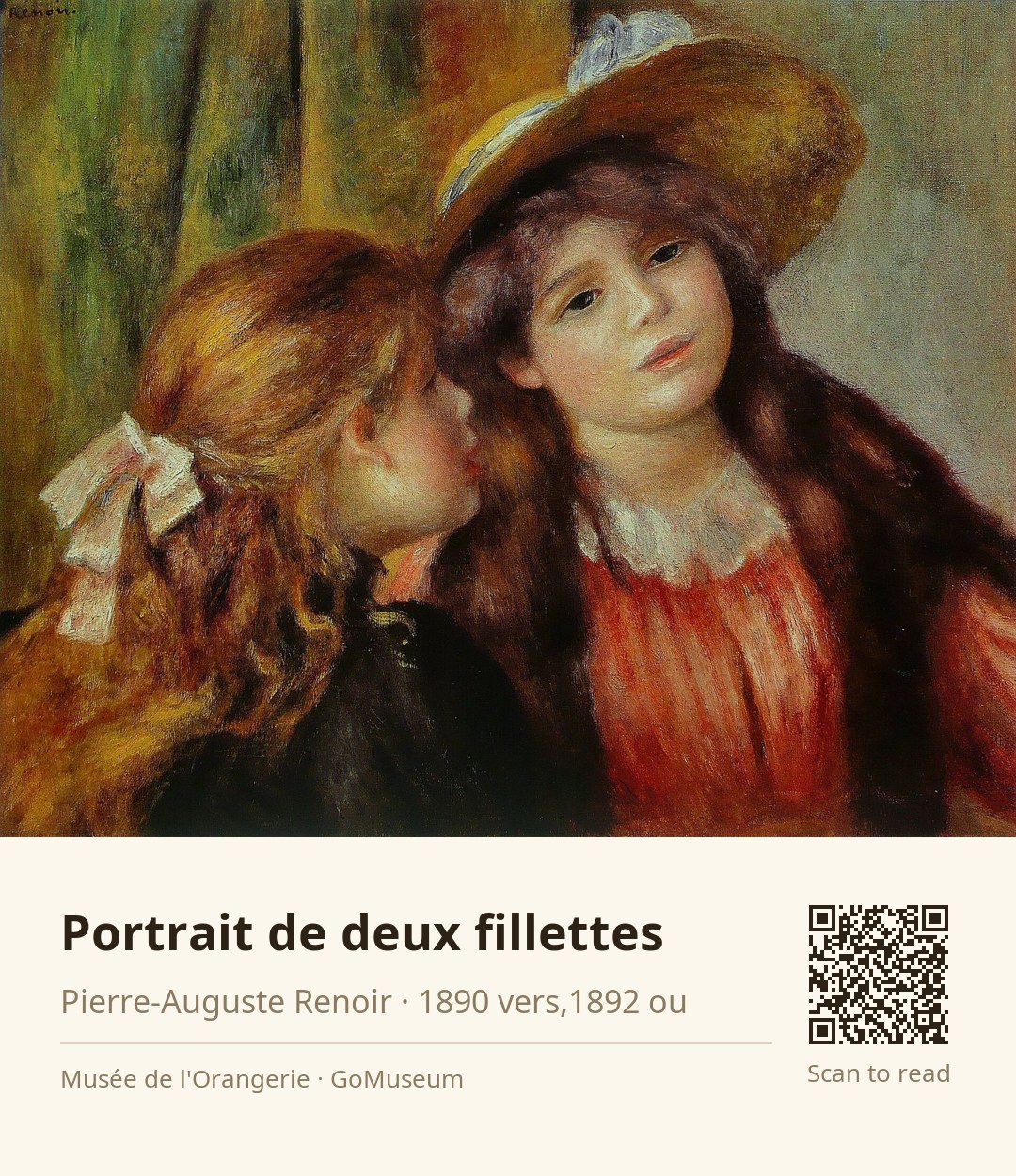
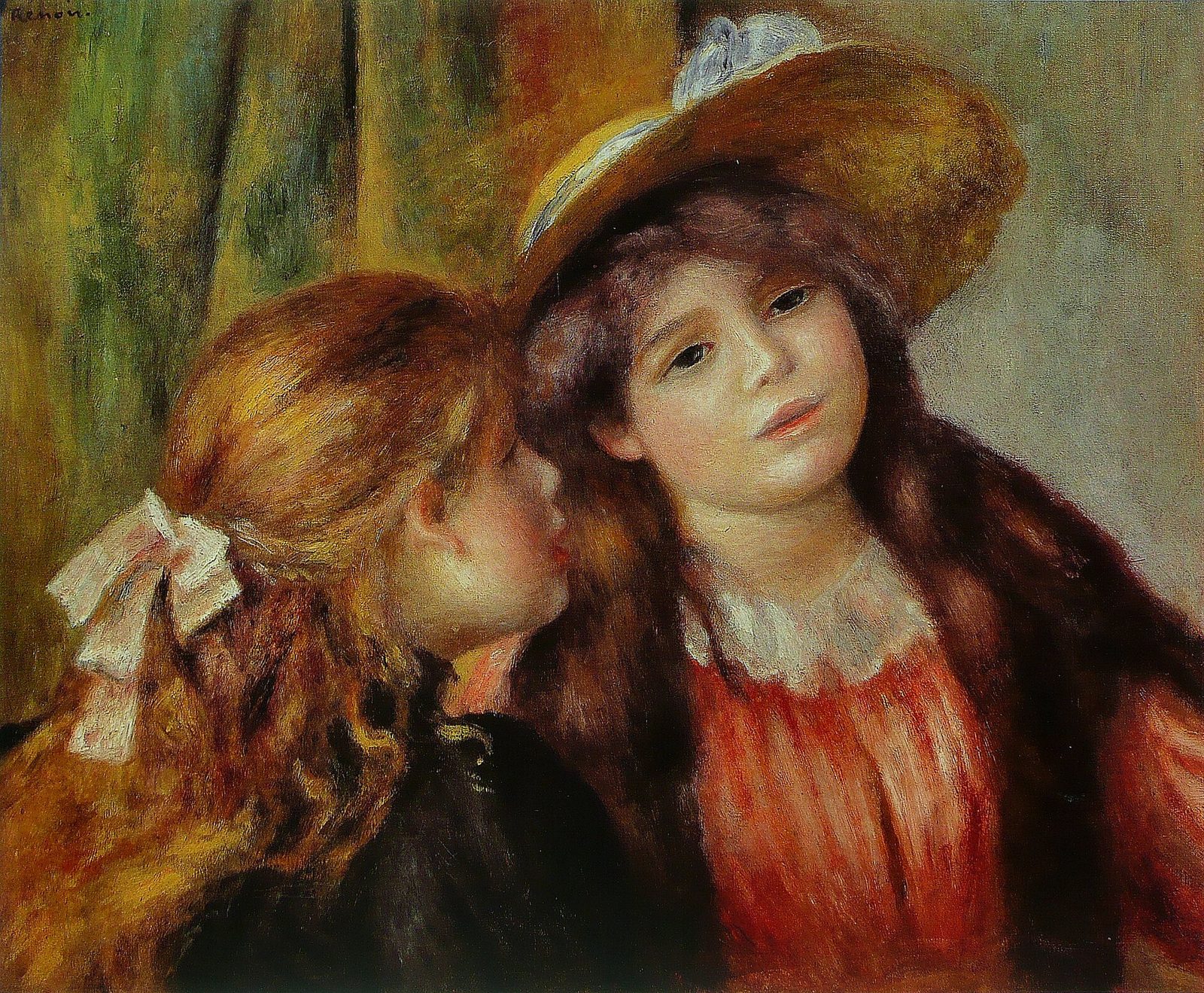
🎧 This work has audio narration — listen in the appTwo young girls share a moment in Renoir's "Portrait de deux fillettes," their closeness captured in a whisper. The girl on the left, with her reddish-brown hair tied with a white ribbon, leans in, her dark garment contrasting with the vibrant red dress of the girl on the right, who gazes outward with a serene expression, her straw hat adorned with a white ribbon framing her face.
This intimate scene illustrates not just their attire but also the innocence of childhood, highlighted by the soft, textured background of greens and browns that envelops them. Renoir's loose and fluid brushwork, a hallmark of Impressionism, brings a sense of warmth and harmony to the composition, inviting viewers into their world. The painting, created around 1890 to 1892, reflects the artist's fascination with capturing fleeting moments of joy and connection.
Pierre-Auguste Renoir, born on February 25, 1841, in Limoges, France, emerged as a pivotal figure in the Impressionist movement. His early life in a modest family led him to Paris, where he honed his artistic skills amidst the masterpieces of the Louvre. Initially apprenticed in a porcelain factory, Renoir's passion for painting flourished, particularly after studying under Charles Gleyre, where he befriended fellow artists like Monet and Sisley.
Renoir's work celebrated feminine beauty and vibrant social scenes, exemplified in iconic pieces like "Dance at Le Moulin de la Galette." Despite facing criticism early on, he gained recognition, especially after participating in the first Impressionist exhibition in 1874. His style evolved over the years, transitioning towards realism influenced by classical masters like Raphael.
Throughout his life, Renoir balanced personal struggles, including health issues, with a prolific output, reportedly creating around four thousand works. He became a beloved figure in art history, known for his warm palette and expressive brushwork. Renoir passed away on December 3, 1919, leaving a legacy that continues to inspire artists and art lovers alike.
In "Portrait de deux fillettes," Renoir employs loose, fluid brushwork that captures the essence of Impressionism. The way he layers paint creates a soft, textured background that envelops the girls, enhancing their intimate moment. The warm color palette, dominated by greens and browns, contrasts beautifully with the vibrant red of the dress worn by the girl on the right. The brushstrokes are not just a technique; they evoke a sense of warmth and immediacy, inviting you to feel the joy and innocence of childhood that Renoir so masterfully encapsulates.
The painting was owned by notable figures such as Gauguin Abbé and Maurice Leclanche, and it was sold at auction in Paris in 1901.
In 1949, 'Portrait de deux fillettes' was part of an exhibition at the galerie Charpentier in Paris that focused on themes of childhood.
Renoir employed loose and fluid brushwork in 'Portrait de deux fillettes,' which is characteristic of his Impressionist style.