 Image: Siren-Com
Jeunes filles au piano
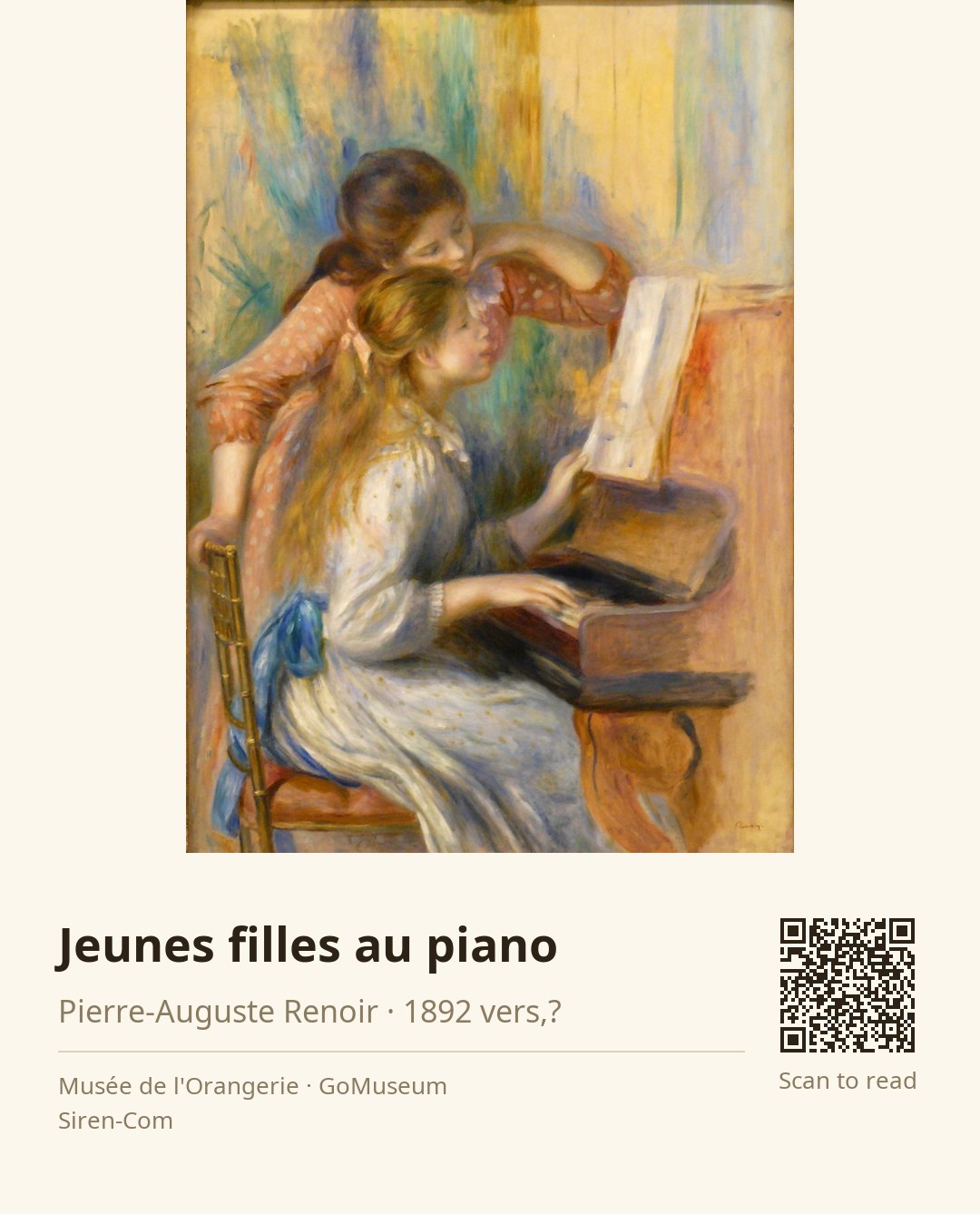
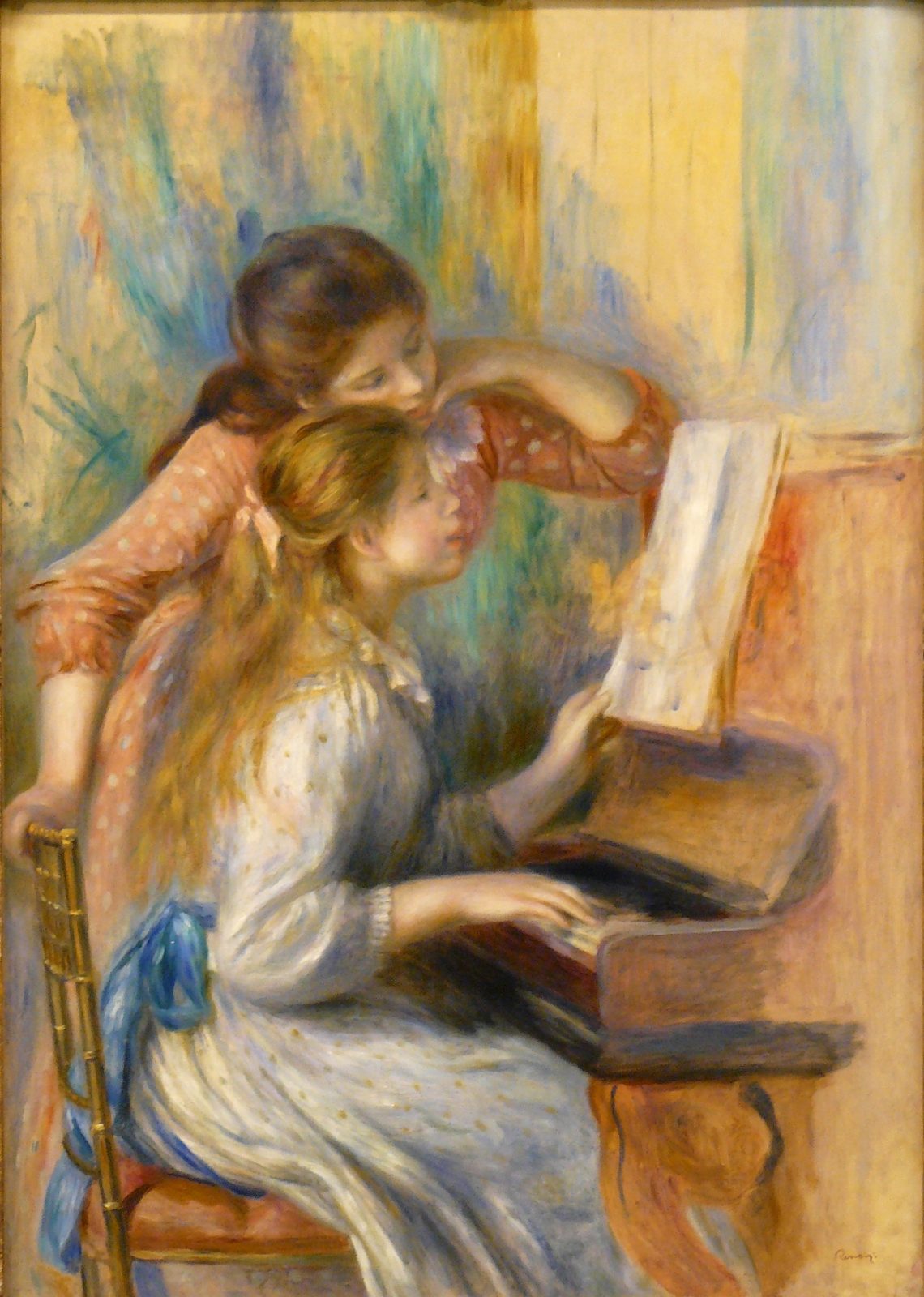
🎧 This work has audio narration — listen in the appTwo young women share a moment at the piano, one seated in a white dress with delicate patterns and a blue ribbon, while the other leans in beside her, dressed in a playful pink with white polka dots. The way their hands hover over the keys and the sheet music suggests a shared passion for music, drawing you into their intimate world.
The soft, impressionistic strokes of blues, greens, and yellows in the background create a warm ambiance, enveloping the figures in a sense of closeness and harmony. Renoir’s loose brushwork captures not just their physical presence but the fleeting nature of the moment, emphasizing the joy of companionship and creativity. This approach reflects the Impressionist movement's focus on light and atmosphere over rigid detail, inviting you to feel the energy of the scene rather than merely observe it.
Pierre-Auguste Renoir, born on February 25, 1841, in Limoges, France, emerged as a pivotal figure in the Impressionist movement. His early life in a modest family led him to Paris, where he honed his artistic skills amidst the masterpieces of the Louvre. Initially apprenticed in a porcelain factory, Renoir's passion for painting flourished, particularly after studying under Charles Gleyre, where he befriended fellow artists like Monet and Sisley.
Renoir's work celebrated feminine beauty and vibrant social scenes, exemplified in iconic pieces like "Dance at Le Moulin de la Galette." Despite facing criticism early on, he gained recognition, especially after participating in the first Impressionist exhibition in 1874. His style evolved over the years, transitioning towards realism influenced by classical masters like Raphael.
Throughout his life, Renoir balanced personal struggles, including health issues, with a prolific output, reportedly creating around four thousand works. He became a beloved figure in art history, known for his warm palette and expressive brushwork. Renoir passed away on December 3, 1919, leaving a legacy that continues to inspire artists and art lovers alike.
Created in 1892, 'Jeunes filles au piano' was painted by Pierre-Auguste Renoir, a leading figure of the Impressionist movement. The work was part of a collection that included notable patrons like Paul Durand-Ruel, a key supporter of Impressionist artists. After Renoir's passing, the painting changed hands several times, moving from the artist's collection to Ambroise Vollard, a prominent art dealer, and later to Paul Guillaume. It was exhibited in significant shows, including the 1929 'La grande peinture contemporaine' at the Bernheim-Jeune gallery in Paris and again in 1933 at the Orangerie des Tuileries, where it was well-received, showcasing Renoir's evolving style and the emotional depth he infused into his works.
Renoir's technique in 'Jeunes filles au piano' is a masterclass in Impressionist brushwork. The loose, fluid strokes create a sense of movement and spontaneity, allowing the viewer to feel the energy of the scene. The soft blending of colors—blues, greens, and yellows—forms a warm backdrop that envelops the figures, enhancing their intimacy. Renoir's choice to focus on the interplay of light and the figures’ expressions rather than on sharp details draws you into their shared moment. The scale of the painting, measuring 116 by 81 centimeters, allows for a larger-than-life portrayal of these young women, inviting you to step into their world and experience their joy. This approach not only captures their physical presence but also the ephemeral nature of their interaction, embodying the essence of Impressionism.
The painting was showcased in the 1929 exhibition 'La grande peinture contemporaine' at the Bernheim-Jeune gallery and again in 1933 at the Orangerie des Tuileries.
Renoir emphasized the interplay of light and the expressions of the figures, rather than sharp details, which invites viewers into the intimate moment shared by the women.