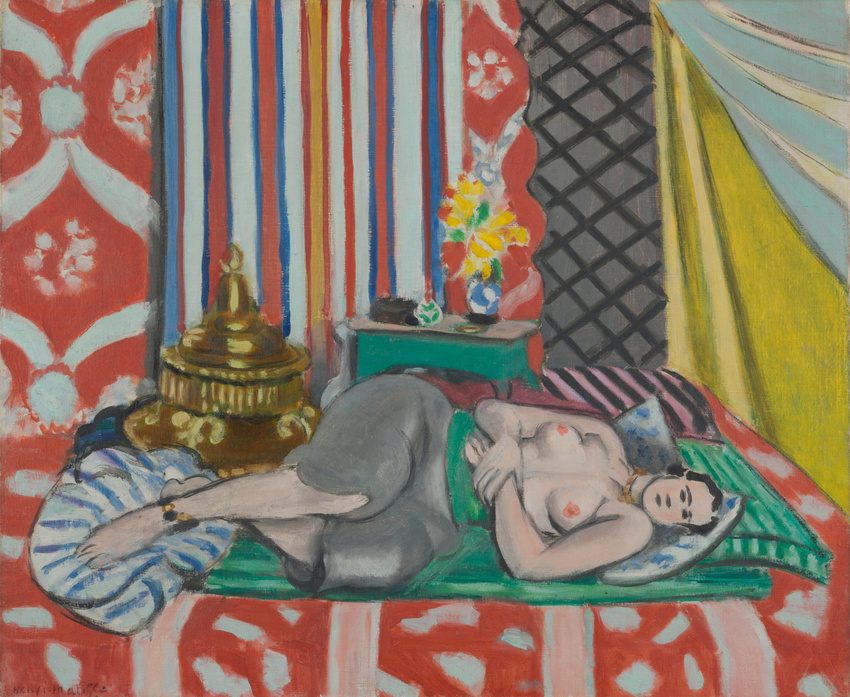
Odalisque à la culotte grise
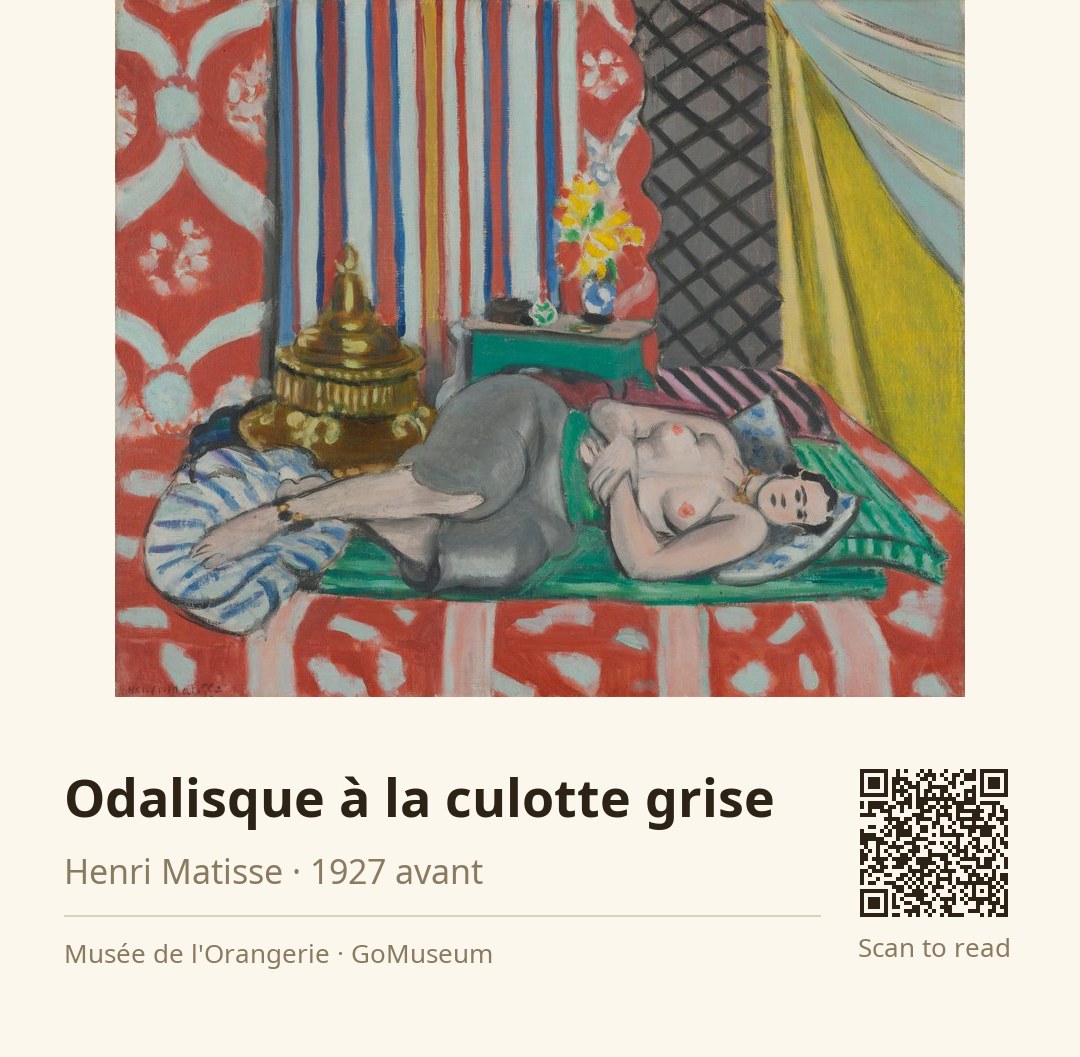
🎧 This work has audio narration — listen in the appThe reclining figure in "Odalisque à la culotte grise" embodies a moment of serene intimacy, draped in a soft gray garment that contrasts beautifully with the vibrant patterns surrounding her. The floral designs in red and white, along with the bold blue and red stripes in the background, create a lively tapestry that draws the eye, while the black lattice pattern adds depth and complexity to the scene.
Matisse's choice of colors and patterns reflects his fascination with the interplay between form and decoration, inviting you to experience the richness of the space rather than just the figure itself. The golden ornate object to the left and the small table with bright yellow flowers introduce elements of luxury and warmth, enhancing the overall atmosphere of comfort and relaxation.
Created in 1927, this work showcases Matisse's innovative approach during the early 20th century, where he pushed the boundaries of color and form, establishing himself as a leading figure in modern art. The painting was exhibited at the Salon d'automne in Paris the same year, marking its place in the vibrant art scene of the time.
Henri Matisse was a pioneering French artist born on December 31, 1869, in Le Cateau-Cambrésis. Initially studying law, he turned to art during a period of convalescence, discovering a passion that would lead him to become one of the most influential figures in modern art. Matisse's vibrant use of color and innovative forms defined the Fauvist movement, earning him recognition alongside contemporaries like Pablo Picasso.
His early works, characterized by traditional still lifes and landscapes, evolved dramatically after exposure to Impressionism and the color theories of John Russell. Matisse's style matured in the early 1900s, marked by bold colors and flattened forms. His relocation to Nice in 1917 ushered in a more relaxed aesthetic, blending classical influences with modern sensibilities.
Despite facing health challenges later in life, Matisse continued to innovate, creating significant cut paper collages. His mastery of color and form left an indelible mark on the art world, influencing generations of artists and solidifying his legacy as a central figure in 20th-century art history. Matisse passed away on November 3, 1954, leaving behind a rich body of work that continues to inspire.
The brushwork is fluid, with broad strokes that create a sense of movement and softness, particularly in the way the gray garment drapes over the figure. The vibrant palette—rich reds, deep blues, and bright yellows—interacts dynamically, drawing the viewer's eye across the canvas. The floral patterns and stripes are not just decorative; they serve to envelop the figure, creating a sense of space that feels both intimate and expansive. Matisse's choice to use a black lattice pattern in the background adds depth, contrasting with the lighter elements and enhancing the overall composition. The scale of the painting, quite large at 54 by 65 inches, allows for an immersive experience, inviting viewers to lose themselves in the lush textures and colors.
The large scale of the painting creates an immersive experience, encouraging viewers to engage deeply with its rich textures and vibrant colors.
The black lattice pattern provides depth to the composition and contrasts with the lighter elements, enhancing the overall visual impact of the artwork.