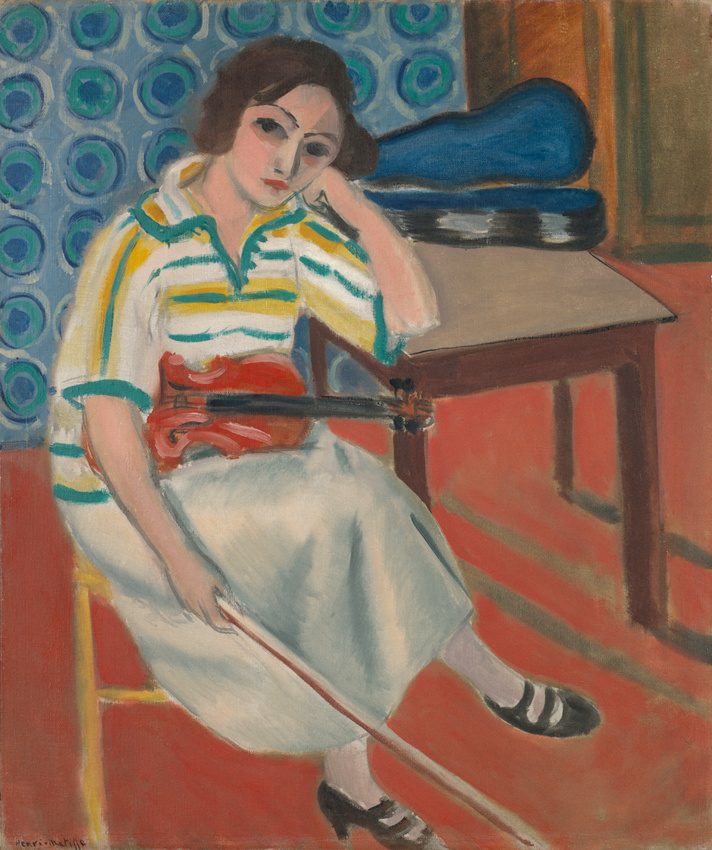
Femme au violon
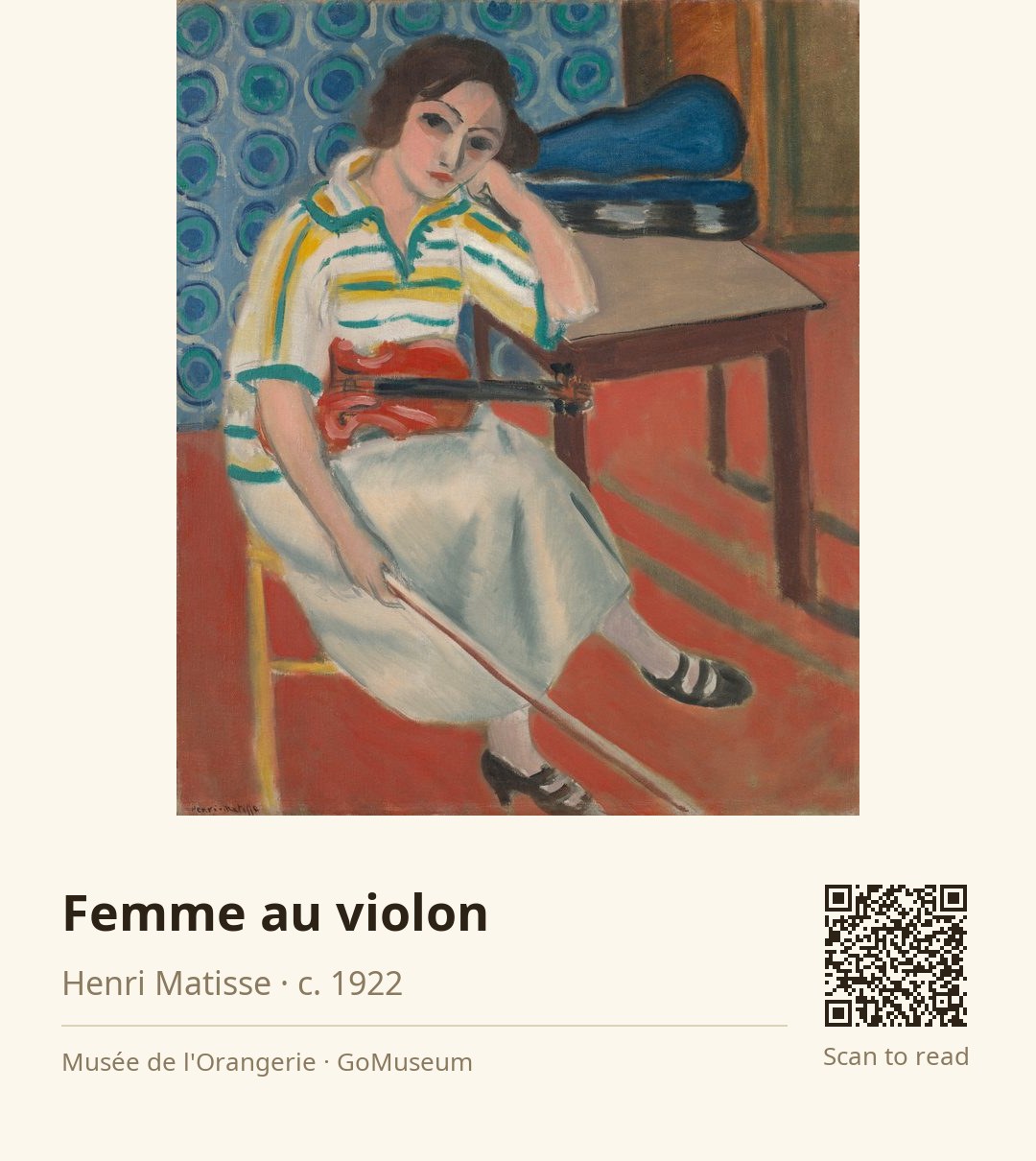
🎧 This work has audio narration — listen in the appThe seated woman in "Femme au violon" cradles a striking red violin, a bold contrast to her soft, striped blouse in greens and yellows. Her contemplative pose, with her head resting on her hand, invites you into a moment of introspection, as if she’s lost in thought about the music she might play.
The vibrant colors and smooth brushwork create a lively atmosphere, while the patterned blue and green wallpaper adds a touch of elegance to the scene. This combination of elements not only highlights the woman’s figure but also suggests a narrative of creativity and reflection. The yellow chair and warm red floor ground her in a space that feels both intimate and inviting, while the closed violin case on the table hints at the potential for music that remains just out of reach.
Henri Matisse was a pioneering French artist born on December 31, 1869, in Le Cateau-Cambrésis. Initially studying law, he turned to art during a period of convalescence, discovering a passion that would lead him to become one of the most influential figures in modern art. Matisse's vibrant use of color and innovative forms defined the Fauvist movement, earning him recognition alongside contemporaries like Pablo Picasso.
His early works, characterized by traditional still lifes and landscapes, evolved dramatically after exposure to Impressionism and the color theories of John Russell. Matisse's style matured in the early 1900s, marked by bold colors and flattened forms. His relocation to Nice in 1917 ushered in a more relaxed aesthetic, blending classical influences with modern sensibilities.
Despite facing health challenges later in life, Matisse continued to innovate, creating significant cut paper collages. His mastery of color and form left an indelible mark on the art world, influencing generations of artists and solidifying his legacy as a central figure in 20th-century art history. Matisse passed away on November 3, 1954, leaving behind a rich body of work that continues to inspire.
Henri Matisse's 'Femme au violon' was created around 1922, a time when the artist was deeply engaged in exploring the emotional power of color. After its completion, it was exhibited at the Bernheim-Jeune gallery in Paris in 1929, as part of 'La grande peinture contemporaine.' The work later appeared in the 1937 Exposition Universelle, showcasing the masters of independent art from 1895 to 1937. Over the years, it changed hands several times, passing through notable collectors like Paul Guillaume and Madame Vve Jean Walter, which speaks to its desirability and the esteem in which it was held. Each of these events contributed to the painting's rich provenance, marking its journey through the evolving landscape of 20th-century art.
The smooth brushwork creates a sense of fluidity, allowing the vibrant hues to interact harmoniously. Notice how the bold red of the violin pops against the softer tones of the woman's striped blouse, drawing your eye immediately to the instrument. The outlines are clear yet not harsh, giving the figures a sense of presence without overwhelming the viewer. The wallpaper's intricate patterns add depth to the background, while the warm red floor grounds the composition, creating a cozy, intimate setting. Matisse's choice of a yellow chair not only complements the color palette but also enhances the overall warmth of the scene, inviting you into this moment of quiet reflection.
'Femme au violon' was showcased at the 1937 Exposition Universelle, which highlighted the masters of independent art from 1895 to 1937.
Notable collectors of 'Femme au violon' included Paul Guillaume and Madame Vve Jean Walter.
Matisse's smooth brushwork creates a sense of fluidity, enabling the vibrant colors to interact harmoniously.